| Trial&Error believes Dennis
Dechaine deserves a new trial |
||||
| Home |
Evidence |
Chronology |
Who
is Dennis? |
Articles |
| News |
Events |
What you can do | Books |
Petition & Support |
| Documents | Related sites | Convicted Innocents |
Fundraising |
Contact
us |
Proposed Bill Could Grant Convicted Murderor New Trialby Laura Roberts - May 10th 2011 05:41pm - Read more Local News Augusta - The statehouse hosted a public hearing on Tuesday on a bill that could grant a new trial to convicted murderor Dennis Dechaine. Video at: http://www.wabi.tv/news/20094/proposed-bill-could-grant-convicted-murderor-new-trial Dennis Dechaine’s drug case temporarily postponedBy Heather Steeves, BDN Staff Posted April 29, 2011, at 4:29 p.m. AP Dennis Dechaine ROCKLAND, Maine — Dennis Dechaine, who is serving a life sentence for the kidnapping and murder of 12-year-old Sarah Cherry in Bowdoin in 1988, will not have his first court appearance Monday as planned for a new drug crime. Dechaine, 52, was indicted last July by the Knox County grand jury on a charge of trafficking in prison contraband. A hearing on the drug charge that had been scheduled for Monday, May 2, in Knox County Superior Court has since been postponed. It was not clear Friday when and where the hearing would be rescheduled. Dechaine’s attorney, Steve Peterson of Rockport, also indicated Friday that new DNA tests of crime-scene evidence are being conducted in a pending bid to get a retrial on the murder case. According to Peterson, the judge initially assigned to the contraband-trafficking case recused himself and a new one had to be found. “It was assigned to another judge because of potential conflicts of interest,” Peterson said Friday. “There are so many judges who are familiar with his underlying case.” Dechaine was taken to Maine Medical Center in Portland on April 5 for a drop in blood pressure and a high heart rate. The indictment alleges that on that day Dechaine was found in possession of the painkiller morphine and-or the anti-anxiety drug Klonopin, according to Knox County District Attorney Geoffrey Rushlau. Dechaine was in the Portland hospital for more than two weeks. At the time, Dechaine told the Portland Press Herald that he was hospitalized after he tried to kill himself by overdosing on prescription drugs. Dechaine, a former Bowdoinham farmer who has served the last 22 years in the Maine State Prison for murdering Cherry, maintains that he is innocent. He and his attorney are pressing for a new trial based on DNA evidence. Dechaine’s four previous appeals were rejected. Cherry was kidnapped, stabbed and strangled in the woods of Bowdoin on July 6, 1988, and Dechaine was found wandering in the woods nearby. His truck was found 450 feet from where her body was found, and rope inside in the truck matched rope that bound her wrists. Dechaine was convicted of Cherry’s murder in Knox County Superior Court in March 1989. Peterson also indicated Friday that new DNA tests of crime-scene evidence are now being conducted. He has received preliminary results, but could not share them Friday, by order of the court. “They’re doing a new kind of testing than they had done before. We are using newer techniques to retest items that had been tested earlier,” Peterson said. It will likely be several months before Dechaine’s next hearing on his appeal, Peterson said. By that time, the DNA testing will be done and reports from the tests will be filed, according to the attorney. If Dechaine is guilty of the new drug charge, he will face up to five more years in prison. Peterson has previously stated that the drug case would not affect the bid for a retrial in the murder case. Playing Trial & Error by the BonfirePilgrim's progress By SAM PFEIFLE | March 30, 2011 Jesse Pilgrim and the Bonfire do a couple things pretty well on their debut record, Trial & Error, that are hard to do well: create an album with a sense of place, and create an album with something to say. Combining those attributes makes for a pretty sharp piece of cowpunk and old-time folk that evokes the long musical tradition that manages to link Woody Guthrie to Joe Strummer and Shane MacGowan. Pilgrim likes Portland pretty well — except when he doesn't. Coming just a bit more than half-way through this 11-song, half-hour full-length, "Love/Hate" is in many ways its heart. The distorted and fuzzed out guitar paired with the quick country strum (Pilgrim and Andy Barbo) and walk in the bass (Mica Jones) is pretty indicative of the cow-punk feel record, somewhat akin at times to No Depression, other times more of a mix between Johnny Cash and Soltero's Tim Howard. On the one hand, Pilgrim refers to Portland as "this godforsaken town." On the other, he notes that if he and his gal left, "we'll both miss our home and have to wipe away our tears." Personally, I'm a Portland fanboy. I can't imagine it being godforsaken in any way. But everyplace sucks when you're unhappy, right? And everyone is unhappy sometimes. The stompy and off-kilter way Pilgrim brings the song to a halt is pretty unhappy-sounding. Same with the opening and title track, which is ballsy in its take on the Dennis Dechaine case. Trial & Error is actually the title of the book and blog that focuses on Dechaine's innocence (go Google Dechaine and Sarah Cherry if you don't know what I'm talking about) and Pilgrim makes no bones about whom he stands with, finishing the song with "Dennis Dechaine, you should be free/But sadly the judges and courts don't agree." I'm not educated enough on the case to have an opinion worth putting forth here, but I will say it's nice to see a musician write something political, and not just national big-picture stuff. We need more of this, and we need more acceptance of it as valid material that's not "corny" or "just politics." Putting some importance back in music is a good thing. "Sawed Off" goes after our state's well-documented prison culture, focusing on an armed robber doing time and who "got stabbed in Warren state pen." Here Pilgrim takes on the prisoner's lament — what if I just didn't do it? Why did I do it? "His mind raced back to being 24/He could have had a wife, and he could have had a son/But he robbed a liquor store with a sawed-off gun." It's fairly punky, but the resonator-sounding guitar and the whining pedal steel effect keeps it grounded. In addition to the rest of the Bonfire (Derek Gierhan gives the album a reckless feel on drums; Zach Pilgrim is on mandolin and has a piercingly pretty solo on "Whiskey"), Pilgrim also gets help of note from Aly Spaltro and D Gross. Spaltro's verse on the charming, bluegrass-pop "Lead Me Down" is typically self-assured and playful: "Don't you worry/I'll be just fine." Meanwhile, D Gross lends a lilting fingerpick to the old-timey "Now My Darling," which wins for bringing texting into a verse without seeming forced. There are times where this disc is rough around the edges, but that's mostly on purpose; Eric Bettencourt and Jim Begley have combined to help Pilgrim do well in creating the rootsy-punk feel he's going for. Maybe he doesn't hit all the notes here with his singing voice (especially when he reaches up), but the record as a whole hits the mark for vision and feel. Sam Pfeifle can be reached at sam_pfeifle@yahoo.com. TRIAL & ERROR | Released by Jesse Pilgrim and the Bonfire | with Panda Bandits + Grant Street Orchestra + Butcher Boy | at SPACE Gallery, in Portland | April 2 | jessepilgrimthebonfire.bandcamp.com Bill's passage will let Dechaine prove innocence April 2 2011 Kennebec Journal Thank God, after all these years, someone is finally doing something about Dennis Dechaine asking to have a DNA test. Rep. John Martin, D-Eagle Lake, has crafted a bill to consider a trial for Dechaine using the DNA testing he has been asking for to prove his innocence. It is hard to believe that the people with the power to get a trial for him have allowed him to sit in jail for 22 years when a simple test could prove his innocence. How do they sleep at night? Dechaine's frustration must be unbearable, knowing that he is innocent and being denied every opportunity to prove it. It is understandable why he tried to commit suicide; one person can take only so much disappointment, agony and hellish conditions. The same can be applied to the family of Sarah Cherry, every time a new trial or testing is discussed, they have to relive the whole thing over again. They will now know for sure whether Dechaine was the one who brutally murdered their daughter, or if the guilty one is still out there, perhaps reoffending. When Dechaine is proven innocent, it will be a difficult job to find out who did do this heinous act and find out how many other innocent little girls he has brutalized in the 22 years he has been free. Former Attorney General Janet Mills sees a problem with proving Dechaine's innocence because she feels it is going to step on too many toes. I believe she is right, and I also believe the time has come to find out the truth. Gail French Belgrade Attorney general should reopen Dechaine casehttp://www.kjonline.com/opinion/letters/Attorney-general-should-reopen-Dechaine-case-.htmlJanuary 17 2010 In Colorado’s JonBenet Ramsey murder case, unidentified DNA on her pants eliminated her parents as suspects. MAINE SUNDAY TELEGRAM Here are 25 stories that really clicked with readerslhttp://www.pressherald.com/news/here-are-25-stories-that-really-clicked-with-readers_2011-01-02.html January 2 2011 Last Sunday, the Maine Sunday Telegram published readers' picks for the 10 most significant news stories of 2010. click image to enlarge
A group of women and men who had shed their tops march down a Congress Street sidewalk from Longfellow Square to Tommy's Park. They were promoting the freedom of women to be topless in public. The group attracted many amateur and professional photographers. Gordon Chibroski/Staff Photographer click image to enlarge
Paul LePage speaks to supporters at the election results party at Champions in Waterville Tuesday night. Staff photo by Michael G. Seamans Select images available for purchase in theMaine Today Photo Store Today, we invite you to remember the 25 news articles and columns that were the most-read on pressherald.com. With the exception of Gov.-elect Paul LePage's victory, there wasn't much overlap between the two lists. For one thing, news online can get picked up and shared with readers around the world. That's what happened with most of the top stories on the list. Here's what had people clicking in 2010: 1. Women march topless in Portland without incident On April 3, about two dozen women marched topless from Longfellow Square to Tommy's Park in an effort to raise awareness about what they said was a double standard on male and female nudity. The news update posted soon after the march ended attracted international attention -- and more than 742,000 views. 2. Marching for the right to bare breasts, women faced with sea of cameras The more lengthy version of the topless march story, which appeared in the Maine Sunday Telegram print edition and was posted online early April 4, also attracted readers from all over the world. It garnered an additional 125,000 views. Readers waited throughout election night to see who would be Maine's next governor. This story, which was viewed more than 42,000 times, was the final word from early Wednesday morning. Republican Paul LePage, while expressing optimism, had not yet claimed victory and runner-up Eliot Cutler, an independent, had not yet conceded. 4. Bill Nemitz: Call it class struggle: How politics went too far Bill Nemitz's May 12 column discussed the controversy that erupted when a King Middle School teacher said that someone took a poster depicting the history of the labor movement from his classroom while Republicans were caucusing there during the state party convention. National websites linked to the column, which picked up more than 33,000 page views. 5. Paul LePage is Maine's next governor This story, which attracted more than 30,000 views, initially was posted only minutes after reporters learned that Cutler would concede to LePage and was updated throughout the day. 6. Driver killed when trying to avoid porcupine Police said that an Arundel woman was apparently trying to avoid a porcupine when she lost control of her car and hit a pole on Nov. 2. The story was viewed nearly 30,000 times. 7. Deadly Portland kayaking trip: Young women die in 'very cold' bay Two young women, a Peaks Island summer resident and her visiting college friend, died in Casco Bay in a May kayaking accident after they apparently capsized. The story was viewed more than 23,000 times. 8. Prom night crash kills one, leaves three injured A Scarborough High School senior was killed and three other teens were hurt, one critically, when their car was hit by a tractor-trailer. The two couples were on their way to the Gorham High School prom when the crash occurred. The story was viewed nearly 22,000 times. 9. Woman finds diamond from engagement ring lost in accident Bill Nemitz in October told the improbable story of how a minister's wife recovered a diamond that flew from her engagement ring when the couple's motorcycle crashed on Interstate 295. It was widely shared through social media and received more than 21,000 page views. 10. Man's body found hanging from tree in Fort Allen Park Portland police said the man, who had recently moved to Portland, had committed suicide. The story was viewed just over 21,000 times. 11. Sneaking a peek at Trader Joe's Food writer Meredith Goad got a sneak peek at the hotly anticipated Trader Joe's on Marginal Way a few days before it officially opened in late October. Curious and possibly hungry readers viewed her story nearly 19,000 times. 12. Bill Nemitz: Plane truth is that Donald Sussman's private jet flew dying Mainer home Sussman, the fiance of U.S. Rep. Chellie Pingree, was revealed as the anonymous benefactor who provided a private jet to fly a dying man home to Maine from Kansas so he could be near family. The story was viewed more than 18,000 times. 13. A single punch, then death The death of a young man in Monument Square after a confrontation with another man was one of the year's most-read stories. This article, viewed almost 18,000 times, detailed the arraignment of William Googins, who faces manslaughter charges. He told police that he had no idea his single punch would injure Eric Benson so badly. 14. Incident spurs call for school use review The King Middle School-GOP convention controversy continued to flare, with a Portland School Committee member calling for an investigation and review of the district's policies on outside groups using schools. This story was viewed nearly 18,000 times. 15. Two local Tim Hortons among those to close Mainers apparently take an interest in their coffee, with this initial announcement drawing lots of attention -- and more than 17,000 page views. (The closed locations turned out to be in Westbrook and Windham.) 16. Woman drowns after saving her grandchild Anne McNaughton Farley of Westbrook died after jumping in to save her granddaughter from a strong current off Old Orchard Beach in July, a story that was viewed more than 17,000 times. 17. Pownal boy dies after being crushed by tree In a freak accident, a child was killed by a tree. He had been playing in the hole left by tree when it suddenly snapped back upright as his grandfather trimmed branches away. The story was viewed nearly 17,000 times. 18. Gray man, 20, charged in deadly assault This story, which was viewed more than 16,000 times, detailed the arrest of William Googins in connection with the Monument Square assault that left Eric Benson dead. 19. Alcohol, speed, lack of seat belts contribute to fatal crash A two-car crash in Standish left one woman dead, her body found in a tree 40 feet above where her car came to rest. The story was viewed more than 16,000 times. 20. Grinding ban has students griping Portland High students complained after their principal announced a crackdown on suggestive dancing in advance of the school's homecoming dance, and the story attracted more than 16,000 page views. 21. Poll: Cutler up, Mitchell down, Scontras even This poll in the governor's race found a dramatic surge by Eliot Cutler, who ended up finishing second, and Democrat Libby Mitchell, who wound up third in the race. The story attracted just over 16,000 page views. 22. Drugs, alcohol found in father, son who died at camp A father and son from Saco were found dead in early August at their camp in Sangerville. In November, the state Medical Examiner's Office announced that the men had cocaine, painkillers and alcohol in their bodies. The story received just under 16,000 page views. This story, which was viewed almost 16,000 times, described how some rural Maine establishments were turning to exotic dancers at night to augment their business. 24. 'We're experiencing how fragile life is' This story, which was viewed more than 15,000 times, focused on how students from several southern Maine schools were mourning after the prom night crash that killed a Scarborough High senior. 25. Did this man kill Sarah Cherry? Convicted murderer Dennis Dechaine pins his hopes for one final shot at a retrial on new DNA evidence from Sarah Cherry's body. Courts reporter Trevor Maxwell examined the case and both sides' arguments in this July investigation published in the Maine Sunday Telegram, which was viewed more than 15,000 times. DNA clears Texas man who spent 30 years in prisonBy JEFF CARLTON, Associated Press Jeff Carlton, Associated Press January 3 2011 DALLAS – Prosecutors declared a Texas man innocent Monday of a rape and robbery that put him in prison for 30 years, more than any other DNA exoneree in Texas. DNA test results that came back barely a week after Cornelius Dupree Jr. was paroled in July excluded him as the person who attacked a Dallas woman in 1979, prosecutors said Monday. Dupree was just 20 when he was sentenced to 75 years in prison in 1980. Now 51, he has spent more time wrongly imprisoned than any DNA exoneree in Texas, which has freed 41 wrongly convicted inmates through DNA since 2001 — more than any other state. "Our Conviction Integrity Unit thoroughly reinvestigated this case, tested the biological evidence and based on the results, concluded Cornelius Dupree did not commit this crime," Dallas County District Attorney Craig Watkins said. Dupree is expected to have his aggravated robbery with a deadly weapon conviction overturned Tuesday at an exoneration hearing in a Dallas court. There have been 21 DNA exonerations in Dallas since 2001, more than any other county in the nation. Only two states — Illinois and New York — have freed more of the wrongly convicted through DNA evidence, according to the Innocence Project, a New York-based legal center representing Dupree that specializes in wrongful conviction cases. Dallas' record of DNA exonerations is unmatched nationally because the county crime lab maintains biological evidence even decades after a conviction, leaving samples available to test. In addition, Watkins has cooperated with innocence groups in reviewing hundreds of requests by inmates for DNA testing. Watkins, the first black DA in Texas history, has also pointed to what he calls "a convict-at-all-costs mentality" that he says permeated the DA's office before he arrived in 2007. Dupree's 30 years in prison will surpass James Woodard, who spent more than 27 years in a Texas prison for a murder that he was cleared of in 2008. Nationally, there are at least two other DNA exonerees who spent more time in prison, according to the Innocence Project. James Bain was wrongly imprisoned for 35 years in Florida and Lawrence McKinney spent more than 31 years in a Tennessee prison. Phillip Bivens was locked up for more than 30 years in Mississippi, but it wasn't immediately clear whether he or Dupree were in longer. The DNA testing in Dupree's case also excluded a second defendant, Anthony Massingill, who was subsequently convicted in another sexual assault case and sentenced to life in prison. Massingill remains in prison but maintains his innocence. DNA testing in that second case is ongoing. Dupree was charged in 1979 with raping and robbing a 26-year-old woman and sentenced in 1980 to 75 years in prison for aggravated robbery. He was never tried on the rape charge. According to court documents, the woman and her male companion stopped at a Dallas liquor store in November 1979 to buy cigarettes and use a payphone. As they returned to their car, two men, at least one of whom was armed, forced their way into the vehicle and ordered them to drive. They also demanded money from the two victims. The men eventually ordered the car to the side of the road and forced the male driver out of the car. The woman attempted to flee but was pulled back inside. The perpetrators drove the woman to a nearby park, where they raped her at gunpoint. They debated killing her but eventually let her live, keeping her rabbit-fur coat and her driver's license and warning her they would kill her if she reported the assault to police. The victim ran to the nearest highway and collapsed unconscious by the side of the road, where she was discovered. About five days later, two men whose descriptions did not match Dupree tried to sell the rabbit-fur coat at a grocery store two miles from the liquor store, according to court documents. The car stolen from the victims was found abandoned in the parking lot. Dupree and Massingill were arrested in December because they looked similar to two suspects being sought in another sexual assault and robbery. The 26-year-old woman picked both men out of a photo array, but her male companion did not identify either defendant in the same photo array. Dupree was convicted and spent the next three decades appealing. The Court of Criminal Appeals turned him down three times. The Innocence Project, which took on his case in 2006, obtained DNA testing last summer on biological evidence taken from a vaginal swab. In July, shortly after Dupree's release, the test results cleared Dupree and Massingill. The hearing is happening now because authorities needed additional testing to confirm that the 30-year-old biological material was a DNA match to the victim. State continues to interfere with Dechaine's defense http://www.pressherald.com/opinion/cost-shifting-hurts-the-insured_2011-01-02.html January 2 2011 Since January 1989, when Dennis Dechaine was first denied his request for DNA testing on the evidence surrounding the gruesome death of Sarah Cherry, this case has been massively tilted in the state's favor.
In the 22 years since, a plethora of new evidence has been unearthed and/or substantiated that both the state and the courts do not want considered in new proceedings that surely should result in a new trial for the 52-year-old Madawaska native.
What is the Attorney General's Office hiding this time?
The evidence, some of it sealed in the state's lockboxes for years, includes perjury on the part of testifying police officers; officers who were allegedly reading from their notes at the first trial but when those notes were finally unsealed we learned they said something very different than what the jury heard as revealed in trial transcript.
The time-of-death questions raised are clearly the most evocative, but so are the mathematically highly improbable statistics of Dechaine's identifiable possessions being discovered at and near the crime scene as they allegedly were. The odds against that were greater than 99 to 1.
And why did the state incinerate evidence, including hairs found on Sarah's battered body that would have exonerated Dechaine and perhaps identified her killer? As we now know, the male DNA found under her thumbnail did not belong to Dechaine.
Why is the state so reticent to have all the facts on the table, side by side, at the same time? Why does it want a potentially innocent man to remain in prison for life for a crime a massive amount of evidence says he did not commit? Why do the judge and the state insist on playing loophole games to keep information from a potential jury?
Understand, Dechaine is not looking for a get-out-of-jail-free card. He is only seeking a new trial -- a fair one.
Why is the state so opposed to that? Why?
Dennis Curley President, CanXus Broadcasting Corp. Caribou Why was evidence proving Dechaine innocent withheld?http://www.kjonline.com/opinion/letters/Why-was-evidence-proving-Dechaine-innocent-withheld-.html December 18 2010
New trial for Dechaine December 15 2010 Bangor Daily News
I, too, cannot understand why Dechaine does not get a new trial. It was found that the DNA at the scene did not match his DNA. Yet, he is not given another trial. I wonder if the trial is about winning instead of justice. This reminds me of a television movie I saw quite a few years ago and will never forget. At the end of the trial, the judge reprimands both lawyers, telling them that their interest must be focused on justice and not on winning. Let’s keep this case at the forefront until Dechaine gets a new and fair trial and is finally set free. The real murderer may finally be caught, brought to trial and convicted of the murder of Sarah Cherry. Anne Borreggine
KENNEBEC JOURNAL and MORNING SENTINEL http://www.kjonline.com/opinion/letters/Stink-of-injustice-hangs-around-Dennis-Dechaine-.html http://www.onlinesentinel.com/opinion/letters/Stink-of-injustice-hangs-around-Dennis-Dechaine-.html Posted: December 12
‘Stink of injustice’ hangs around Dennis Dechaine There’s a smell around Maine’s judicial system, and it’s hung in the air around here for quite some time. It’s the stink of injustice and its lingering, rancid odor that corrupts the independent minds of those who are so easily swayed to believe that their jobs are more important than the life of someone who is begging to prove his innocence. And you have to beg in front of the same judge who convicted you in the first place. What chance do you have? But that’s Maine law. Dennis Dechaine has been in prison now for 22 years. He would like a retrial where all the evidence that the first jury never heard will finally be. Some being DNA evidence which in many other states, would have already exonerated him. Why are we in denial? Do we want to have a system that turns a blind eye to truth and scientific data? Some say, “There are no innocent men or women in Maine jails.” Will Dechaine be our first? Certainly more could follow. We do not have the perfect system; other states have already admitted this. In Pennsylvania, where nine men have been proven innocent by DNA testing in recent years, the state Senate created an Innocence Commission in 2006. California, Connecticut and Wisconsin also have created commissions to study the causes of wrongful conviction. In 2003, the Illinois Legislature passed into law 85 recommendations by a special commission that studied capital punishment and created safeguards against all wrongful convictions. People who haven’t seen the movie “Conviction,” should see it. This story happened in Massachusetts, a place where “things of this sort never happen,” either. Sandy Weston Madison ‘Stink of injustice’ hangs around Dennis Dechainehttp://www.kjonline.com/opinion/letters/Stink-of-injustice-hangs-around-Dennis-Dechaine-.htmlDecember 12
Dec. 8 Letters to the Editor http://www.bangordailynews.com/story/Opinion/Dec-8-Letters-to-the-Editor,160919?ref=mostReadBox BANGOR DAILY NEWS Dec. 8 2010 Dechaine questionsSince January 1989, when Dennis Dechaine was denied his request for DNA testing on the evidence surrounding the gruesome death of Sarah Cherry, this case has been massively tilted in the state’s favor. In the 22 years hence, new evidence has been unearthed and-or substantiated that both the state and the court do not want considered in new proceeding that surely should result in a new trial. The evidence, some sealed in the state’s lockboxes for years, includes perjury on the part of testifying police officers; officers who were allegedly reading from their notes at the first trial, but when those notes were finally unsealed we learned they said something very different than what the jury heard as revealed in trial transcript. The time of death questions raised are clearly the most evocative, but so are the highly improbable mathematically statistics of Dechaine’s identifiable assets being discovered at and near the crime scene as they were. Why did the state incinerate evidence; hairs found on Sarah’s battered body that would have exonerated Dechaine and perhaps identified her killer? We now know, the male DNA found under her thumbnail did not belong to Dechaine. Why is the state so reticent to have all the facts on the table at the same time? Why does it want a potentially innocent man to remain in prison for life for a crime a massive amount of evidence says he did not commit? Dechaine is not looking for a get-out-of-jail free card, he is seeking a new fair trial. Dennis Curley Caribou ‘We all need the truth’ about Dechaine case December 2 2010
Hoping for justice Nov 29, 2010 http://www.bangordailynews.com/story/bdn/Nov-29-Letters-to-the-Editor,160100?ref=mostReadBox More than 21 years ago, Judge Carl Bradford decided that he didn’t want to waste time on DNA testing in the original Dennis Dechaine trial. Dechaine had asked to have the DNA testing done and even offered to pay for it. Then, after Dechaine appealed his conviction, the state incinerated likely DNA evidence including the rape kit, unidentified hair, and the victim’s pants, but kept items deemed evidence for the prosecution. KENNEBEC JOURNAL http://www.kjonline.com/opinion/letters/Judge-doesnt-seem-to-want-to-learn-the-truth-.html November 28 2010
So, now Judge Carl Bradford has ruled that even though forensic evidence could well prove that Dennis Dechaine was already talking to police when Sarah Cherry was murdered, he will not consider it in his upcoming decision whether grant a retrial. Robert MacLaughlin What does the state have against a fair trial for Dennis Dechaine? I can find very few people who think the first trial was fair. We know there was evidence that was never heard, and we know that some of what was heard was incorrect. So what's up? Steve Sandau
Judge ‘technically correct’ in narrowest sense http://www.kjonline.com/opinion/letters/Judge-technically-correct-in-narrowest-sense-.html November 25 2010
By Lucy L. Martin
F.Lee Bailey interview on WGAN Radio on the Dennis Dechaine CaseNovember 20 2010 Click the link below to listen to the 2 part interview http://560wgan.com/play_window.php?audioType=Episode&audioId=5017550 Our Views: Judge right to limit scope of Dechaine hearingPosted: November 19
| ||||||||||||||||||||||||||||||||||||||||||
WCXU 97.7 WCXX 102.3 WCXV 98.1 W276AY 103.1 Caribou & Madawaska, ME Van Buren, ME Fort Kent, ME Presque Isle, ME Edmundston, NB Grand Falls, NB Clair, NB
The CanXus Broadcasting Corporation 152 East Green Ridge Road, Caribou, Maine 04736-3737 207-473-7513 800-660-9298 FAX 207-472-3221
Dennis Curley, President aroostocrat@yahoo.com |
4 August, 2010
Hon. Janet T. Mills, Attorney General
STATE OF MAINE
Department of Attorney General
6 State House Station
Augusta, Maine 04333
RE: State vs. Dennis Dechaine
Dear Madam Attorney General:
Dennis Dechaine is a native of Madawaska, one of the communities to which we are licensed. Members of his family continue to reside in the Saint John Valley. Many facts, some new, some old, continue to produce pivotal, but unanswered questions. I have outlined below some of the facts various members of our audience find troubling:
2. A microscopic search of that vehicle by lab technicians did not find a single trace of Sarah Cherry: not blood, sweet or tears, not hair, urine, or salvia, not skin, fabric or fiber; nor were Sarah’s fingerprints or DNA found there.
discovered in blood under one of Sarah’s thumb nails, DNA not belonging to
Dechaine; not from police or medical personnel, or family members, or any of the
cadavers autopsied just prior to Sarah’s. Some of this DNA belongs to a male (not
Dechaine), but yet unidentified.
(conducted at 2:30PM on Friday, July 8, 1988), although he did add that “it could have been longer.” That would mean Sarah expired between 2:30 and 8:30 Thursday morning—five-hours after Dechaine was in police custody.
7. That 36-hour time span has been reconfirmed recently by two extremely experienced and competent forensic pathologists: Dr. Cyril Wecht and Dr. Walter Hofman, both of Pennsylvania.
9. At that time, Dechaine weighed 135-pounds; Sarah, 93. Is it realistic to think he could have abducted this athletic young girl from that second floor home without some sign(s) of a struggle? Police found no evidence of a struggle in or around that structure. Does that fact, combined with the lack of forensic evidence, and more recently the mismatched DNA, create any doubts, any at all, for the State? We are asked that repeatedly.
10. The AG’s office incinerated evidence on June 18, 1992: the rape kit and hairs found with Sarah Cherry’s body and did so even though a motion for a new trial had been filed 44-days earlier, on May 5, 1992. Investigators were unable to match those hairs with Sarah or Dechaine.
Articles belonging to Dennis Dechaine were found at the home where Sarah was
baby-sitting, and in the woods off the Hallowell Road in Bowdoin between Sarah’s body
and Dechaine’s vehicle, while still others were with her remains. We have been asked time and again how Dechaine could have been so “out-of-it”, so careless to do that, while not transferring any forensic evidence to or from her body? This question takes on added importance when one understands that Sarah ultimately died of strangulation—after she was cut—a murder method requiring extremely close and somewhat prolonged personal contact, contact that would reveal the transference of some forensic traces (hair, blood, DNA) from one to the other.
Another question our listeners have raised is about the objects found in the Henkel driveway: It seems odd to some that of the eight-score items in Dechaine’s truck, only two of those items “fell out;” the only two which bore his name. Mathematicians in the University of Maine system tell us the odds of that happening are: <1.6 in 10,000.
The State contends Dechaine’s truck was locked, and it might have been—but it wasn’t locked tight. Trooper Thomas Bureau has no difficulty opening the sliding rear window, reaching into the cab to lace the seatbelt through the steering wheel prior to towing. In addition, a report submitted by Detective Hendsbee a few days before the trial stated that the truck’s doors could be locked without a key.
Dennis and Sarah had never met, never knew each other, and the State has never established or even suggested they were previously acquainted. Thus Dechaine’s knowledge of her whereabouts was,.zero.
Now faced with Dennis Dechaine’s attempted April, 2010, suicide, another set of questions is being raised by those who would like to know:
Given the number of unresolved serious issues in this case, we believe in would be in the public interest if the Attorney General asked the court to grant a new trial where jurors would hear all the evidence and the above questions could be answered publicly once and for all.
We will be pleased to share your response with our audience if you so desire.
Thank you for your consideration.
Sincerely,
Dennis Curley
President
News Director
Kennebec Journal
August 13
After looking at the evidence presented recently in the Court TV documentary shown here in New Zealand, I am amazed that the great United States of America, which is undoubtedly a world leader in civil justice, has allowed such a disgrace as the Dennis Dechaine situation to exist, let alone continue for so many years.
Surely a people with a heart for truth and justice would want all of the evidence in a case such as this fully examined, leaving no possibility for error. That an innocent man is condemned to death by stealth is unkind enough without beginning to factor the injustice possibly dealt to the tiny innocent victim and her family by not properly resolving the identity of her assassin.
I pray that the real perpetrator, when finally discovered, is not found to have quietly continued his perverted ways for more than 20 years, undetected.
Please give Dechaine a proper opportunity to present in court the unclouded version of events surrounding the murder of little Sarah Cherry, including all of the forensic evidence, and restore some of the former faith we all had in your American system of law.
Clint Pearce
Auckland, New Zealand
August 5 2010
By Trevor Maxwell tmaxwell@mainetoday.com
Staff Writer
click image to enlarge
Dennis Dechaine
Select images available for purchase in theNowhere is the need to avoid judicial conflict of interest more pressing than when it may affect the very freedom of an individual imprisoned for life or the certainty due a murder victim's family that the real murderer is no longer at large.
click image to enlarge
Dennis Dechaine listens to questions from a reporter during an interview at the Maine State Prison in Warren on March 22.
2010 Press Herald file
Select images available for purchase in theBoth are powerfully present in the case of Dennis Dechaine.
We are fast approaching the two-year mark since Dechaine filed his motion for a re-trial, based primarily but not exclusively on DNA test results unavailable at the original 1989 trial.
Remarkably, not even a hearing date has been set by Judge Carl Bradford, the original trial judge who, by statute, holds the authority to rule on the motion
It is not too late, therefore, for Bradford to recuse himself in the public's interest of avoiding an apparent conflict of interest. I'm not questioning Bradford's integrity; I'm confident he made all his trial decisions believing they were right in terms of due process and fairness.
Among these are his ruling against Dechaine's pre-trial request for DNA testing (the results of which now strongly suggest his innocence), and his prohibiting testimony regarding alternative suspects, leading the jury to believe there were none (though now we know clearly there were).
But the public's confidence in its judicial system requires there be not even the appearance of such a conflict. And yet, to rule on Dechaine's motion, Bradford will have to choose between approving it, thus implicating himself in having obstructed due process, or rejecting it, even more damaging in its suggestion of his serving the personal interest of his judicial reputation.
The solution, of course, is to remove himself from this moral dilemma, with its appearance of a paralyzing conflict of interest.
Dechaine is serving a life sentence, so there is still time.
Bernie Huebner
Waterville
In response to the letters to the editor July 27, I find it interesting that only one of the four respondents has firsthand knowledge of the Dennis Dechaine trial and appeals, Christine Beckwith-Hout. The others respond out of speculation and emotion.
Christine heard court testimony of Dechaine's drug history that started in his early high school days. Evidently it continues today. This last overdose was not his first. Staff writer Trevor Maxwell should have had that information and included it in his article. He would have painted a much truer picture of Dechaine for his readers.
Christine speaks of Sarah Cherry's family's pain. She is right. But yet each year in July near the aniversary of Sarah's murder, The Press Herald reruns all the old file information as if it is new information.
Maxwell quotes me and includes pictures, most of which came from old files. His focus when talking to me was "the strong faith of the family."
I believe the indictment of Dechaine for drug trafficking is true based on his history. He wasn't the only one indicted. He isn't the victim here -- nor has he ever been. His claim of attempted suicide is just another Dechaine spin.
How about a real story on his drug history from this paper? Let's finally be honest.
Bob Dorr
Waldoboro
There aren't many mysteries here. Dennis Dechaine is in prison for the rest of his life, no parole. Prison life cannot be that great, so it's not hard to accept that after 22 years he might have had a moment in which he wanted to give up.
I can also accept that in prison one can "get things" that should not be available, i.e. enough prescription drugs to commit suicide.
What I really want to know is, in these tight budgetary times and state belt-tightening, who in state government put "indict Dechaine on drug trafficking charges" at the top of his or her to-do list, and why?
I worked for the state last year. We all had to prioritize our work carefully. Don't these guys have any real work to do? What is really going on here?
Steve Sandau
Brunswick
The letters July 18 concerning the Dennis Deschaine case by Emily Paine, Zach White and Genie Nakel ("Dechaine case, coverage disturbing") have, in my opinion, hit the nail on the head.
Conscientious jurisdiction should be of primary concern. Does Maine continue to condone incarceration of a man whose innocence or guilt is debatable, not proved "beyond a reasonable doubt"?
Taking new evidence and past inefficiencies into account, could this state's jurisprudence make the error of committing a possibly innocent man to life behind bars -- especially considering the magnitude of the crime?
Is it, perhaps more convenient and empowering for our law enforcement, lawyers, judges et al. -- however irritating and/or inconvenient it may be -- to mitigate our residents' fears by claiming, "We found the criminal. See? Problem solved. We've done a good job. Now you can safely go on with your normal daily patterns"?
I intend no slur on our police forces, litigators, judges and penal system. I appreciate the comfort they offer and admire many of them. However, people of any occupation can be fallible. Every human being should keep in mind the need for justice.
During this period of economic hardship, environmental disasters, green concerns and seemingly perpetual wars, it would be uplifting to know that at least one traumatic experience is handled with accurate, thorough examination, philanthropically: It's the American Way.
Alice W. Ingraham
Yarmouth
Is Dennis Dechaine a murderer or a scapegoat? After following this case for years, I'm still in doubt whether he's guilty or not.
Let's see if I have all this straight.
1. Dennis was found under the influence of drugs in the vicinity of Sarah Cherry's body.
2. His truck was nearby.
3. Rope that was supposed to be the same as Sarah was tied with was found in the truck along with some of Dechaine's papers that were on the ground.
4. Sarah was beaten and tied and strangled and bloody. But Dennis had no blood on his person or scratches anywhere, There was no evidence of Sarah being in his truck.
5. At Dennis' trial, the prosecutor and the detective lied under oath (why weren't they charged with perjury?).
6. They found DNA under Sarah's fingernails that was not Dennis'.
Dennis is found guilty and was sentenced to life in prison without parole. How many other murderers got 25 to life and were let out of prison early?
The judge has kept him from getting a new trial. Why? The investigators have burned all the evidence. Why?
I feel that Judge Carl Bradford should step down and let a new judge hear this case, as he has been too involved in this case where he has refused Dennis a new hearing.
If I'm correct, Judge Bradford has said Dennis must prove he had new evidence. What ever happened to a case being proven without a doubt -- that a man was innocent until proven guilty?
Whatever happened to our Attorney General's Office? Did it drop this case like a hot potatao?
Let's give Dennis a new trial and stop this once and for all, without Judge Bradford sitting on the bench.
Richard C. Campbell
South Portland
OldGuy said...
Poor old Bob Dorr. This former member of the AG's staff heard the bits of circumstantial evidence prosecutors fed the jury and can't get his mind around the evidence they concealed, nor the facts (like false testimony by police) unearthed when our Legislature forced the attorney general to open his "confidential file" on the case, nor the scientific (DNA and time of death) evidence discovered in recent years. Now he's whining that reporter Maxwell didn't offer him a forum for his out-dated perceptions of this case. Well, as Lincoln once said, "I do not think much of a man who is not wiser today than he was yesterday."
August 7, 2010 at 4:34 AM
Dechaine Deserves New Trial, New Judge
http://timmooreat949whom.blogspot.com/
Tim Moore at 94.9 WHOM
Fact, Fiction & Fun, Not Neccesarily In That Order
Wednesday, August 4, 2010
Justice.
Webster’s Dictionary defines it as : a)“the quality of being just, impartial, or fair b)(1) the principle or ideal of just dealing or right action (2): conformity to this principle or ideal.”
In a world where we see a known terrorist who murdered hundreds released by Scottish officials on “humanitarian” grounds, where we hear of admitted murderers get plea-bargained sentences that allow them to see the light of day a few scant years after their crimes, it is no wonder that the public has no appetite for going “soft” on criminals.
Justice is a joke when these abuses are made known.
But what about those wrongly accused?
Dennis Dechaine has been behind bars for over 22 YEARS for a crime he could not possibly have committed. He was in the wrong place at the wrong time. It could have happened to you or me.
An enormity of evidence—both denied to the jury at trial and discovered after the conviction—have, in my opinion, cleared Dennis Dechaine from any involvement in the abduction and murder of 12 year old Sarah Cherry back in 1988.
Despite this evidence, including DNA—Dechaine and his lawyers have been thwarted at every turn in their quest to gain Dennis a new trial. Legal procedure delays, petty maneuvering and the Maine “good ‘ol boy” legal community have conspired to deny a man with a compelling case for innocence the chance at a new trial.
Why?
Simple, really. The ego investment of the prosecutor, the judge and those police officers who failed to follow ANY OTHER leads or suspects would have their incompetence or obstruction of justice become completely exposed in a new trial.
The original prosecutor Eric Wright, in his zeal to satiate the public’s thirst for a suspect and a conviction, made a series of decisions that obscured the time of death (something defense attorney Tom Connolly acknowledged was a failing on his part to explore) This piece of critical evidence alone would have exonerated Dechaine. While finding the TRUTH should be the charge of the Prosecutor’s office, instead it was merely about finding someone to convict—and making the circumstantial evidence conform to sway a jury already predisposed by intense media exposure—to punish someone.
The judge?
Justice Carl O. Bradford. Many believe he made a series of errors in the original trial. I won’t assume his motives were suspect, but clearly the legal tradition of having the ORIGINAL PRESIDING JUDGE decide the fate of appeals is simply ludicrous!
Judge Bradford is semi-retired but still active enough to be the JUDGE WHO WILL DECIDE whether Dechaine gets a new trial in September?
Are you kidding me?
It’s been said that only judges have bigger egos than lawyers—and this judge has turned a blind eye to the JUSTICE principle defined above—to hide behind a stream of legal mumbo-jumbo, anything at all to divert attention away from the blunders he made that have ruined an innocent man’s life. Dennis actually pushed for DNA testing prior to his trial. Does this sound like the request of a guilty man?
Prosecutors opposed the introduction of this DNA evidence—and it was denied by Judge Bradford. One can speculate on WHY the state would oppose a method that would definitively isolate the true killer. Or, why, before Dechaine’s appeal could come to court, why the state INCINERATED all potential DNA evidence, save for a thumbnail, which, through an error of the court clerk, was placed in the possession of the defense counsel.
State laws were painstakingly changed to allow for the presentation of DNA evidence. Here’s another suggestion for a state law:
FORBID THE APPELATE REVIEW OF ANY CASE FROM BEING HEARD BY THE ORIGINAL PRESIDING JUDGE.
Yeah, I know that judges are SUPPOSED to be unbiased, but they are also human—and the last thing that Justice Carl O. Bradford will ever do is admit that he screwed up.
He did.
He probably knows it.
And he doesn’t care…….or does he? Does he really care for this concept called “justice”?
While we certainly can suspect the prosecutor’s office in the withholding and/or destruction of critical evidence, we will ASSUME the judge was not at all aware of these shenanigans. Revelation of these irregularities ALONE should compel the good judge to err on the side of…JUSTICE…and allow a new trial on this basis solely.
Judge Bradford’s upcoming decision on whether or not to grant Dechaine a new trial will define his career on the bench. Should he take into account the mountain of evidence that points in another direction, evidence that makes Dechaine’s guilt physically impossible and takes into consideration the criminally irresponsible behavior of the prosecutor’s office in the conduct of its investigation and subsequent trial, he will rule for justice, a forum where ALL of the evidence can be heard by a jury. Should he continue to hide behind the manipulation of words that lawyers use to distort the truth, he will concoct a lengthy document that, while filled with impressive legalese, will say nothing—other than the system he presides over is corrupt—and he is a part of that corruption.
Which will it be, your honor?
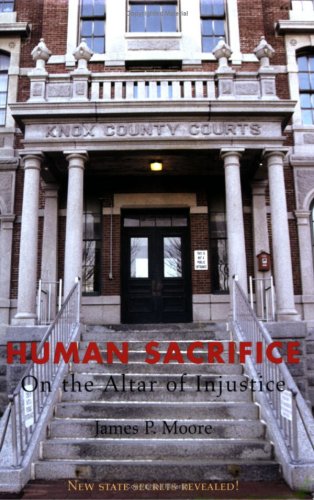
This case has haunted me ever since I read the excellent book by James P. Moore (no relation), entitled “Human Sacrifice”. It reads like a novel—gripping and astonishing, but to those connected to both the victim and the accused, it is nothing short of a real-life horror story. A retired law enforcement officer with the Bureau of Alcohol, Tobacco and Firearms, Moore attended a meeting of “Trial and error”, the group of Dechaine supporters who believe in his innocence and have, for over two decades, sought legal avenues toward gaining Dennis a new trial.
It is difficult to imagine living in prison, but to do so knowing that you didn’t commit the crime is beyond my ability to comprehend.
For those not familiar with the case, here are the basics.
On July 6, 1988, 12-year old Sarah Cherry was abducted while babysitting. Her body was found two days later in the woods. She had been strangled and tortured. Dennis Dechaine was picked up by police after leaving the woods. He was injecting drugs and had become disoriented, losing awareness of the location of his truck. He emerged from the woods around 8:45pm on the 6th.
After Sarah’s body was discovered on the 8th, Dechaine was arrested and charged with murder. He has not been free since.
I remember the case well. I also remember being convinced by news reports—ones that I myself delivered on the radio back then---that the police had arrested the right guy. I am about the same age as Dechaine. In 1988, I was 30 years old and living in Ellsworth, Maine. In the 22 years since then, my life has changed profoundly. Three children, two of whom are in college now. Advances in my career, moving to Portland, buying new houses and cars. Countless vacations, dinners out, family celebrations, holidays and excursions and simple pleasures have filled my days and nights. My wife and I just celebrated our 25th anniversary. It has truly been glorious.
For Dennis Dechaine?
Those same 22 years—losing his wife (a mutually agreed upon divorce to protect her assets from a civil trial), no family, no such simple pleasures—and the crushing boredom of endless days in the hell that is prison. No end in sight. Every hope, every wisp of a chance to introduce JUSTICE is delayed, blunted and thwarted by players in a legal system that’s more concerned with “following procedure/precedent” than finding truth. How Dennis has maintained his sanity and seemingly has come to terms with the bitterness of his situation is beyond my ability to comprehend.
Author James Moore was intrigued by the case—enough to conduct his own investigation—but warned members of “Trial and error” that if he found evidence to CONFIRM Dechaine’s guilt, he would make it public.
In fact, Moore, in his own telling of the circumstances, entered his investigation convinced of Dechaine’s guilt. After all, Dechaine was seen stumbling out the woods near where Sarah Cherry’s body was later found. Items from his truck were found in the driveway where Sarah was abducted. Police reports told of “confessions” by Dechaine-which was used as evidence in the trial, despite the absence of these so-called confessions in the police notes-and Dechaine’s denial of ever confessing to the crime.
The evidence that exonerates Dechaine (in my opinion) but at the VERY LEAST should gain him a new trial is overwhelming, but contains these highlights:
1) According to the medical examiner’s report—given huge windows on either side of the time of death of Sarah Cherry, Dennis Dechaine could not POSSIBLY have committed the crime-----because he was either in custody, being questioned or at home following his initial release by police—and under surveillance. Sarah’s throat was constricted in such a manner that she could not possibly have lived more than about 2 minutes from the time she was strangled. Dechaine was in custody when she died. It’s my opinion that Prosecutor Eric Wright was also aware of the problematic nature of the timing and thus, glossed over it at trial. Had the defense made this an issue, there could have been a different result.
2) DNA evidence from Sarah’s fingernails contain blood that is hers, but also blood from a man who is NOT Dennis Dechaine.
3) Forensic evidence concluded that Sarah Cherry was NEVER in Dennis Dechaine’s pickup truck. No fiber, no hairs, nothing. She was never there.
4) A known child molester with a history of violence was ignored as a suspect. Police notes outlining a set of footprints to this persons trailer—one adult and one barefoot child (Sarah was barefoot when abducted-her shoes left at the home of the people she was babysitting) were never followed up on.
5) Dennis Dechaine had absolutely no record of violence in his past. None. The mutilation that occurred to Sarah suggests a sociopath. Additionally, her panties were missing. Psychologists say that perpetrators of crimes like these often take a “souvenir” such as this. Dechaine had nothing like this on his person, in his truck or in his house. They have never been found—because the killer took them. A killer who is not Dennis Dechaine.
6) Of the nearly 200 items found in Dechaine’s truck, the only two that contained his name (and were part of the damning evidence that convicted him) where the ones that “fell out” of his truck during the abduction. The odds that only these two would be left behind is astronomical. This was a frameup. Remember, Sarah Cherry was NEVER in this truck that supposedly abducted her.
7) Dennis Dechaine did not know Sarah Cherry and would have had no reason to know that she would be at that house, at that time.
8) Dechaine himself pressed for examination of his house, his truck and his person, confident that an honest investigation would clear him. His mistake was in believing in the system, believing that his innocence would be evident.
9) There were multiple alternate suspects in the vicinity, men with criminal records of violence—and violence towards children. Dechaine’s arrest effectively halted all subsequent investigation into these more likely killers. Dechaine’s arrest was reasonable—he should have been a suspect, but certainly NOT the only one—and, as it turns out, the exclusive attention paid to him allowed the real killer to escape investigation and arrest.
There are many other pieces of evidence, circumstances—and just plain common sense that would point towards the notion of a new trial being a good idea.
Here is some video of Dennis himself, being interviewed in prison 6 years ago:
http://www.youtube.com/watch?v=zVIb2qplq_U
http://www.youtube.com/watch?v=KslcRNuk9iQ&feature=related
Dennis Dechaine tried to take his own life in April. It was not successful—and new charges of trafficking in the drugs he used may be pending. Who could blame him? If you ask: how someone with a new trial decision pending could possibly take his own life, my only response would be that after over two decades of one legal disappointment after another, it’s likely that Dennis is just about out of hope.
So what about the victim’s family?
Many believe that Sarah’s family has been short-changed in all of this—and I cannot disagree. While at least one juror who voted for conviction has publicly said that the introduction of this new evidence would have been grounds for acquittal, I have yet to read or hear from a family member of the victim who believes Dechaine is innocent.
Sarah Cherry, were she alive today, would no doubt be a beautiful and vibrant 34 year old woman. Judging from the details we know about her as a 12 year old, she would likely have graduated college with distinction, perhaps have been an athlete and would likely now be a mother herself.
Perhaps the only “witness” to the abduction of Sarah Cherry was the infant who was being cared for—and who would be about 23 years old today. Apart from the killer, this infant was likely the last person to see Sarah alive.
This brutal murder cries out for justice, not merely “closure”. The conviction of the wrong person does not constitute justice or closure, only retribution.
If you’d like to know more about this case, I highly recommend the book “Human Sacrifice” by James P. Moore. I also encourage you to visit the website of Trial and error: www.trialanderrordennis.org
The tragedy of Sarah Cherry’s death is the ultimate one.
The tragedy of Dennis Dechaine’s wrongful conviction is second in line---and vies with the knowledge that the TRUE killer got away with it (and did God knows what to others since)
Let’s not compound this series of tragedies by allowing Dechaine to be denied a new trial by a judge who has NO BUSINESS being involved with this case any longer. Judge Bradford has the final say, whether he deserves it or not.
It’s not about who made a mistake—or who may have concealed evidence.
It’s about justice.
If you’d like my blog in your box, just let me know: tim.moore@citcomm.com
http://knox.villagesoup.com/news/story/dechaine-pleads-not-guilty-to-drug-charges/343068
![]()
By Shlomit Auciello | Aug 04, 2010
Rockland — Convicted murderer Dennis J. Dechaine pleaded not guilty Aug. 4 to a charge that he was in possession of prohibited materials, in the form of drugs, while incarcerated at the Maine State Prison.
Dechaine, who attended the hearing at Knox County Superior Court by way of a video hearing from the prison, was represented by attorney Jeremy Pratt. District Attorney Geoffrey Rushlau represented the state at the hearing, which was heard by Judge John David Kennedy.
Dechaine, 52, has been at the Maine State Prison for more than 21 years for the murder in 1988 of 12-year-old Sarah Cherry in Bowdoinham.
Dechaine was indicted in mid-July for trafficking in prison contraband. The indictment alleged that Dechaine had morphine and/or klonopine on April 5 at the prison.
At the Aug. 4 hearing, Pratt said Dechaine's attorney in the Cherry case, Steve Peterson, had expressed willingness to be retained to represent Dechaine on the drug charges.
Rushlau said he was not seeking bail because Dechaine was not a flight risk while he remained at the prison. The district attorney said he would ask to revisit the question of bail if a new trial in the Cherry case, currently being sought by Dechaine, were to be granted. Rushlau asked to be notified if Peterson was assigned to the drug case.
Dechaine has maintained his innocence in the murder of Cherry who was last seen alive while babysitting at a Bowdoinham home. Attorneys for Dechaine are attempting to introduce DNA evidence to try to win a new trial.
The Herald Gazette reporter Shlomit Auciello can be reached at 207-236-8511 or by e-mail at sauciello@villagesoup.com.
July 31 2010 Posted: 12:00 AM
Kennec Journal
http://www.kjonline.com/opinion/letters/Who-named-Bradford-as-Dechaine-hearing-judge.html
When I read that the presiding judge in the court hearing for Dennis Dechaine was Carl Bradford, the same judge who convicted him 22 years ago, I was puzzled and uneasy.
Certainly the state of Maine has many judges, and it would look better if the judge were someone else.
Why Bradford? Who named him as the judge for this case? Isn’t he retired? Won’t there be questions?
It seems that with the national publicity this case has received, the judicial system would not leave itself vulnerable to questions such as mine.
Gail Schade
Hallowell
Dechaine: 'What I sensed ... was relief'
http://www.pressherald.com/news/what-i-sensed-___-was-relief-_2010-07-25.html
Posted: July 25
Updated: Today at 10:43 PM
By Trevor Maxwelltmaxwell@mainetoday.com
Staff Writer
Prisoner Dennis Dechaine, in his first interview with the media since his suicide attempt in April, said Friday he believes prosecutors have charged him with trafficking in prison contraband as payback for his outspokenness about his case, and also to undermine his pending motion for a new trial.
click image to enlarge
Joined by his attorney Steve Peterson, left, of Rockport, Dennis Dechaine speaks to a reporter at the Maine State Prison in Warren in March. Dechaine, incarcerated since his arrest and subsequent conviction for the 1988 slaying of 12-year-old Sarah Cherry in Bowdoin, has a court hearing in September which his attorney has described as his “last, best chance” at a new trial.
2010 file photo by The Portland Press Herald/Maine Sunday Telegram
SEE THE COMPLETE PACKAGE including multimedia resources here
"This is nothing more than a political ploy," Dechaine said in a 30-minute telephone interview from the mental health unit at the Maine State Prison in Warren.
"I think it's a case of kicking a man when he is down," he said.
Chris Fernald, an assistant district attorney for Knox County, declined to comment specifically about the trafficking charge against Dechaine, which was handed up by a grand jury July 15. But Fernald said it is not uncommon for prisoners serving life sentences to be charged with other crimes during their incarcerations.
"If we didn't prosecute these individuals, then basically the message would be sent to the inmates that if you are serving a life sentence you can do anything you want," Fernald said.
Dechaine, 52, was convicted by a jury and sent to prison for life for the 1988 kidnapping and murder of 12-year-old Sarah Cherry in the small Sagadahoc County town of Bowdoin. He claims that he is innocent, but four court appeals at the state and federal levels have failed.
His latest motion for a new trial, filed by his attorney in August 2008, is tentatively set to be heard by a judge in September.
Dechaine said he tried to commit suicide on April 4 by overdosing on a combination of morphine and Klonopin inside his cell. The next morning, guards found him unconscious, with an extremely low pulse rate and blood pressure. He was taken by helicopter to a Portland hospital, where he spent the next two weeks recovering before being sent back to the prison.
The Department of Corrections investigated the incident and Knox County prosecutors sought charges against him. No date has been set for his arraignment.
Until Friday, Dechaine had been off limits to the media since his hospitalization. A spokeswoman for the Department of Corrections has said there were several reasons for prohibiting interviews of Dechaine in that time frame, but she said those reasons are confidential.
The suicide attempt raised questions about why Dechaine would try to end his life when he is just months away from a court hearing that has been described by his attorney as Dechaine's "last, best chance" at getting a new trial.
On Friday, Dechaine explained that by early April the cumulative impact of his years in prison had pushed him to a state of despair. Also, he came to believe that his appeal could not succeed, particularly because it will be heard by the same judge who sentenced him.
But even more than his doubts about the court proceedings, Dechaine said he arrived at the suicide decision because he felt that the life he could have had outside of prison had already been lost.
"Even if I do overturn my case, the best years of my life have been taken from me," he said. "I can't start a family. I'm too old to start a business. That is depressing."
"Oddly enough, what I sensed when I made the decision (to kill myself) was a sense of relief," Dechaine said.
He said he was devastated when he regained consciousness at Maine Medical Center. Dechaine said his outlook on life improved during his hospital stay thanks to the kindness of the medical staff, but that outlook deteriorated when he was returned to the prison. He said he has never attempted suicide before, and this is the first time that he has been housed in the prison's mental health unit, which consists of two areas of 16 cells.
For the first two weeks back, Dechaine said, he was on a strict suicide watch and he was not allowed to have any items in his cell except for a thin pad on the floor on which he slept. He said he now has a bunk and has been provided some reading and writing materials. He is allowed one hour per week for approved visitors such as family members, he said.
Dechaine said he was not taking any medications before his suicide attempt. He declined to say how he obtained the drugs he used on April 4, and said he has not answered questions about that from Department of Corrections investigators, because he is concerned about retribution.
In the mental health unit, Dechaine meets for one hour a week with a counselor, he said, and the only drug he is taking is a blood thinner to treat the effects of a clot suffered in the suicide attempt.
Dechaine said he has asked to be returned to the general prison population, but so far the request has been denied.
"It doesn't look promising," he said.
Dechaine's pending motion is based on a state law originally passed in 2001 and revised in 2006 that allows prisoners to seek new trials based on DNA evidence.
The evidence in question is a fragment of unidentified male DNA extracted from Sarah Cherry's clipped thumbnail five years after Dechaine's conviction. His attorney says the partial DNA profile discovered by scientists holds the key to finding the real killer. Prosecutors say the right man is behind bars, and the DNA could have come from any incidental contact Sarah Cherry had leading up to her death, or from contaminated nail clippers at her autopsy.
Sarah Cherry, a straight-A student at Bowdoin Central School, was kidnapped while baby-sitting on July 6, 1988.
The mother who had hired her to baby-sit came home around 3:20 p.m. and found a notebook and a receipt in her driveway, bearing the name Dennis Dechaine. Police began a search for both the missing girl and Dechaine, and about five hours later he was seen walking out of the woods about three miles north of the home where Sarah had been baby-sitting.
He told police that he had been fishing and had gotten lost and he could not find his truck. He denied having anything to do with Sarah's disappearance. Later that night, police found his pickup truck on a discontinued logging road nearby.
A search team found Sarah's body around noon on July 8, in the woods near the spot where Dechaine's truck was found. She had been stabbed about a dozen times, and was strangled to death with a scarf. The rope binding her wrists and the scarf had come from Dechaine's truck.
Dechaine says he went into the woods on July 6 to inject speed and to wander around. He claims he was alone the whole day, got lost, and someone must have grabbed his papers, the rope and the scarf from his truck.
Dechaine sounded despondent during the interview Friday, and while he did not expressly say that he was still suicidal, he indicated that his will to live was not strong.
"I'd rather not be here," Dechaine said.
When asked if he meant the prison's Special Management Unit, or if he meant he did not want to be alive, he said: "I'd rather not be here. I'll just leave it at that."
Staff Writer Trevor Maxwell can be contacted at 791-6451 or at:
tmaxwell@pressherald.com
Posted: July 25
Updated: Today at 1:14 AM
By TRACY SCHECKEL
GRAY - As a news editor myself, I'm always reading for the "editorial slant." I found the Dennis Dechaine series quite balanced, yet intriguing. In Maine for only three years, and hailing from New Jersey where Megan's Law originated after an equally heinous murder of an innocent child, I've been a proponent of the death penalty for certain crimes. I bear no sympathy for perpetrators of such unthinkable crimes.
click image to enlarge
James Moore’s account of the case for Dennis Dechaine’s innocence was impressive to this Maine writer.
Telegram file photo
ABOUT THE AUTHOR
Tracy Scheckel is editor and half-owner of Maine Hometown News LLC, publisher of the Gray and New Gloucester Gazette, an online journal (www.gnggazette.com).
Reading Trevor Maxwell's stories, I pondered, "If Maine had the death penalty, we wouldn't have been supporting this guy for the last 22 years."
I reflected on the horror that both Sarah Cherry's parents and Megan Kanka's family in New Jersey continue to endure. I became intrigued at the Trial and Error group, so convinced of Dechaine's innocence. They couldn't be right and not have prevailed after 22 years.
CRACKING THE BOOK
I really wanted to read James Moore's book, "Human Sacrifice," mentioned in Maxwell's stories. Aware that the proceeds from the sale went to the Dechaine defense fund, I was reluctant to "contribute."
Curiosity becoming the victor, I ordered the book. In two days I devoured all 418 pages. I re-read and thumbed back and forth, getting more incensed by the page. Moore portrays a miscarriage of justice that would be unbelievable in a John Grisham crime novel.
Recently, a reader from Waldoboro commented that he thought the Dechaine series running on Independence Day was inappropriate. In some ways he's correct; this must be a horrid time for Sarah's family, the state is brimming with summer tourists, and "Vacationland" is supposed to be a happy place.
His comments explain the zeal with which the police worked in July 1988 to see that justice was done. "It's the height of the tourist season, this is the worst crime ever committed here, and this is 'Vacationland,' crimes like this don't happen here, and, above all, the family of this child needs closure. This crime needs to be solved ASAP!"
Dechaine was an easy suspect. His truck, belongings and drug-impaired self, all in the vicinity of the crime, created an open-and-shut case for police. Based on trial transcripts, notes and police reports, the entire Dechaine saga is reminiscent of the Keystone Cops, Good Ol' Boys, and Catch 22 all rolled into one giant nightmare.
Everybody makes mistakes, but our legal system, through its appellate process and other legal mechanisms, is designed to assure that justice is ultimately done. In spite of numerous efforts by the Dechaine defense team, it is obvious that our judicial system has failed repeatedly.
The lack of hard evidence against Dechaine is far more compelling than the prosecution's circumstantial evidence. The judge disallowed evidence of the existence of two other viable suspects, both known child sex offenders.
The time of death, per the testimony of the state coroner -- if one could decode the rhetoric and do the math -- places Dechaine in the custody of police while Sarah was being murdered. There's DNA evidence that doesn't match Dechaine's. I could go on ...
The point is that the system has failed Dennis Dechaine and the family of Sarah Cherry. Her murderer is still out there, and an innocent man is imprisoned. One can't begin to imagine the eternal pain felt by little Sarah's family. In spite of the need for closure, one has to conclude that they would want the real murderer incarcerated.
"Human Sacrifice" brought mixed emotions. My assumption of fairness in our judicial system has been obliterated, yet I am glad to have provided even some support for Dechaine's defense. I now wonder if the death penalty should be abolished nationwide. I'm sure the judicial ineptness doesn't stop at Maine's borders.
I commend the Portland Press Herald/Maine Sunday Telegram for having the courage to tell the story and inspire readers like me to look at all the facts, not just what the jury saw and heard.
WILL A RETRIAL HAPPEN?
The Dechaine team will seek a retrial in September based on DNA information. I contacted Moore regarding his book and to see what might be done in support of Dechaine.
To my suggestion of a pardon request, he replied, "Dennis has consistently rejected suggestions that he apply for a pardon, since that would imply he'd done something to be pardoned for. He and some Trial and Error members have urged the governor to commission an honest, objective, bona fide inquiry into the case but to no avail."
He did suggest letters be sent to the Attorney General's office.
Maybe it's not too late.
- Special to the Telegram
Morning Sentinel Staff
"Did Dennis Dechaine kill Sarah Cherry?" was the headline in the July 4 Morning Sentinel. It referred to a more than 22-year-old case in which a man was convicted of a crime for which he has always maintained his innocence.
Upon reading it, I was reminded of an interview I conducted three years ago for an access TV show I was producing. I interviewed retired federal agent James P. Moore and several people who had studied transcripts of the trial. At the end of the interview, I was convinced Dechaine at least deserved a new trial.
Moore drew an actual police investigative time line. This time line showed Dechaine to be in a lengthy police custody. Forensics by experts determined that Sarah Cherry died in the middle of that custody. It was even determined that there was a scuffle in the woods, 'in the same spot where Sarah Cherry's body was found.' At the time, the detective holding Dechaine refused to let police dogs investigate the scene. Had that search been allowed, the real killer might have been apprehended, and Cherry might still be alive.
Another troublesome fact was that one of the detectives changed the wording of his original notes. The new version implied guilt, while the original notes implied innocence. During the trial, another of the detectives actually testified in conflict with his own crime- scene notes. Again, the court version implied guilt, whereas the original notes implied innocence.
The position of Dechaine's truck also bothered me. According to the detective's version, Dechaine abducted Cherry, drove her to a location, killed her, walked way past his truck and exited the woods.
Why didn't he just get in his truck and leave?
Peter P. Sirois
Madison
Posted: July 24 2010
Updated: Today at 7:20 PM
Morning Sentinel Staff
Moved by news of Dennis Dechaine's attempted suicide, I've just studied that part of Maine law that pertains to "trafficking in prison contraband."
It's clear that Knox County (and AG's office?) officials are risking mental dislocation in their over-reaching attempts to stifle the growing awareness of the injustices visited upon MSP inmate #1725 by responding to his suicide attempt with an indictment for criminal possession of prescription drugs.
Forget the lawyers with their jargon and the bureaucrats their stone walls. In the court of public opinion, it's finally the straight face test that must be met.
Try and keep one here:
* While the indictment uses the inflammatory word "trafficking," the only drugs found were in Dechaine's blood stream. There were none in his cell or on his person.
* After 22 years of frustrated effort to present DNA and other new evidence of his innocence in a new jury trial, Dechaine's desperate but "reasonable response to an intolerable situation" (his words) is being twisted to conform to a section of the law code (Maine Revised Statutes Title 17-A, Part 2, Chapter 31, Section 756) whose heading, ironically, is "Aiding escape."
* Even though Dechaine is working out two hours a day and is reinvigorated, he is being kept in solitary confinement indefinitely, presumably because he is a risk to himself.
* Anyone who has visited prisoners knows how difficult it would be to smuggle in drugs. Likely Dechaine obtained them from prison staff, yet he is the only one being charged.
* Why go to the trouble and expense of trying to convict someone who is already serving a life sentence without parole?
Why, indeed. Unless it is the equally desperate act of a justice system trying to destroy itself.
Bernie Huebner
Waterville
More Letters to the editor, July 22, 2010
Dechaine series continues to elicit strong reactions
http://www.pressherald.com/opinion/letters/commentary_2010-07-22.html
July 22 2010
Since it is not against the law to attempt to commit suicide, Dennis Dechaine is to be persecuted, er, prosecuted for having traces of prescription drugs in his blood.
Traffficking" makes great headlines, even though legally the charge is a real stretch, and morally it is indefensible -- talk about kicking a guy when he is down!
No matter. The Maine Attorney General's Office -- and until told otherwise we can assume the local district attorney is a puppet for the state -- has shown no shame over having sealed the records on the Dechaine case; incinerated evidence; opposed DNA testing and the findings of its own psychological experts; presented perjured testimony; obscured the time of death, etc.
If Dechaine receives five years for trying to commit suicide, but is later exonerated on the wrongful murder conviction, do you suppose our attorney general will insist that he serve the five years before being freed? It's a fair question.
William Bunting
Whitefield
In the Dennis Dechaine case, DNA proves the wrong man has been in prison for 22 years.
I applaud Trevor Maxwell for his in-depth investigative story about the Sarah Cherry murder case and owner Richard Connor for publishing it. The two-part special report in the Maine Sunday Telegram and the multimedia information presented on The Portland Press Herald website are outstanding.
DNA technology has been used successfully by the Innocence Project to exonerate over 250 wrongfully convicted individuals. The Innocence Project lawyers believe the DNA profile found in the Cherry case is significant enough for Dechaine to be granted a new trial.
How can Maine prosecutors say that DNA in the Dechaine case is irrelevant? How can the head of the Criminal Division of the Attorney General's Office, William Stokes, say with a straight face that the DNA evidence from the 1988 Cherry case came from "dirty" nail clippers?
Stokes recently argued and won the case against Thomas Mitchell for the 1984 murder of Judith Flagg of Fayette using DNA evidence extracted from Flagg's fingernail clippings. The AG's office felt that DNA technology was relevant enough in the Flagg case to send material for testing in the summer of 1988, yet it opposed DNA testing to be done in 1989 in the Cherry case, saying that the technology was too new. Then-Judge Carl Bradford denied Dechaine's request.
I commend the AG's office for the conviction of Mitchell; however, the same degree of importance concerning DNA evidence should be used when it proves a wrongful conviction.
It is becoming abundantly clear that the Attorney General's Office can no longer be objective when it comes to the Dechaine case. For prosecutors, it is no longer about finding the truth but about upholding the jury's verdict.
Nancy Farrin
Pittston
With all the passion, facts, fiction and misinformation around the guilt or innocence of Dennis Dechaine, it's hard to keep one's eyes on the prize -- certainty about the perpetrator without doubt.
My fervent hope is that Justice Carl Bradford will allow a new trial so that all the evidence -- old and new -- can be laid on the table.
I believe the citizenry, the law enforcement community, the family and friends of Sarah Cherry, those of us who have followed this case since 1988 and certainly the AG's office and the judiciary want justice -- a fair, impartial, honest conclusion reached from consideration of true events and scientific data.
I believe there is more than reasonable doubt as to Dechaine's guilt. Once that is recognized, we can get on with following other lines of investigation and maybe find a child's killer.
Charlotte Henderson
Washington
Trevor Maxwell has done a stellar job again reporting on the Dennis Dechaine case. With all the facts of the case so thoroughly laid out, only questions remain.
The state's case is based solely on items from Dechaine's truck. Would the state have incinerated hairs, clothing and swabs if they showed any evidence whatsoever that Sarah had contact with Dennis or his truck?
If Sarah Cherry's hands were bound in front of her and had her own blood on them, how could Dennis emerge from the woods without a drop of blood on him?
If no forensic evidence was found in Dennis' truck, how could he drive her three miles from where she was babysitting to the woods?
How could he have carried her 350 feet into the woods without any trace evidence on either of them? Why was no missing article of Sarah's clothing or a knife found on Dennis, or anywhere else?
What guilty person asks for DNA testing to be done? There are potentially thousands of people worldwide whose DNA would match the partial profile in this case. But Dennis Dechaine is not one of them!
William Stokes, the head of the Criminal Division of the Attorney General's Office, states that DNA on a murder victim's fingers doesn't automatically identify the killer. But it certainly rules one out! The state would have relied heavily on this DNA evidence had it been a match for Dechaine.
Stokes states: "With partial profiles, you have to be careful because you may actually implicate a lot of innocent people."
Is Mr. Stokes more concerned about implicating an innocent person whose DNA does match the profile than he is about implicating an innocent person whose DNA does not match the profile? Let's have a new trial where all the evidence is presented. Let's finally have a fair trial.
Susan Pastore
Portland
It's not like Dechaine is asking for pardon
http://www.onlinesentinel.com/opinion/letters/98972129.html
Morning Sentinel Staff
July 22 2010
Thank you for publishing Trevor Maxwell's piece on the Dennis Dechaine case. It's journalism like this that makes me optimistic that local newspapers can survive.
Like most Mainers I've been somewhat aware of this case over the years but only in snippets or fragments. It was very helpful see the sad story from its beginning to the present. With a case this of this magnitude I can't understand why the authorities have fought a retrial for so many years, especially with the science of DNA being so much more developed.
The fact that Dechaine was denied the use of DNA testing from the beginning is grounds for a new trial. It's not like he's asking for a pardon.
It's almost like the prosecution doesn't believe in their own judicial system.
David Jordan
Somerville
http://www.bangordailynews.com/detail/149215.html
7/20/10 07:37 pm Updated: 7/20/10 07:45 pm
Not the whole story
Emmet Meara’s July 9-10 BDN column expressing his certainty of Dennis Dechaine’s guilt in the murder of Sarah Cherry would have been more convincing if his listed evidence had dealt with a thorough investigation of two factors that have left me questioning Mr. Dechaine’s guilt over the years.
Why hasn’t the government deemed it important to know who the DNA found under her fingernails belongs to and provided a clear reason why tha DNA hasn’t been compared with an extended family member who had been charged with child sexual abuse of other family members at the time of this murder?
When convictions are the result of circumstantial evidence, no matter how prolific, and hard evidence is ignored, doubts will remain.
I cannot imagine the pain that the Cherry family has endured over the years and they have my profound sympathy. But if Mr. Dechaine is not guilty, a murderer is still walking free among us.
Pat Jenkins
Bangor
Wasteful indictment
There aren’t many mysteries here. Dennis Dechaine is in prison for the rest of his life, no parole. Prison life cannot be that great, so it’s not hard to accept that after 22 years he might have had a moment in which he wanted to give up.
I can also accept that in prison one can get things that should not be available, i.e. enough prescription drugs to commit suicide.
What I really want to know is, in these tight budgetary times of state belt-tightening, who in state government put “indict Dechaine on drug trafficking charges” at the top of his or her to-do list and why?
I worked for the state last year. We all had to prioritize our work carefully. Don’t these guys have any real work to do? What is really going on here?
Steve Sandau
Brunswick
Wrongly convicted
http://www.bangordailynews.com/detail/149097.html
July 19 2010
I was saddened to read in the July 17-18 BDN that Dennis Dechaine had attempted suicide this past April. He obviously felt such despair from having lost faith in the Maine state justice system that even while waiting for a decision about a retrial, he didn’t have faith that the justice system would know what we all know would be right: a retrial.
Having been let down countless times before, from having concrete evidence that proved his innocence brought forward over the years and ignored by the AG’s office, it’s no wonder he felt the way he did. He’s only human. A wrongly convicted human.
Why would he be charged with “drug trafficking” for having it for the sole purpose to use to try to take his own life?
In Maine a life sentence isn’t 25 years, as in some states. It’s for life, unless you were wrongly convicted and can prove it. Why charge him for using something for the sole purpose of committing suicide? What’s to be gained from that? Tack on more years to a life sentence? That doesn’t make any sense.
In my opinion, these are very suspicious actions by an office that has fought to try to prevent Dennis from receiving a fair trial with all of the evidence that was not brought forth in the initial trial.
Add this indictment to the growing list of suspicious actions of that office, where Dennis and real justice is concerned.
Lori Dumont
Bangor
July 20 2010
In the Dechaine case, DNA proves the wrong man has been in prison for 22 years. I applaud Trevor Maxwell for his in depth investigative story of the Sarah Cherry murder case and Richard Connor for publishing it. The two part special report appearing in the Maine Sunday Telegram and the multimedia information presented on the Portland Press Herald website are outstanding. DNA technology has been used successfully by the Innocence Project to exonerate over 250 wrongfully convicted individuals.
The Innocence Project lawyers believe the DNA profile found in the Cherry case is significant enough for Dennis Dechaine to be granted a new trial. How can State of Maine prosecutors say that DNA in the Dechaine case is irrelevant? How can the head of the Criminal Division of the state Attorney General’s Office, William Stokes, say with a straight face that the DNA evidence from the 1988 Cherry case came from “dirty” nail clippers? William Stokes recently argued and won the case against Thomas Mitchell for the 1984 murder of Judith Flagg of Fayette using DNA evidence extracted from Flagg’s fingernail clippings. The AG’s office felt that DNA technology was relevant enough in the Flagg case to send material for testing in the summer of 1988 yet opposed DNA testing to be done in 1989 in the Cherry case citing that the technology was too new. Judge Bradford denied Dechaine’s request.
I commend the AG’s office for the conviction of Mitchell, however, the same degree of importance concerning DNA evidence should be used when it proves a wrongful conviction. It is becoming abundantly clear that the state Attorney General’s office can no longer be objective when it comes to the Dechaine case. For them, it is no longer about finding the truth but about upholding the original jury’s verdict.
Nancy
Letter from Dennis to Trevor Maxwell at the PPH
Dear Trevor,
I have received the first series of articles you wrote, published July 4.
I was surprised that there was such an interest in making public my recent
hospitalization. The reason why I was hospitalized on April 5 is because
on the evening of April 4 I ingested a combination of prescription drugs
in an attempt to end my life.
I didn't think I would ever have to explain myself, but since the state
now seems intent in charging me criminally, it appears that keeping this a
private matter is no longer a possibility. What drove me to suicide? A
combination of factors.
I have been imprisoned 22 years and the soul crushing monotony, boredom,
institutional food, pervasive violence, 24 hour lights, near constant
noise, harsh treatment, myriad petty rules, lack of resources, loss of
potential, separation from family and friends, along with a raft of other
negativity, simply conspired to erode my will to live.
Combined with the overwhelming oppression of prison were thoughts about my
case and my chances for justice. It seems that every time exculpatory
facts are revealed, state agents respond by digging their heels in with
greater resolve. The state, with its infinite resources, tilts the playing
field so precipitously that a defendant with limited resources doesn't
stand a chance. All I ever wanted is the right to present all of the facts
in my case to a jury of my peers, something our constitution fundamentally
affords. Why can't I do that in Maine?
Prosecutor Bill Stokes implied that I should not be allowed to continue
appealing my case because I failed to make my case in previous efforts.
That's the sort of flawed reasoning that drives me to distraction. Stokes'
office first argued against DNA testing and now it's arguing to keep a
jury from ever hearing the results of that testing. His office also fought
to keep any discussion of alternate suspects from a jury. One of his
colleagues had potentially crucial forensic evidence incinerated before
the value of that hair and fiber could be ascertained. Why would a
prosecutor want to make evidence disappear? Logically, anyone who destroys
evidence or sanctions its destruction, clearly isn't interested in truth
or justice. That no jury will ever benefit from the knowledge inherent in
that evidence creates frustration that weighs heavily on me.
Another source of frustration was also alluded to in one of your articles,
which stated that no other case in Maine has ever been litigated for so
long. The vast majority of that time has been wasted waiting for the state
to respond to motions, and for the courts to schedule hearings or make
decisions. As time goes by the torment of waiting worsens, diminishing any
hope for a return to a meaningful and productive life.
In Maine, a life sentence is a cruel and lingering death sentence that
eventually breeds despair and hopelessness. I have watched men grow old in
prison and I have been horrified by the thought of it. This is no place
for men weakened by age or disability. Given my prison experience, the
lack of control over my own life, the sense of frustration where
prosecutors and courts are concerned, it takes no great effort to
understand why I tried to end it all. Is it unreasonable to believe that
suicide may very well be a reasonable response to an intolerable
situation?
Sincerely,
Dennis Dechaine
7-10-10
WARREN, Maine (NEWS CENTER)
July 16 2010
http://www.wcsh6.com/news/local/story.aspx?storyid=120690
A man serving time for a high profile murder has been indicted on charges of trafficking in prison contraband.
Dennis Dechaine was convicted of murdering 12 year old Sarah Cherry in 1988.
NEWS CENTER'S midcoast media partner Village Soup dot com reports that a Knox County grand jury has indicted Dechaine.
The indictment alleges that on April fifth, Dechaine had morphine and / or klonopine. That was the week that he was rushed to the hospital, reportedly near death after his heart rate and blood pressure dropped. Dechaine was hospitalized for two weeks.
Prison officials have never said what he was treated for.
Posted: 12:00 AM
July 18 2010
What madness is this, that state officials, including prosecutors and judges, bound by some of the oldest and most revered oaths in U.S. history, would willfully ignore evidence that may not only prove that an innocent man has been imprisoned for a horrible crime, but also serve to lead investigators to the person who is truly responsible for the unimaginable atrocities committed against 12-year-old Sarah Cherry?
Dennis Dechaine, right, and his attorney Steve Peterson listen to a question asked by reporter Trevor Maxwell during an interview at the Maine state Prison in Warren on March 22.
2010 Telegram file
As an American citizen and citizen of the great state of Maine, it is inconceivable to me that the men and women we trust to uphold our values, defend our liberties and protect us from harm could be so casually dismissive in their attitude toward the overwhelming evidence that has come to light pointing toward Dennis Dechaine's innocence.
I do not know who killed Sarah Cherry in 1988, but I'd like to find out. I would like to be shown undeniable proof that some terrible monster who has been lurking around snatching up little girls has been caught and dealt with.
I'd like to think state officials would like this, too, and will finally leave their egos at the door and do their jobs as they swore an oath to do and listen to what forensic experts and witnesses to events surrounding the case have been trying to say:
They say there's more to this story, more facts to consider and suspects to pursue, and that there may still be a monster out there somewhere, free to take more innocent lives.
Professional integrity. Doing the right thing in the face of public humiliation. Officials owe that much to Sarah Cherry. They owe that much to Dennis Dechaine. They owe that much to you and me, and they owe that much and more to whoever destroyed that little girl.
It's time they paid up.
Emily Paine
Buxton
Hats off to?Trevor Maxwell and the Maine Sunday Telegram for such extensive coverage of the Dennis Dechaine case.
I do want to comment on a few points: What does state prosecutor William Stokes mean that Dennis "does not deserve a new trial"? How does he define "deserve" and under what circumstances would someone "deserve" a new trial?
As for being given "so many opportunities to make your case and you haven't done it," I would hope Mr. Stokes knows that appeals are based on procedural issues, not evidence.
Secondly, Mr. Stokes complains about how much the state has spent on the case. Think how much the state might have saved on incarceration expenses had Dennis been allowed to be tested and present DNA evidence that would have excluded him back in 1988.
Lastly, Mr. Stokes is quoted as saying Dennis said, "It must be somebody else inside of me." This statement comes from the trial testimony of Detective Alfred Hendsbee who claimed, under oath, that he was reading this statement from his notes.
However, when Jim Moore gained access to those notes, he discovered that no such quote is in those notes.
Webster's Dictionary defines "deserve" as "to have a right to because of acts or qualities; be worthy of." I always thought any person in America deserves the right to a fair trial.
If a defendant does not receive a fair trial, then he deserves a new trial. Dennis did not receive a fair trial because the investigation was incompetent, evidence was concealed and police gave false testimony.
I think those are grounds for "deserving" a new trial and Dennis is most certainly worthy of one.
Genie Nakell
Portland
Dechaine says he attempted to commit suicide
Dennis Dechaine, who is serving a life sentence for murdering a 12-year-old girl in 1988, says he tried to kill himself with prescription drugs earlier this year.
In a letter sent this week to The Portland Press Herald/Maine Sunday Telegram, Dechaine said he "ingested a combination of prescription drugs in an attempt to end my life" in early April at the Maine State Prison in Warren.
A grand jury in Knox County indicted Dechaine this week on a charge of trafficking in prison contraband. Dechaine wrote in the letter to the newspaper that he acknowledged the suicide attempt publicly because he is being charged in the case.
Dechaine, 52, was convicted in 1989 of killing Sarah Cherry of Bowdoin. The Madawaska native has maintained his innocence through four unsuccessful appeals, and the case has been the subject of intense legal and media interest over the years.
This fall, the judge who presided at his trial is expected to hear arguments on whether Dechaine should get a new trial, based primarily on a fragment of unidentified male DNA extracted from Sarah Cherry's clipped thumbnail.
Dechaine was hospitalized on April 5. His brother said Dechaine was near death, but prison officials have refused to comment, citing confidentiality laws.
According to the indictment issued Tuesday, Dechaine had morphine and Klonopine, a drug that's used to treat seizure and panic disorders. No one else was indicted in connection with the incident, according Geoffrey Rushlau, Knox County's district attorney.
Dechaine wrote in his letter, dated July 10, "I have been imprisoned 22 years and the soul crushing monotony, boredom, institutional food, pervasive violence, 24 hour lights, near constant noise, harsh treatment, myriad petty rules, lack of resources, loss of potential, separation from family and friends, along with a raft of other negativity, simply conspired to erode my will to live."
Dechaine's letter detailed frustration with his case and called his suicide attempt "a reasonable response to an intolerable situation."
Dechaine's attorney, Steve Peterson, said he doesn't expect the indictment to affect his client's push for a new trial.
If Dechaine were convicted of trafficking before his hearing on the request for a new murder trial, it could be brought up at the hearing, Peterson said, but a rapid conviction is unlikely.
"I don't know how much sense it makes to indict someone who's already serving a life sentence," said Peterson. "I've seen it happen before."
Asked if some might see the suicide attempt as an admission of guilt, Peterson said he has seen the letter his client wrote and doesn't think so.
"What it is, is a venting of how frustrated he is about being in jail and being wrongfully convicted," said Peterson. "Trying to get this righted has been a very frustrating thing for him."
Peterson said Dechaine is now in an exercise program at the prison and appears to be stable. "Whatever depression he was in that caused this to have happened seems to have passed," he said.
Dechaine's friends and family in Madawaska said they took the news of the attempted suicide hard.
"It was devastating for us," said Carol Waltman, a friend of Dechaine's since high school and the founder of Trial and Error, an advocacy group that maintains his innocence. "We've got to understand where he's coming from. Being in a place like that, it's a hellhole."
Both Waltman and Don Dechaine, Dennis Dechaine's older brother, were upset that he got prescription drugs in the first place.
Don Dechaine said people who visit inmates go through an intensive search. He said he believes the drugs had to have been smuggled in by a prison worker.
"They search, scan, there's no way to receive any drugs," said Don Dechaine. "It has to come from within the prison."
He said he plans to talk with Peterson about filing a complaint with the state.
Denise Lord, associate commissioner of the Department of Corrections, said the department is continuing to investigate the circumstances.
"We're concerned if drugs are coming, or are in the facility inappropriately or illegally," said Lord. "We're definitely looking into it."
http://www.onlinesentinel.com/news/Dechaine-indicted-following-suicide-try.html
A Knox County grand jury has indicted convicted murder Dennis Dechaine on trafficking in prison contraband following a suicide attempt at the state prison in Warren.
In a letter sent this week to The Portland Press Herald/Maine Sunday Telegram, Dechaine said he had “ingested a combination of prescription drugs in an attempt to end my life.”
Dechaine, 52, is serving a life sentence for the 1988 murder of 12-year-old Sarah Cherry in Bowdoin. The Madawaska native has maintained his innocence through four unsuccessful appeals – as have a number of friends, family and others – and the case has been the subject of both legal and media interest over the years. This fall, he is expected to get a hearing before the judge who originally convicted him on whether Dechaine should get a new trial based primarily on a microscopic fragment of unidentified male DNA extracted from Cherry’s clipped thumbnail.
Dechaine was hospitalized on April 5. His brother said Dechaine was near death, but prison officials have refused to comment, citing confidentiality laws. According to the indictment handed down July 13, Dechaine had in his custody morphine and Klonopine, a drug used to treat seizure and panic disorders.
Dechaine wrote in the letter that he was acknowledging the suicide attempt publicly because he was being charged criminally in the case.
“I have been imprisoned 22 years and the soul crushing monotony, boredom, institutional food, pervasive violence, 24 hour lights, near constant noise, harsh treatment, myriad petty rules, lack of resources, loss of potential, separation from family and friends, along with a raft of other negativity, simply conspired to erode my will to live,” Dechaine wrote in the letter dated July 10.
Dechaine’s letter detailed frustration with his case, and called his suicide attempt “a reasonable response to an intolerable situation.”
To read more about the Dechaine case and watch a video interview with Dechaine, visit our multimedia package.
July 11 2010
SEE THE COMPLETE PACKAGE including multimedia resources here
Posted: 12:00 AMBy Trevor Maxwell tmaxwell@mainetoday.com
Staff Writer
July 11 2010
In prisoner Dennis Dechaine’s latest bid for a new trial, the key piece of evidence is actually old news.
click image to enlarge
Accompanied by his attorney Steve Peterson, Dennis Dechaine listens to a reporter's questions during an interview at the Maine State Prison in Warren on March 22. With a new appeal more than two decades after his conviction in the death of Sarah Cherry, no other case has been litigated in Maine's court system for so long.
March 2010 photo by Gregory Rec/Staff Photographer
click image to enlarge
Thomas Connolly, the Portland lawyer who represented Dennis Dechaine at his 1989 trial, says he regrets not pushing harder for pretrial DNA testing. "I wasn't hanging my hat on the DNA at the time," Connolly said this spring. "It was only after the verdict that I realized the enormity of it.'
December 2006 file photo/The Portland Press Herald/Maine Sunday Telegram
Select images available for purchase in theIt is a fragment of unidentified male DNA, extracted by scientists in 1994 from a thumbnail clipping of 12-year-old murder victim Sarah Cherry.
Dechaine was convicted of the murder in 1989 and is serving a life sentence. He says he was in the wrong place at the wrong time, and that another man set him up.
Prosecutors say the right man is behind bars.
Although the mystery DNA was discovered 16 years ago, an upcoming court hearing would be the first time for that evidence to be considered by a judge. It took a new state law in 2001, a revision of that law in 2006, additional genetic tests on the thumbnail by the state and the defense, and a great deal of legal wrangling to reach this point.
At the hearing, tentatively scheduled for September, Dechaine’s legal team must convince a judge that jurors in 1989 probably would have acquitted him if they had known about the thumbnail DNA.
His lawyers also will ask Justice Carl O. Bradford to consider other evidence in the case, such as recently obtained opinions about Sarah Cherry’s time of death, and information about alternate suspects.
But the crux of the motion is the DNA, whether it will be deemed credible by the judge, and whether it raises enough doubt for a new trial to be granted in one of Maine’s most notorious homicides.
“That is overwhelming evidence, in our view, that it was not Dennis Dechaine who did this,” said his attorney, Steve Peterson of Rockport.
‘THIS CAN’T ... BE RANDOM’
Sarah Cherry was abducted while baby-sitting at a home in Bowdoin on July 6, 1988. Her body was found two days later, in the woods about three miles north of the home.
Her wrists were tied together in front of her chest. A gag had been placed in her mouth and a scarf was wrapped around her neck. The killer sexually assaulted her with sticks, and tortured her with a small blade before strangling her.
Papers belonging to Dechaine were found in the driveway of the house where Sarah had been baby-sitting.
His truck was found about 450 feet from the body. The rope and scarf used to commit the crime had come from Dechaine’s truck. He walked out of the woods on the night of July 6 in the general vicinity of his truck and Sarah Cherry’s body.
Dechaine maintains that he went into the woods that afternoon to inject drugs and to wander around. He says he was alone the whole day, got lost, and someone must have grabbed his papers, the rope and the scarf from his truck.
“I offered up my truck willingly for them to go through,” Dechaine said during a March 22 interview at the Maine State Prison in Warren.
“They went through it microscopically. There was absolutely no proof that Sarah Cherry had ever been in my vehicle.
There’s no proof that Sarah Cherry ever knew me, or that I ever knew her.
“And there is no doubt in my mind that whoever took Sarah Cherry knew who she was and where she was. This can’t possibly be random.”
Dechaine hopes his defense team will be able to obtain DNA samples from a number of people, including a list of alternate suspects put together by private investigators who have worked on his behalf.
DNA ‘DOESN’T SHOW ANYTHING’
State prosecutors say Dechaine murdered Sarah Cherry, the evidence proved it, and the DNA is irrelevant.
The thumbnail was subject to possible contamination both during the autopsy and during the year it was in the custody of Dechaine’s trial lawyer, Tom Connolly, said William Stokes, head of the criminal division at the state Attorney General’s Office.
“Our position has been that the most likely source of that DNA is contamination at the time of the autopsy, since nail clippers were reused from autopsy to autopsy at that time and were stored in a way that was conducive to contamination,” Stokes said.
Clippers, blades and other equipment used by medical examiners in 1988, he said, were stored in a toolbox lined with a towel.
While scientists have confirmed the existence of the DNA on Sarah Cherry’s thumbnail, they cannot say what type of material it is. It could be from blood, saliva or even a particle of skin. The only other biological material found on the thumbnail was her own blood.
Stokes said there was no evidence suggesting that Sarah Cherry had scratched her killer; state chemists found no tissue underneath her fingernails.
Even if the unknown DNA somehow got transferred to the thumbnail before her death, that doesn’t prove someone else killed her, Stokes said. Unlike a rape case, where a sperm sample can identify or clear a defendant, DNA on a murder victim’s fingers doesn’t automatically identify the killer.
“What does the DNA prove? From our perspective, it doesn’t show anything.”
SEARCH CONTINUES FOR IDENTITY
The male DNA profile found on Sarah Cherry’s thumbnail is incomplete; there is enough genetic material to rule out most people as the source, but there is not enough to conclusively identify an individual.
In 2004, the state crime lab ran the partial profile through a database containing DNA profiles of convicted felons in Maine. Seven possible matches were identified.
Crime lab officials reviewed the histories of the men, and conducted further analysis on the DNA profiles, and ruled them out as potential suspects.
The list of the convicts whose DNA matched the partial profile on the thumbnail remains under seal by an order of the court.
“With partial profiles, you have to be careful because you may actually implicate a lot of innocent people,” Stokes said. “We just don’t have enough of a profile to make a perfect match.”
Dechaine criticized the Attorney General’s Office for not doing more to determine the source of the DNA.
“Is that really why we hire prosecutors? Is that why we hire police?” he said. “It would seem to me that anything that could be examined and investigated should be. I would obviously put DNA at the top of that list.”
Although neither side has determined whose DNA is on Sarah Cherry’s thumbnail, they have ruled out more than a dozen people who had contact with her.
Lawyers who handled the evidence envelopes, police officers and members of the Medical Examiner’s Office were all tested and excluded. Family members of Sarah Cherry also were ruled out.
Peterson said the defense also reviewed some autopsies that were performed before Sarah’s body was delivered to the Medical Examiner’s Office. None of the autopsies reviewed provided a match.
JUDGE DENIES TESTING
After Sarah Cherry’s fingernails were clipped during her autopsy in July 1988, a state chemist used up all of them – except for the thumbnails – while testing for blood types.
Chemist Judith Brinkman determined that the blood found on her fingernails was a match for Sarah. Because her hands had been bound in front of her body, the blood likely was transferred as Sarah groped at her upper chest and neck, where she had been stabbed repeatedly.
About three months before his trial was set to begin, Dechaine asked for a continuance and for DNA testing of the bloodstained thumbnails.
DNA profiling was considered pioneer science at the time. In 1988, an appeals court in Florida was the first U.S. court to admit DNA findings as evidence. Courts around the country were developing standards for how DNA evidence would be handled by lawyers, judges and juries.
While DNA findings had not yet been admitted in a Maine court, the state Attorney General’s Office was using the technology by the summer of 1988. Several months before Dechaine made his request, the state sent out items for testing at a commercial lab in New York in connection with a homicide in Fayette.
A hearing on Dechaine’s request for DNA testing was held in front of Justice Bradford on Jan. 27, 1989.
The judge relied primarily on input from Brinkman, who had spoken with staffers at a lab in California. They thought the chances of getting usable results were remote, because of the small amount of blood on the nails.
In light of Brinkman’s testimony and the other evidence in the case, Bradford denied the request for testing, which would have delayed the trial for at least a few months.
“I have never gotten over the fact that the judge ruled against me,” Dechaine said. “My personal feeling is that there was one overlying reason, and that was that it was simply inconvenient to the court schedule.”
Connolly, Dechaine’s trial lawyer, blames himself for not pushing harder for pretrial DNA testing. Connolly said he failed to bring in his own expert to argue against Brinkman and the state prosecutors.
“I wasn’t hanging my hat on the DNA at the time. I thought we were going to win with or without it,” Connolly said during an interview at his office in March.
“It was only after the verdict that I realized the enormity of it.”
LONG, STRANGE JOURNEY FOR CLIPPINGS
But Connolly did one thing that has essentially kept the case open ever since: During the trial, he placed a defense exhibit sticker on the sealed envelope that contained Sarah’s thumbnails, even though they technically belonged to the state.
Then he got a letter from court officials in 1992, saying the exhibits would be destroyed if the lawyers did not pick them up. After writing back to make sure there was not some mistake, Connolly picked up the envelope.
Connolly sent the package for DNA testing at CBR Laboratories in Boston, using money raised by Dechaine’s supporters.
State prosecutors found out that Connolly had the nails, and he returned them to state officials under an order from Bradford in late 1993. The results from the lab came back in 1994, showing a mixture of Sarah’s blood with DNA from an unknown individual, not Dechaine.
Dechaine filed two court appeals in the years following the discovery of the thumbnail DNA – a petition for post-conviction review with the state supreme court in 1995, and a federal habeas corpus petition in 2000 – asking the court to decide the legality of his imprisonment. Connolly resigned as Dechaine’s lawyer in 1995 because the appeal focused on the claim that Connolly had provided ineffective counsel.
In both appeals, judges determined that the case did not merit any new hearings.
State supreme court Justice Donald Marden and U.S. Magistrate Judge David Cohen, in written opinions, said that even with knowledge of the thumbnail DNA, a reasonable juror could have found Dechaine guilty.
“The presence of a DNA profile inconsistent with those of either Cherry or Dechaine does not in itself undermine the weight of the evidence against Dechaine,” Cohen wrote.
DOORS OPEN FOR DNA APPEALS
Just as it seemed that Dechaine had exhausted all of his legal options, the Maine Legislature in 2001 passed a law giving prisoners the right to seek new trials based on DNA evidence.
Dechaine’s new lawyer, M. Michaela Murphy of Waterville, filed a motion for a new trial in May 2003.
She got help from the Innocence Project, a national organization founded by Barry Scheck and Peter Neufeld, who became famous as members of O.J. Simpson’s “Dream Team.” The project is dedicated to the exoneration of wrongfully convicted people through DNA testing. Six staff lawyers are currently working on about 300 active cases, including Dechaine’s.
According to statistics compiled by the Innocence Project, 255 people in 34 states have been exonerated through DNA evidence in the past 21 years. None of those exonerations has been in Maine. In New England, Massachusetts and Connecticut are the only states to have adjudicated DNA-based exonerations, with nine and three respectively.
The majority of the exonerations have occurred after a full DNA profile was obtained from testing of evidence such as blood or semen found on a victim, and the profile did not match the person convicted of the crime, the Innocence Project reports. The group does not keep data on exonerations based on partial DNA profiles, such as the one extracted from Sarah Cherry’s thumbnail.
Murphy and state prosecutors agreed in 2003 to a new round of DNA testing for the thumbnail clippings. The results confirmed those from the 1994 test: One of the thumbnails contained a mixture of Sarah’s blood with unidentified DNA. The new tests also showed the unidentified DNA belonged to a male.
A hearing was scheduled in September 2005, but Murphy abruptly withdrew her motion just before it was set to begin.
In order to get a new trial, Dechaine would have needed to prove that the DNA on the thumbnail was not his, and that only the real killer could have left it on Sarah’s thumbnail. It was an unfair demand on the defendant, and one that the lawyers could not possibly meet, Murphy said at the time.
Michigan and Maine were the only states in the country that put such a heavy burden on convicts.
Dechaine’s supporters lobbied for a change in the law that would bring Maine in line with the majority of states. In the spring of 2006, the Legislature revised the statute. Lawmakers critical of the revision dubbed it “The Dennis Dechaine Bill.”
Under the revised law, a convicted person has to show that the DNA evidence, had it been available at the trial, probably would have resulted in an acquittal.
In August 2008, Peterson filed the motion for a new trial based on the revised law. Murphy was forced to leave the case behind because she took a post as a Superior Court justice.
Since the time that Peterson filed the motion, little progress has been made toward a hearing. But Peterson and Stokes recently agreed on a schedule that set a hearing date for September.
In the meantime, Peterson has asked the court for $6,500 to have some of the original evidence tested again for DNA. That evidence includes the sticks, the rope, the bandana and the scarf used to kill Sarah Cherry.
Tests on those items in the past decade failed to detect the DNA of anyone other than the 12-year-old victim, but
Peterson wants them tested again using a scraping method that has not been tried on the items. Peterson also intends to have the thumbnail clippings tested one more time.
The court has not yet ruled on his request for funds. If he is denied, Peterson said he will turn to private sources.
Other evidence that might have yielded DNA results was incinerated by the state in 1992. At that time, it was routine for the state to destroy evidence that was not introduced by either side at trial. Several items from the murder investigation were incinerated, including the jeans Sarah Cherry was wearing, hairs found on her body and swabs of Sarah’s body that were obtained during the autopsy.
The state is now required to preserve all physical evidence in cases where the identity of the perpetrator is disputed.
That requirement was part of the 2001 state law governing post-conviction appeals based on DNA evidence.
“It’s unfortunate,” Peterson said of the 1992 incineration. “Now that we’ve proven the technology to be as good as it is, it would have been helpful to have those items available for testing.”
Staff Writer Trevor Maxwell can be contacted at 791-6451 or at:
tmaxwell@pressherald.com
By Trevor Maxwell tmaxwell@mainetoday.com
Staff Writer
July 11 2010
Famed defense lawyer F. Lee Bailey thinks the unidentified male DNA found on murder victim Sarah Cherry's thumbnail is intriguing, but it might not be enough to get a new trial for prisoner Dennis Dechaine.
click image to enlarge
Inmate Dennis Dechaine shakes hands with attorney F. Lee Bailey, right, after a meeting at the Maine State Prison in Warren on April 8, 2009. “All that I promised to do, and have done, is to use past friendships and associations to get Dennis what he couldn’t afford,” Bailey said. “I don’t wish to be an advocate for anybody.”
April 2009 file photo/The Associated Press
click image to enlarge
F. Lee Bailey
Jack Milton
Select images available for purchase in theNEW EXPERTS WEIGH IN
• Dr. Cyril Wecht, based in Pittsburgh, has served as a medical-legal and forensic pathology consultant in civil and criminal cases since 1962. He is perhaps best known nationally for his criticism of the Warren Commission’s conclusions in the assassination of President John F. Kennedy. For more information, see www.cyrilwecht.com.
• Dr. Walter Hofman is coroner for Montgomery County, Pa., and practices pathology at Roxborough Memorial Hospital in Philadelphia. Hofman is a designated forensic pathologist for the State of New Jersey and is a consultant to the Department of Health for the State of Florida. For more information, see www.drhofmanfourn6path.com.
But Bailey does believe, based on two new expert opinions, that she was killed several hours after Dechaine was in custody, and that should tip the scales in favor of a new trial.
The reports were prepared in December, at Bailey's personal request, by Dr. Cyril Wecht and Dr. Walter Hofman.
Both forensic pathologists have performed more than 10,000 autopsies each, and have testified as consultants for prosecutors and defendants in civil and criminal cases nationwide.
"If the pathologists are right, he has to be innocent," Bailey said of Dechaine. Bailey said it is not possible, given the nature of Sarah Cherry's injuries, that the 12-year-old survived for several hours after the attack.
Dechaine is serving a life sentence for his conviction in 1989. His latest motion for a new trial is tentatively scheduled to be heard by a judge this fall.
State prosecutors say the new opinions are not credible, and have no place in the upcoming proceedings.
"These are doctors who were not there, who are reviewing only a few facts and pieces of evidence, coming up with an opinion more than 20 years later," said William Stokes, head of the criminal division at the state Attorney General's Office.
"Most forensic pathologists that I have dealt with, when you ask them about time of death, are understandably cautious," Stokes said. "I don't think any medical examiner can give you a precise time of death. Anyone who tells you that is not credible.
"Dr. Wecht and Dr. Hofman are fine, but they weren't there," Stokes said. "It's speculation."
Bailey, 77, became famous for his work on high-profile cases, including the trials of Dr. Sam Sheppard, Patty Hearst and O.J. Simpson. He has been a figure of controversy in recent years.
He was jailed briefly in 1996 for refusing to return millions of dollars in stocks formerly held by one of his clients. Bailey was later disbarred in Florida and Massachusetts for his conduct related to that case.
Bailey has business ties in Maine and he is moving to Yarmouth this month from Massachusetts. A longtime pilot, Bailey is a close friend and business partner with Jim Horowitz, the founder of Oxford Aviation.
Bailey heard about the Dechaine case a few years ago from Waterville lawyer Jon Nale. Bailey read a copy of "Human Sacrifice," the book about the case by James P. Moore, a Brunswick author and retired federal agent. Bailey was intrigued by Moore's contention that Sarah Cherry's time of death was much later than the theory put forward by state prosecutors.
Bailey met Dechaine and his attorney, Steve Peterson of Rockport, at the Maine State Prison in April 2009. He agreed to serve as an unpaid "ombudsman" in the case.
"All that I promised to do, and have done, is to use past friendships and associations to get Dennis what he couldn't afford," Bailey said. "I don't wish to be an advocate for anybody."
Bailey said he receives about a dozen requests each year from lawyers and prisoners asking him to review their cases but he rarely gets involved. Moore's book was the difference-maker that prompted him to take an active role in Dechaine's case.
Bailey sent a packet -- including Sarah Cherry's autopsy report, portions of the trial testimony, weather reports and other case data -- to Wecht, who is a longtime friend. Wecht agreed to provide an opinion for free. Bailey also sought a second opinion from Hofman, whose nominal fee of $1,000 was paid by Dechaine's advocacy group, Trial and Error.
Both Wecht and Hofman disagreed with the findings of Ronald Roy, the deputy state medical examiner who conducted Sarah Cherry's autopsy after her body was found by a search team around noon on July 8, 1988.
At Dechaine's trial, Roy testified that when he examined Sarah's body that afternoon, rigor mortis -- the temporary stiffening of a corpse's joints and muscles -- was still present but was passing off. The body had been found in the woods in Bowdoin, covered by five to six inches of leaves, sticks and other forest debris.
In the estimate he provided for the jury, Roy said Sarah died a minimum of 30 hours before he examined her, or sometime before 8 a.m. July 7. But Roy said Sarah probably died much earlier than that, most likely sometime on the afternoon of July 6.
Dechaine walked out of the woods in Bowdoin around 8:45 p.m. on July 6, and his whereabouts after that time are accounted for.
According to the opinions written by Wecht and Hofman, if Sarah had died anytime on July 6, there is no way that rigor mortis still should have been present when Roy examined the body. There also should have been much more insect activity on Sarah's body, given the daytime temperatures of close to 90 degrees, the pathologists contend.
In Wecht's opinion, the earliest possible time of Sarah Cherry's death would have been 3 a.m. on July 7, six hours after Dechaine was picked up by police. Hofman's report said the earliest time of death would have been around noon on July 7.
Roy is retired and living in British Columbia, Canada. He did not respond to phone messages seeking comment for this story.
Peterson, Dechaine's attorney, continues to prepare arguments in hopes of convincing a judge to grant Dechaine a new trial. At that upcoming hearing, Peterson intends to introduce the DNA evidence found on Sarah Cherry's thumbnail; the time of death opinions written by Wecht and Hofman; and witness testimony supporting the defense's theory of an alternate suspect.
But it is unclear whether Justice Carl O. Bradford will consider the Wecht and Hofman reports at the hearing. Dechaine is the first prisoner to test the state law allowing this type of appeal. The law was passed in 2001 and revised in 2006.
"The scope (of the law) includes bringing in old and new evidence in any area that had been involved in earlier proceedings," Peterson said.
Stokes disagrees with Peterson's reading of the law. He said the defense is limited to the DNA evidence, and the law does not open the door to other evidence. Disagreements over time of death and the possibility of alternate suspects have already been heard in several previous appeals lodged by Dechaine, all of which have been rejected by the courts.
"This is a hearing on DNA evidence," Stokes said. "It is not an opportunity to retry the case."
Bradford will likely have to make a ruling before the hearing on what pieces of evidence he will consider.
By Matt Wickenheiser mwickenheiser@mainetoday.com
Staff Writer
July 11 2010
MADAWASKA - The boys would play on the train tracks near their neighborhood, climbing ladders on the sides of the freight cars and jumping from one to the next.
click image to enlarge
In a yearbook photo from Dennis Dechaine's
junior year at Madawaska High School, the teenage Dechaine,
left, holds a camera that he used when he was on the yearbook staff.
"The camera was bigger than him," said his childhood friend Carol Waltman.
Courtesy photo
Jesse and Carol Waltman of Madawaska
were childhood friends of Dennis Dechaine
and remain among his supporters today.
Carol Waltman is the founder of Trial and Error,
the group advocating for Dechaine's freedom.
Maatt Wickenheiser photo
Down across the flood plains of the St. John River, they'd launch into the air on Tarzan swings that stretched from tall trees across old gullies.
One, Jesse Waltman, had moved to town when he was in fifth grade, after his dad died in Vietnam. The other, Dennis Dechaine, was 9 years old and had lost his mother to cancer. The two became best friends.
But in 1988, Dechaine's life took a dark turn. He was 30 when he was charged with the murder of 12-year-old Sarah Cherry. Dechaine has been incarcerated since his 1988 arrest.
His path from life in this small mill town to the central role in one of Maine's most contentious and notorious murders is inconceivable to those who knew him.
"I've never been able to accept that Dennis could have done this," said Roger Martin, Dechaine's guidance counselor at Madawaska High School.
"I didn't see him getting into any fights in school, altercations with other kids ... Dennis was just a good kid, easy to talk to, always very polite -- just a nice kid."
Dechaine, the youngest of four brothers, grew up in a big house in a neighborhood off Main Street, behind the town's police station.
His father owned a gas station and ran a taxi service. After Dechaine's mother died, an aunt helped keep house and watch the kids.
But then, when Dennis was 14, his father died of a heart attack. His oldest brother, Phil, left the Coast Guard and returned home to take care of his brothers.
Dechaine was a good student, recalls Carol Waltman, Jesse Waltman's wife, who herself was a good friend of Dechaine's in high school. She is the founder and main force behind Trial and Error, the advocacy group that has been pushing for a new trial for Dechaine.
Even after losing both parents, Dechaine was a very positive person, said Carol Waltman, adding that he enjoyed photography and took pictures for the school yearbook.
"In high school, all you'd see was Dennis with a smile, and a camera -- and the camera was bigger than him," she said.
Carol Waltman said she didn't know Dechaine was experimenting with illegal drugs during high school. At his 1989 trial, Dechaine said he tried to hide that aspect of his life because he was embarrassed. He began smoking marijuana around his sophomore year, and he also tried cocaine and LSD while he was a teenager. At his trial, Dechaine said that when he was in his 20s, he sporadically used marijuana and cocaine.
In high school, Martin, the guidance counselor, recommended Dechaine for the Upward Bound program at Bowdoin College, an outdoors-based education experience.
Martin said Dechaine didn't have a lot of parental oversight, and he wanted him to experience a bit of the world, and to get him thinking about college. "I probably felt he had more ability than he used," he said.
Dechaine took part in the program for three years. After graduating in 1976, Dechaine enrolled at Vermont Technical College, where he studied agricultural business management.
Dechaine received his associate's degree and moved on to Western Washington University.
Steve Young didn't know Dechaine well in high school. But when Young was at the University of Maine at Orono, Dechaine came for a concert and stayed with him. The two became good friends.
The two talked about nature and jazz music, and canoed the Allagash. When Dechaine moved to Washington state, he convinced Young to join him.
Dechaine was always working, keeping busy, said Young.
"Dennis was the kind of guy that if it rained, he was out there picking up night crawlers to go fishing," said Young. "He represented to me what people say about the work ethic of people from northern Maine."
Dechaine had met a woman, Nancy Emmons, at Western Washington University. They graduated together in 1983, married that fall in Colorado and returned to Maine to work on a sheep farm in Bowdoinham.
The couple started their own business, with a vegetable stand, greenhouses and Christmas wreaths and gift baskets. They bought a house and called it Basswood Farm, where they raised sheep, goats, chickens, rabbits, geese and ducks.
Days before his arrest, Dechaine was in Madawaska for a family reunion. He visited with Young's parents, and with Young, who had a 3-week-old daughter. Dechaine wanted Young, an accomplished photographer, to take some product shots of the gift baskets he and his wife were selling.
"He was real happy," said Young.
A few days later, Young's sister called to tell him Dechaine had been arrested for murder. Young called the jail and spoke with Dechaine; his friend told him he didn't know what was going on.
"It was like a dream, but like a bad one, of course," said Young.
Nancy Dechaine and Dennis Dechaine divorced shortly after he was convicted in March 1989.
Tom Connolly, Dechaine's trial lawyer, said Nancy still supported Dennis but needed the divorce to protect her half of the marital property in a wrongful death lawsuit filed against Dechaine by Cherry's family. The family later won its case.
Nancy moved out of Maine, remarried and had children. She eventually told Dechaine that she would not be in contact because she did not want to expose her new family to the case, Connolly said.
Reached last week by e-mail, Nancy Emmons declined to comment for this story.
Over the years, Young said, he would visit regularly with Dechaine in prison, bringing photos of his daughter. But Dechaine eventually asked him not to communicate so often.
"It'd bum him out -- he'd think about what it was, about what it could have been," said Young.
Young firmly believes his friend is innocent, and a guilty person is free.
And his close friends wonder how Dechaine's life -- and their own -- would be different if he hadn't been charged and convicted.
"Compared to Sarah Cherry's family, or to Dennis -- you can't compare. But all his close friends and relations have never been the same," said Young.
At the end of an interview, Jesse Waltman leaned forward, tapping his finger where his neck meets his head.
"The Dennis thing's always here, in the back of my head."
click image to enlarge
Dennis Dechaine,1976 senior class photo |
click image to enlarge
Steve Young, a good friend of Dechaine’s from Madawaska, said “he represented to me what people say about the work ethic of people from northern Maine.” Matt Wickenheiser photo |
click image to enlarge
Retired Madawaska High School guidance counselor Roger Martin knew Dechaine as a student. "I've never been able to accept that Dennis could have done this," he said. Matt Wickenheiser photo |
||||||||||||
Staff Writer Trevor Maxwell contributed to this report.
Staff Writer Matt Wickenheiser can be contacted at 791-6316 or at:
By Trevor Maxwell tmaxwell@mainetoday.com
Staff Writer
July 11 2010
In 1992, a retired federal agent from Brunswick saw a notice in a local newspaper.
click image to enlarge Select images available for purchase in theTrial and Error, the group of people who believe Dennis Dechaine was wrongfully convicted for a murder in 1988, was holding a meeting in town.
James P. Moore, a private investigator who had retired in 1985 from the U.S. Bureau of Alcohol, Tobacco and Firearms, recalls thinking that the group was likely a "bunch of birdbrains." Out of curiosity, though, he attended the meeting.
By the end of that evening, Moore agreed to look into the case, with one caveat.
"I told them if I found more evidence that he is guilty, I'm giving it to police," Moore said.
He began by reviewing the 1,500-page trial transcript. Moore was initially struck by the testimony of the deputy state medical examiner, who could not rule out the possibility that Sarah Cherry was killed after Dechaine was in police custody.
Other elements of the case concerned Moore: the lack of physical evidence and the fact that police did not pursue leads on other suspects, including a known child rapist who lived down the road from the house where Sarah Cherry had been abducted.
For the next 15 years or so, Moore devoted a significant part of his life to the investigation of the case, and he became one of Dechaine's fiercest advocates.
"You have some poor guy in jail that didn't do anything," Moore said in an April 26 interview. "I couldn't let go of it."
In the fall of 2002, Blackberry Press published Moore's book, "Human Sacrifice." Moore's central claim was that Dechaine could not have committed the crime and had been set up by another man. Moore contended that police and prosecutors, in their single-minded belief that Dechaine was guilty, ignored other leads, manipulated witnesses and withheld police reports from Dechaine's lawyers before the trial.
The book sparked a renewed public interest in Dechaine's case, and it swelled the ranks of Trial and Error. A revised version of the book was published in 2006, after Moore filed a lawsuit against the state Attorney General's Office and gained access to the investigative files.
Moore said he did not accept payment for his work as an investigator or as a writer. He also has received none of the royalties from "Human Sacrifice," which retailed at $15 and has sold more than 10,000 copies. Profits from the books have gone to Trial and Error, Moore said.
He said he decided a few years ago to cut down his advocacy work on the case, and to let Dechaine's lawyers go about their business of seeking a new trial.
In response to the book, the lawyers at the Attorney General's Office have said the evidence led to Dechaine, and to no one else, because he kidnapped, tortured and murdered Sarah Cherry.
Eric Wright, the prosecutor who represented the state at Dechaine's trial in 1989, now works as an attorney for the Maine Bureau of Consumer Credit Protection. He declined to comment for this story. But Wright did respond to Moore's book in 2003 in a newspaper article published in the Lewiston Sun Journal.
"Moore goes so far as to suggest, though not with proof, that the trial justice was unfair; that the Maine Supreme Judicial Court did not give this case any more than cursory review; that Mr. Dechaine did not stand a chance against a self-protective, clubby legal profession; that the state's deputy chief medical examiner was incompetent, subject to manipulation, or a liar; that a dozen or so detectives and deputies from the Maine State Police and the Sagadahoc County Sheriff's Office were either bumblers or conniving co-conspirators in repeated perjury," Wright wrote in a five-page letter to the Sun Journal.
"This is no more than savaging good people for sport," he wrote.
Posted: 12:10 AM
The Alternate Suspect: Is former Mainer linked, or 'nothing but speculation'?
By Trevor Maxwell tmaxwell@mainetoday.com
Staff Writer
July 11 2010
Lawyers, friends and supporters who believe Dennis Dechaine was framed for the murder in 1988 of 12-year-old Sarah Cherry have pointed fingers at several possible alternate suspects.
But one name -- Douglas Senecal -- has been at or near the top of their lists since the beginning.
At least three judges, however, have found no credible evidence linking Senecal to the crime, and they have said Dechaine's alternate suspect theory is nothing more than speculation.
Senecal himself says the target painted on his back forced him to move out of Maine shortly after Dechaine's conviction. Being labeled as a possible suspect in one of Maine's most infamous murders has essentially destroyed his life over the past 22 years, Senecal said in a brief telephone interview last week.
"Whose life is ruined?" he asked tersely.
Senecal, 57, said he hopes he outlives Dechaine, but he still wants to hear a confession from the prisoner so his own name might finally be cleared.
"He won't do it," Senecal said. "He can't confess because he is too far into it, and he is too intelligent."
During the telephone interview, the retired drywall mason used profanity to blast Dechaine's camp and the media, including The Portland Press Herald, for dragging his name through the mud in the past two decades.
Since leaving Maine, Senecal has lived in North Carolina and Florida. He wouldn't say where he currently resides.
In 1988, Senecal lived in Phippsburg and ran a drywall business. He was under indictment in Sagadahoc County for the alleged sexual abuse of one of his stepdaughters five years earlier.
Senecal was connected to Sarah Cherry through a series of divorces and marriages. His stepdaughters were stepsisters to Sarah, and the girls lived in the same home in 1983 at the time of the alleged abuse.
A few days after Sarah Cherry's body was found in July of 1988, a tenant of a property owned by Senecal called a state social worker to report that she believed Senecal had committed the crime. According to court records, the social worker contacted detectives and told them Senecal had been acting strangely since the murder and was the subject of several allegations of sexual abuse in addition to the pending indictment.
Tom Connolly, Dechaine's trial lawyer, wanted to call Senecal and his tenant as witnesses at the trial, under the theory of an alternate suspect. Connolly theorized that Senecal feared Sarah Cherry would testify against him in the sexual abuse case. Connolly also claimed Senecal could have known where Sarah was baby-sitting on the day she was abducted.
Senecal's attorney said his client was running errands the afternoon of the abduction, and his whereabouts were accounted for. The lawyer, Joseph Field, said Senecal had no motive because Sarah was not on the witness list in the sexual abuse case. Field said Senecal had no knowledge of Sarah's plans to baby-sit.
Justice Carl O. Bradford agreed with Field, and he would not allow Connolly to present his theory at Dechaine's March 1989 trial.
"I admire your ingenuity, but this is inviting the jury to engage in nothing but speculation," the judge told Connolly during a conference in chambers, according to a court transcript.
Nor was Senecal tried on the sexual abuse charge. His case was scheduled for trial in late July 1988, but prosecutors continued the case twice because Senecal's stepdaughter left Maine earlier that summer. Several witnesses said in affidavits that Senecal's wife arranged for the girl to travel to California so she would not be available to testify. Prosecutors did not resurrect the charge after the girl returned to Maine.
Connolly focused on Senecal again in 1992 in a motion for a new trial for Dechaine. At the hearing, five witnesses provided information implicating Senecal in the murder. One man claimed to have heard Senecal's voice and the voice of a little girl on a road near the spot where Sarah's body was found.
Justice Bradford found the testimony was either not credible, hearsay or otherwise inadmissible. The judge ruled that the new evidence "still lacked the substantial link between Douglas Senecal and the alternative perpetrator theory of defense."
Then in 1994, laboratory testing done by Dechaine's legal team discovered a partial DNA profile from an unidentified male on Sarah Cherry's clipped thumbnail. The profile is sufficient to rule out some people, including Dechaine, but there is not enough genetic material to conclusively match the profile to any other individual. There are potentially thousands of people worldwide whose DNA would match the partial profile.
Undeterred by the odds, Dechaine's defense team has tried to identify the man whose DNA was left on or under Sarah's thumbnail.
In 1996 and in 1998, Dechaine asked the Superior Court to order Senecal to provide a sample of his saliva for the purposes of a comparison. Dechaine made the same request to a federal judge in 2000. The requests were denied.
In a 2004 interview with Bill Nemitz, columnist for The Portland Press Herald/Maine Sunday Telegram, Senecal said he would not provide a DNA sample to Dechaine's defense team because he did not trust them. Senecal believed lawyer Connolly might have already secretly obtained his DNA -- perhaps by taking one of his hairbrushes or a dropped cigarette butt -- and transferred it onto Sarah Cherry's thumbnail.
Senecal reiterated that deep sense of suspicion in last week's telephone interview.
"There is not a soul on this earth that I trust, except my wife and son," he said, while noting that his wife died three years ago.
Senecal is aware that his name could come up once again in Dechaine's pending bid for a new trial. Dechaine's current attorney, Steve Peterson of Rockport, has said he will try to introduce evidence to support his theory that another man killed Sarah Cherry. But Peterson said a court order prohibits him from talking about that aspect of the appeal.
"When is it going to be done? I've been waiting 25 years," Senecal said. "I don't need an attorney, I have done nothing wrong except be born."
His son, 29-year-old Isaac Senecal, said anyone who truly knows his father knows that Doug Senecal had nothing to do with Sarah Cherry's death.
"Having seen what my dad and the rest of my family has had to go through, it is disheartening," Isaac Senecal said of the constant intrusions by reporters and private investigators.
Isaac Senecal lives in North Carolina and serves in the Air Force Reserves. He went on reserve status three years ago after seven years of active duty that included three years in the Iraq war. Isaac was 7 years old when his father's name was first connected with the Dechaine case.
"He is my best friend in the world," Isaac Senecal said of his father. "He is an awesome person, and I have a very close circle of friends that would say the same thing.
"You can go to anybody in prison and they have an army of people behind them who say they didn't do it. What bothers me is they have no facts," he said. "A name came up on the radar, it was my dad's, and he has had to live with that."
SEE THE COMPLETE PACKAGE including multimedia resources here
Posted: 12:13 AM
Updated: 10:21 AM
July 4 2010
The prisoner says he is tired of telling the story.
click image to enlarge
Thirty-year-old Dennis Dechaine of Bowdoinham is escorted to his arraignment in the slaying of 12-year-old Sarah Cherry on July 12, 1988, four days after his arrest. Dechaine has been in custody since.
1988 file photo/The Associated Press
COMING NEXT WEEK: In Dennis Dechaine’s latest bid for a new trial, the key piece of evidence is a fragment of unidentified male DNA, extracted by scientists in 1994 from a thumbnail clipping of 12-year-old murder victim Sarah Cherry. Serving a life sentence for the crime, the prisoner hopes this trace of genetic material can alter his fate.
But there’s a court hearing on the horizon that could be his last chance at a new trial. There are some things that he wants the public to hear again.
So Dennis Dechaine answers the same questions the officers asked on that summer night in the woods of Bowdoin in 1988. Did you take the girl? Did you kill Sarah Cherry?
“I’m not the guy who did this,” Dechaine said during a March 22 interview at the Maine State Prison in Warren.
“Somebody, somewhere in their heart of hearts at the state level has to know this.
“It is a nightmare,” Dechaine said.
The Dechaine case occupies a unique position in Maine’s collective consciousness.
No other case has been litigated in Maine’s court system for so long – almost 22 years and counting.
Maine knows Dennis Dechaine, inmate No. 1725, as the farmer convicted for one of the most shocking crimes in state history – the kidnapping, torture and murder of 12-year-old Sarah Cherry. Most Mainers also know that Dechaine, now 52, has maintained his innocence, and a large group of backers has provided the emotional and financial support behind his quest for a new trial.
In four appeals, state and federal judges have upheld the conviction and life sentence.
But he will get at least one more shot.
Sometime this fall, a judge is expected to decide whether Dechaine should get a new trial based primarily on a microscopic fragment of unidentified male DNA extracted from Sarah Cherry’s clipped thumbnail.
His lawyers must convince Superior Court Justice Carl O. Bradford – who presided at the 1989 trial – that the jury likely would have acquitted Dechaine if they had known about the thumbnail evidence. The lawyers also will ask Bradford to consider two forensic reports suggesting Dechaine could not have committed the crime. The hearing is tentatively set for September.
“We only get one shot at getting this right,” said attorney Steve Peterson of Rockport, who has worked on the case since 2003 and has been Dechaine’s lead defense lawyer since the fall of 2007.
“It’s his last, best chance,” Peterson said.
William Stokes, head of the Criminal Division at the state’s Attorney General’s Office, will argue that Dechaine does not deserve a new trial. The only mystery, as far as Stokes is concerned, is why the case has not been closed for good.
“When you have been given so many opportunities to make your case, and you haven’t done it, there’s that point where the family of the victim should get some finality,” Stokes said.
AN INCOMPARABLE CASE
The coming court battle was made possible by a state law enacted in 2001, and revised in 2006 at the urging of Dechaine's supporters. The law allows prisoners to seek new trials based on DNA evidence.
Only a handful of prisoners have filed motions based on the law, and Dechaine's motion would be the first to go before a judge if the hearing takes place as scheduled.
"In terms of public interest, there have been no other cases that compare to the Dechaine case. Never. Not even close," said prominent Augusta defense lawyer Walt McKee, who is not involved.
"Everybody has got their own take on the case," McKee said. "The first school of thought is that he had a trial with excellent lawyers on each side, the jury ruled, and how long do we have to go through this. On the other hand, there's the thought that the jury didn't hear some information that we now have, so let's put it in front of a new jury and let them decide."
The stakes are high. An advocacy group called Trial and Error, composed largely of Dechaine's family and friends, have raised and spent more than $200,000 on lobbying to change the state law regarding DNA appeals, DNA testing, private investigators, a website and the production and distribution of DVDs about the case.
The state, meanwhile, has spent thousands of dollars on Dechaine's court-appointed lawyers, court time and the prosecutors who have contested Dechaine's appeals. At least $10,000, including for the estimated cost of more than 200 hours of staff time, also has been spent by the state crime lab for DNA testing.
"We do not keep a running tab on any case, but this case has consumed literally thousands of hours of attorney time and law enforcement time as well as the lab and the court. So it's a lot of money, certainly tens of thousands," Stokes said.
The case has attracted the attention of some high-profile consultants.
The Innocence Project, a New York-based nonprofit organization dedicated to the exoneration of convicts through DNA testing, has been involved in the case since the early 1990s. One of the organization's staff lawers, Alba Morales, is helping Peterson. Lawyers Barry Scheck and Peter Neufeld, who created the Innocence Project in 1992, became famous for their work on the O.J. Simpson "dream team" that won an acquittal for the former football star in 1995.
Another member of the Simpson team, famed defense lawyer F. Lee Bailey, also has entered the Dechaine fray.
Bailey, who has business ties in Maine and is moving to Yarmouth this month, heard about the case from another attorney. Bailey met with Dechaine at the prison in April 2009. At Bailey's request, two nationally recognized forensic pathologists reviewed some of the evidence and gave their opinions that Dechaine could not have committed the crime.
"This was a strong circumstantial case put on by the state, but it is possible that someone could have set him up," Bailey said. "The inflammatory nature of the crime makes it rife for opportunity to go astray because the public wants someone to pay."
Dechaine said that the prosecution's desire to make an arrest and assure the public that the killer was behind bars denied him a full and fair investigation.
"I have forced it so far to the back of my mind that I don't like to think about it anymore," he said while sitting in one of the visitation rooms at the state prison in Warren. "I don't like to think about all of the events that led to my wrongful conviction ... It took a lot of, well, pounding square pegs into round holes to do what was done to me."
HEALTH SCARE, CRIMINAL PROBE
Lawyers on both sides will be watching Dechaine's health as the hearing date approaches, because of an incident that took place at the prison in early April.
On the morning of April 5, two weeks after he was interviewed for this story, Dechaine was found unconscious in his cell, with an extremely low pulse rate and blood pressure. He was taken by helicopter to a Portland hospital, where doctors inserted a tube to help him breathe. Dechaine was speaking and walking again within a few days. He was returned to the prison on April 21.
Don Dechaine, a brother who lives in Madawaska, said Dennis Dechaine apparently ingested an unknown medication that nearly killed him. The family does not know what the medication was, how it got into Dechaine's system or how it was administered.
"There are a lot of questions we don't have the answers to," Don Dechaine said. He said he spoke to his brother on the telephone last week, and he sounded good. Dennis does not appear to have any lasting problems, such as brain damage.
The Maine Department of Corrections investigated the circumstances surrounding the emergency, and passed on the results of their probe to Knox County District Attorney Geoff Rushlau.
Rushlau and Denise Lord, a spokeswoman for the Department of Corrections, declined to comment on details of the investigation.
"The matter is being reviewed for possible criminal charges," Rushlau said last week.
Peterson, Dechaine's lawyer, said any criminal charge arising from the April 5 incident would be dealt with separately from the DNA appeal.
"It will not affect that hearing at all," Peterson said.
VICTIM'S FAMILY SEEKS CLOSURE
Sarah Cherry's family members hope Dechaine's motion for a new trial will be denied and they will be afforded the closure they have been seeking since Sarah was kidnapped while babysitting on July 6, 1988.
Searchers found her body in nearby woods two days later. Sarah had been bound, gagged and sexually assaulted with sticks. She had been stabbed about a dozen times, and was strangled to death with a scarf.
"It's not right that he should be allowed to go on with this forever, to keep coming back to the courts time and time again," said Peg Cherry, Sarah's maternal grandmother.
Peg and her husband, Bud Cherry, live in Lisbon Falls, a short drive from the small town of Bowdoin, where Sarah lived with her mother and stepfather, Debbie and Chris Crosman.
Peg Cherry displays elementary school photographs of Sarah on cabinets. From her tidy living room, the 77-year-old grandmother can see where Sarah and her cousins used to play games of soccer, softball or tag.
Sarah would have been 34 years old on May 5.
Chris and Debbie Crosman declined to comment for this story because they say they still have difficulty discussing it more than two decades after their daughter's murder.
Many family members, including Peg Cherry, attended the trial in March 1989 at Knox County Superior Court in Rockland. Cherry has been in regular contact with prosecutors before and since. And no matter what Dechaine or his supporters say, she is certain he committed the crime.
"The evidence is overwhelming. There is no other answer," she said.
"He thought he was going to hoodwink everybody. Here is this pretty boy, really clean-cut, and he wants you to believe there's no way he could do it.
"Well, looks can be deceiving."
THE STATE'S POSITION
"No question, this was a circumstantial case, but sometimes that can be even more powerful than direct evidence," said William Stokes, the state prosecutor who inherited the Dechaine case from his predecessors in 1995.
Stokes said the state had more evidence against Dechaine than it does in many murder cases:
• A notebook and receipt from Dechaine's truck were found in the driveway of the home where Sarah had been baby-sitting.
• Dechaine was seen walking out of the woods in the general area where Sarah's body was later found.
• His truck was found 450 feet from the site.
• The scarf used to strangle Sarah and the rope binding her wrists had come from Dechaine's truck.
• Two detectives and two corrections officers testified that Dechaine made incriminating statements on the day of his arrest, including, "It must be somebody else inside of me."
Dechaine's testimony at the trial also was a key piece of evidence, Stokes said.
Dechaine said he went into the woods on the afternoon of July 6 to inject drugs, and got lost at some point. In an interview with the state's chief psychologist after the arrest in 1988, Dechaine said his history of drug use began with marijuana around the age of 13, and he had occasionally used various drugs, including cocaine and amphetamines, since that time.
During cross-examination at his trial, Dechaine conceded that his memory of the afternoon of July 6 was not as sharp as it might have been if he had not been using the drugs. But he insisted that he was not in an altered state of consciousness, and that he never saw Sarah Cherry that day. Dechaine believes another man took the items from his truck and used them to frame him.
Stokes takes offense at the accusations made by some of Dechaine's supporters, who claim that he and others within the Attorney General's Office have worked to protect the police and to hide and distort evidence pointing away from Dechaine.
"They have their point of view," Stokes said. "They are entitled to their point of view. What I do have a problem with is the personal attacks."
Stokes, an Augusta city councilor who also has served on the school board, said people sometimes ask him whether Trial and Error, the advocacy group that backs Dechaine, might be right in proclaiming his innocence.
"They're not trying to offend me, but I look at them and say, 'Do you really think I would fight and use my skills in the courtroom to keep someone in prison who I believe to be innocent?' " Stokes said.
"Consider the accusations that have been made, that we are basically conspiring to conceal evidence to keep a man we know is innocent in prison," he said. "That is personally very offensive to me, and I'm sure it's offensive to everyone else who bears the brunt of it."
WAITING AND HOPING, ON BOTH SIDES
At the Maine State Prison, Dechaine awaits the upcoming hearing with "reserved hope." There are some questions about his case that Dechaine wants the public to consider.
He noted that police never found physical evidence, not a hair, fiber or drop of blood, connecting him and Sarah Cherry. Investigators never found the knife used to stab Sarah, or her missing panties.
When the police dog tracked from Dechaine's truck into the woods, the dog took investigators on a few indirect routes, but did not lead to Sarah's body. Also, the dog did not find a scent of Sarah in Dechaine's truck, and that information was not provided to his lawyers before the trial.
"Had I abducted Sarah Cherry while in a complete stupor, which is what would have been required here, evidence of her presence in my vehicle would have been undeniable," Dechaine said. "Had I abducted Sarah Cherry in a complete stupor and killed her in the way that she was killed, I would have been covered in blood."
Dechaine said he would not have pushed for DNA testing of all the evidence, ever since the beginning of the case, if he had anything to hide.
More than anything, though, Dechaine said his own personality demonstrates that he was not capable of committing the acts that were perpetrated on the 12-year-old victim.
"I dare anybody to find a single incidence of violence in my life -- ever," he said. "It's not in my being. It's not who I am."
Peg Cherry says that claim of innocence has a hollow ring, in light of all the evidence against Dechaine. It defies common sense, Cherry said, to believe that anyone other than Dechaine could have been the one who killed her granddaughter.
In Lisbon Falls, Peg and Bud Cherry go about their own routines, supported by their community. They try not to get worked up by the actions of Dechaine's supporters.
Occasionally the phone rings and it is Bill Stokes, keeping them posted on a process that Peg Cherry describes as tiring.
"With each of these appeals, we keep thinking that it's going to be the last one, and then it isn't," she said.
Whenever Dechaine's pending motion goes to court, Cherry intends to be there.
"They're not going to get rid of us," she said. "As long as I can physically get in there, I will -- to my dying breath. And she is worth it."
Staff Writer Trevor Maxwell can be contacted at 791-6451 or at:
Did this man kill Sarah Cherry?
http://www.pressherald.com/news/pressherald_com_2010-07-04.html
July 4 , 2010
by Trevor Maxwell tmaxwell@mainetoday.com Staff Writer
Thirty-year-old Dennis Dechaine of Bowdoinham is escorted to his arraignment in the slaying of 12-year-old Sarah Cherry on July 12, 1988, four days after his arrest. Dechaine has been in custody since. 1988 file photo/The Associated Press
The prisoner says he is tired of telling the story.
But there’s a court hearing on the horizon that could be his last chance at a new trial. There are some things that he wants the public to hear again.
So Dennis Dechaine answers the same questions the officers asked on that summer night in the woods of Bowdoin in 1988. Did you take the girl? Did you kill Sarah Cherry?
“I’m not the guy who did this,” Dechaine said during a March 22 interview at the Maine State Prison in Warren.
“Somebody, somewhere in their heart of hearts at the state level has to know this.
“It is a nightmare,” Dechaine said.
The Dechaine case occupies a unique position in Maine’s collective consciousness. No other case has been litigated in Maine’s court system for so long – almost 22 years and counting.
Maine knows Dennis Dechaine, inmate No. 1725, as the farmer convicted for one of the most shocking crimes in state history – the kidnapping, torture and murder of 12-year-old Sarah Cherry. Most Mainers also know that Dechaine, now 52, has maintained his innocence, and a large group of backers has provided the emotional and financial support behind his quest for a new trial.
In four appeals, state and federal judges have upheld the conviction and life sentence.
But he will get at least one more shot.
Sometime this fall, a judge is expected to decide whether Dechaine should get a new trial based primarily on a microscopic fragment of unidentified male DNA extracted from Sarah Cherry’s clipped thumbnail.
His lawyers must convince Superior Court Justice Carl O. Bradford – who presided at the 1989 trial – that the jury likely would have acquitted Dechaine if they had known about the thumbnail evidence. The lawyers also will ask Bradford to consider two forensic reports suggesting Dechaine could not have committed the crime. The hearing is tentatively set for September.
“We only get one shot at getting this right,” said attorney Steve Peterson of Rockport, who has worked on the case since 2003 and has been Dechaine’s lead defense lawyer since the fall of 2007.
“It’s his last, best chance,” Peterson said.
William Stokes, head of the Criminal Division at the state’s Attorney General’s Office, will argue that Dechaine does not deserve a new trial. The only mystery, as far as Stokes is concerned, is why the case has not been closed for good.
“When you have been given so many opportunities to make your case, and you haven’t done it, there’s that point where the family of the victim should get some finality,” Stokes said.
AN INCOMPARABLE CASE
The coming court battle was made possible by a state law enacted in 2001, and revised in 2006 at the urging of Dechaine's supporters. The law allows prisoners to seek new trials based on DNA evidence.
Only a handful of prisoners have filed motions based on the law, and Dechaine's motion would be the first to go before a judge if the hearing takes place as scheduled.
"In terms of public interest, there have been no other cases that compare to the Dechaine case. Never. Not even close," said prominent Augusta defense lawyer Walt McKee, who is not involved.
"Everybody has got their own take on the case," McKee said. "The first school of thought is that he had a trial with excellent lawyers on each side, the jury ruled, and how long do we have to go through this. On the other hand, there's the thought that the jury didn't hear some information that we now have, so let's put it in front of a new jury and let them decide."
The stakes are high. An advocacy group called Trial and Error, composed largely of Dechaine's family and friends, have raised and spent more than $200,000 on lobbying to change the state law regarding DNA appeals, DNA testing, private investigators, a website and the production and distribution of DVDs about the case.
The state, meanwhile, has spent thousands of dollars on Dechaine's court-appointed lawyers, court time and the prosecutors who have contested Dechaine's appeals. At least $10,000, including for the estimated cost of more than 200 hours of staff time, also has been spent by the state crime lab for DNA testing.
"We do not keep a running tab on any case, but this case has consumed literally thousands of hours of attorney time and law enforcement time as well as the lab and the court. So it's a lot of money, certainly tens of thousands," Stokes said.
The case has attracted the attention of some high-profile consultants.
The Innocence Project, a New York-based nonprofit organization dedicated to the exoneration of convicts through DNA testing, has been involved in the case since the early 1990s. One of the organization's staff lawers, Alba Morales, is helping Peterson. Lawyers Barry Scheck and Peter Neufeld, who created the Innocence Project in 1992, became famous for their work on the O.J. Simpson "dream team" that won an acquittal for the former football star in 1995.
Another member of the Simpson team, famed defense lawyer F. Lee Bailey, also has entered the Dechaine fray.
Bailey, who has business ties in Maine and is moving to Yarmouth this month, heard about the case from another attorney. Bailey met with Dechaine at the prison in April 2009. At Bailey's request, two nationally recognized forensic pathologists reviewed some of the evidence and gave their opinions that Dechaine could not have committed the crime.
"This was a strong circumstantial case put on by the state, but it is possible that someone could have set him up," Bailey said. "The inflammatory nature of the crime makes it rife for opportunity to go astray because the public wants someone to pay."
Dechaine said that the prosecution's desire to make an arrest and assure the public that the killer was behind bars denied him a full and fair investigation. "I have forced it so far to the back of my mind that I don't like to think about it anymore," he said while sitting in one of the visitation rooms at the state prison in Warren. "I don't like to think about all of the events that led to my wrongful conviction ... It took a lot of, well, pounding square pegs into round holes to do what was done to me."
HEALTH SCARE, CRIMINAL PROBE
Lawyers on both sides will be watching Dechaine's health as the hearing date approaches, because of an incident that took place at the prison in early April.
On the morning of April 5, two weeks after he was interviewed for this story, Dechaine was found unconscious in his cell, with an extremely low pulse rate and blood pressure. He was taken by helicopter to a Portland hospital, where doctors inserted a tube to help him breathe. Dechaine was speaking and walking again within a few days. He was returned to the prison on April 21.
Don Dechaine, a brother who lives in Madawaska, said Dennis Dechaine apparently ingested an unknown medication that nearly killed him. The family does not know what the medication was, how it got into Dechaine's system or how it was administered.
"There are a lot of questions we don't have the answers to," Don Dechaine said. He said he spoke to his brother on the telephone last week, and he sounded good. Dennis does not appear to have any lasting problems, such as brain damage.
The Maine Department of Corrections investigated the circumstances surrounding the emergency, and passed on the results of their probe to Knox County District Attorney Geoff Rushlau.
Rushlau and Denise Lord, a spokeswoman for the Department of Corrections, declined to comment on details of the investigation.
"The matter is being reviewed for possible criminal charges," Rushlau said last week.
Peterson, Dechaine's lawyer, said any criminal charge arising from the April 5 incident would be dealt with separately from the DNA appeal.
"It will not affect that hearing at all," Peterson said.
VICTIM'S FAMILY SEEKS CLOSURE
Sarah Cherry's family members hope Dechaine's motion for a new trial will be denied and they will be afforded the closure they have been seeking since Sarah was kidnapped while babysitting on July 6, 1988.
Searchers found her body in nearby woods two days later. Sarah had been bound, gagged and sexually assaulted with sticks. She had been stabbed about a dozen times, and was strangled to death with a scarf.
"It's not right that he should be allowed to go on with this forever, to keep coming back to the courts time and time again," said Peg Cherry, Sarah's maternal grandmother.
Peg and her husband, Bud Cherry, live in Lisbon Falls, a short drive from the small town of Bowdoin, where Sarah lived with her mother and stepfather, Debbie and Chris Crosman.
Peg Cherry displays elementary school photographs of Sarah on cabinets. From her tidy living room, the 77-year-old grandmother can see where Sarah and her cousins used to play games of soccer, softball or tag.
Sarah would have been 34 years old on May 5.
Chris and Debbie Crosman declined to comment for this story because they say they still have difficulty discussing it more than two decades after their daughter's murder.
Many family members, including Peg Cherry, attended the trial in March 1989 at Knox County Superior Court in Rockland. Cherry has been in regular contact with prosecutors before and since. And no matter what Dechaine or his supporters say, she is certain he committed the crime.
"The evidence is overwhelming. There is no other answer," she said.
"He thought he was going to hoodwink everybody. Here is this pretty boy, really clean-cut, and he wants you to believe there's no way he could do it.
"Well, looks can be deceiving."
THE STATE'S POSITION
"No question, this was a circumstantial case, but sometimes that can be even more powerful than direct evidence," said William Stokes, the state prosecutor who inherited the Dechaine case from his predecessors in 1995.
Stokes said the state had more evidence against Dechaine than it does in many murder cases:
• A notebook and receipt from Dechaine's truck were found in the driveway of the home where Sarah had been baby-sitting.
• Dechaine was seen walking out of the woods in the general area where Sarah's body was later found.
• His truck was found 450 feet from the site.
• The scarf used to strangle Sarah and the rope binding her wrists had come from Dechaine's truck.
• Two detectives and two corrections officers testified that Dechaine made incriminating statements on the day of his arrest, including, "It must be somebody else inside of me."
Dechaine's testimony at the trial also was a key piece of evidence, Stokes said. Dechaine said he went into the woods on the afternoon of July 6 to inject drugs, and got lost at some point. In an interview with the state's chief psychologist after the arrest in 1988, Dechaine said his history of drug use began with marijuana around the age of 13, and he had occasionally used various drugs, including cocaine and amphetamines, since that time.
During cross-examination at his trial, Dechaine conceded that his memory of the afternoon of July 6 was not as sharp as it might have been if he had not been using the drugs. But he insisted that he was not in an altered state of consciousness, and that he never saw Sarah Cherry that day. Dechaine believes another man took the items from his truck and used them to frame him.
Stokes takes offense at the accusations made by some of Dechaine's supporters, who claim that he and others within the Attorney General's Office have worked to protect the police and to hide and distort evidence pointing away from Dechaine.
"They have their point of view," Stokes said. "They are entitled to their point of view. What I do have a problem with is the personal attacks."
Stokes, an Augusta city councilor who also has served on the school board, said people sometimes ask him whether Trial and Error, the advocacy group that backs Dechaine, might be right in proclaiming his innocence.
"They're not trying to offend me, but I look at them and say, 'Do you really think I would fight and use my skills in the courtroom to keep someone in prison who I believe to be innocent?' " Stokes said.
"Consider the accusations that have been made, that we are basically conspiring to conceal evidence to keep a man we know is innocent in prison," he said. "That is personally very offensive to me, and I'm sure it's offensive to everyone else who bears the brunt of it."
WAITING AND HOPING, ON BOTH SIDES
At the Maine State Prison, Dechaine awaits the upcoming hearing with "reserved hope." There are some questions about his case that Dechaine wants the public to consider.
He noted that police never found physical evidence, not a hair, fiber or drop of blood, connecting him and Sarah Cherry. Investigators never found the knife used to stab Sarah, or her missing panties.
When the police dog tracked from Dechaine's truck into the woods, the dog took investigators on a few indirect routes, but did not lead to Sarah's body. Also, the dog did not find a scent of Sarah in Dechaine's truck, and that information was not provided to his lawyers before the trial.
"Had I abducted Sarah Cherry while in a complete stupor, which is what would have been required here, evidence of her presence in my vehicle would have been undeniable," Dechaine said. "Had I abducted Sarah Cherry in a complete stupor and killed her in the way that she was killed, I would have been covered in blood."
Dechaine said he would not have pushed for DNA testing of all the evidence, ever since the beginning of the case, if he had anything to hide.
More than anything, though, Dechaine said his own personality demonstrates that he was not capable of committing the acts that were perpetrated on the 12-year-old victim.
"I dare anybody to find a single incidence of violence in my life -- ever," he said. "It's not in my being. It's not who I am."
Peg Cherry says that claim of innocence has a hollow ring, in light of all the evidence against Dechaine. It defies common sense, Cherry said, to believe that anyone other than Dechaine could have been the one who killed her granddaughter.
In Lisbon Falls, Peg and Bud Cherry go about their own routines, supported by their community. They try not to get worked up by the actions of Dechaine's supporters.
Occasionally the phone rings and it is Bill Stokes, keeping them posted on a process that Peg Cherry describes as tiring.
"With each of these appeals, we keep thinking that it's going to be the last one, and then it isn't," she said.
Whenever Dechaine's pending motion goes to court, Cherry intends to be there. "They're not going to get rid of us," she said. "As long as I can physically get in there, I will -- to my dying breath. And she is worth it."
Staff Writer Trevor Maxwell can be contacted at 791-6451 or at:
tmaxwell@pressherald.com
Accompanied by his attorney Steve Peterson, Dennis Dechaine listens to a reporter’s questions during an interview at the Maine State Prison in Warren on March 22. With a new appeal more than two decades after his conviction in the death of Sarah Cherry, no other case has been litigated in Maine’s court system for so long.
Gregory Rec/Staff Photographer
Dennis Dechaine is seen at Maine State Prison in Thomaston in June 1992, about a month after filing a motion for a new trial. It was denied in July.
1992 file photo/The Portland Press Herald/Maine Sunday Telegram
JULY 3 2010
Through 22 years and a conviction, Dechaine maintains the same story: innocence
The case -- already litigated for almost 22 years -- is expected to be revisited this September, when Dechaine makes one more bid for a new trial, based on DNA evidence.
MaineToday Media reporter Trevor Maxwell conducted dozens of interviews and reviewed hundreds of pages of court documents and police records dating back to 1988. Maxwell, 33, is the newspaper's courts and legal affairs reporter. He has been a staff writer for the Portland Press Herald since 2005.
Learn more about the Dennis Dechaine case:
• Time of death opinions by Dr. Cyril Wecht (pdf) and Dr. Walter Hofman(pdf)
• Excerpts from Reporter Trevor Maxwell's interview with Dennis Dechaine (pdf)
• March 2005 letter from Dennis Dechaine to Maine legislators (pdf)
June 26th
To view the interview please follow the link below.
Maybe FBI, federal courts should take Dechaine case
Kennebec Journal Staff
May 1 2010
As the years in prison mount for Dennis Dechaine, the case refuses to go away.
When justice is achieved, the world overcomes tragedy and sorrow and settles in a restful closure. But when injustice is perpetuated on an innocent person, the whole universe is out of whack and cannot rest until justice is restored and the perpetrators exposed and punished.
Almost 22 years after he was convicted of first-degree murder in the slaying of Sarah Cherry, Dechaine has become synonymous with miscarriage of justice and wrongful incarceration. More and more people wonder why this state will not own up to its mistakes, release an innocent man and pursue the real killer and conveyors of injustice with all its authority and vigor.
An act of the Legislature several years go opened up the state's secret files to scrutiny and exposed contradictions between investigators' sworn testimony in court and their notes written at the time.
Why did the Attorney General's Office not pursue that as wrongful testimony that helped convict Dechaine? That office is mired in its own attempts to cover up illegalities and destroy evidence that would have cleared Dechaine.
Pertinent materials from the crime scene were incinerated, including the rape kit that exonerated Dechaine, just before an appeal was heard in court.
If Maine is incapable of rendering justice in this case, maybe it's time for the FBI and federal courts to step in.
Ross Paradis
Frenchville
***This letter was also published in the St.John Valley Times April 28 2010
Dechaine case alive since some believe he's innocent
April 28 2010
Kennebec Journal Staff
Once again (April 21), the Dennis Dechaine case raises its ugly little head in the Maine news.
Since it never goes away, one would think that it was the most heinous crime in Maine history or even in the past 21 years. But surprisingly, it is not.
It certainly is/was a horrific crime and tragedy. I remember as if it were yesterday, seeing Sarah Cherry's picture on TV, then the inevitable announcement of the crime, the pictures of her driveway, the notebook, the truck, Dechaine and the accompanying news coverage and trial.
As with any crime, there is always the debate amongst friends, family, etc. about the guilt or innocence of the accused. And when the accused is found guilty and is incarcerated, those who thought he was guilty have achieved all the compensation that they can possibly get, and the case "goes away."
So why does Dechaine remain in the news so often over the years? I think that many people are uncomfortable with this case -- uncomfortable because they believe that he is innocent and has been wrongfully imprisoned for a very long time.
In 1988, people were quick to convict, out of horror and rage -- now, they may not be so sure. I believe that the murderers of Sarah Cherry are still alive and in the area -- and comfortable that Dechaine is serving their punishment.
Rhonda Hamilton
WashingtonDechaine returns to prison after hospital stay
http://www.onlinesentinel.com/news/dechaine-back-in-prison-after-2-week-hospital-visit_2010-04-22.html Posted: 12:00 AM
April 22 2010
PORTLAND -- Dennis Dechaine is back in the Maine State Prison after staying at a Portland hospital for more than two weeks with an undisclosed medical condition.
Correcti
ons Commissioner Martin Magnusson said Thursday that Dechaine was transported to the prison in Warren sometime in the past few days.
He would not say whether Dechaine has been returned to his regular housing unit, or if he is staying in the prison infirmary or another special unit.
Dechaine, 52, is one of the state's best-known prisoners. He is serving a life sentence for the kidnapping and murder of 12-year-old Sarah Cherry in Bowdoin in 1988. He maintains that he is innocent.
A judge is expected to hear arguments later this year in his most recent bid for a new trial, based on DNA evidence. Dechaine's four previous appeals have been rejected.
Dechaine's family members have said that he was found unconscious in his cell on the morning of April 5, with very low pulse and blood pressure. He was taken by helicopter to Maine Medical Center in Portland.
Don Dechaine, one of Dennis' three brothers, said he doesn't know what caused the emergency.
Magnusson said the Department of Corrections still is investigating the incident. He said it would not be appropriate for him to discuss the nature of the investigation, or any preliminary results, before it is finished.
Magnusson also said the law prohibits him from discussing Dechaine's health.
Don Dechaine said his brother suffered a similar, but less serious, incident about 10 years ago. He was hospitalized briefly at Penobscot Bay Medical Center in Rockport. Don Dechaine said the cause of that incident was undetermined.
He said he doesn't think that Dennis Dechaine has been on any medications, except possibly one to lower his cholesterol.
April 23
By Trevor Maxwell tmaxwell@mainetoday.com
Staff Writer
Dennis Dechaine is back in the Maine State Prison, after staying at a Portland hospital for more than two weeks with an undisclosed medical condition.
Select images available for purchase in the
Maine Today Photo Store
Corrections Commissioner Martin Magnusson said Thursday that Dechaine was transported to the prison in Warren sometime in the past few days.
He would not say whether Dechaine has been returned to his regular housing unit, or if he is staying in the prison infirmary or another special unit.
Dechaine, 52, is one of the state's best-known prisoners. He is serving a life sentence for the kidnapping and murder of 12-year-old Sarah Cherry in Bowdoin in 1988. He maintains that he is innocent.
A judge is expected to hear arguments later this year in his most recent bid for a new trial, based on DNA evidence. Dechaine's four previous appeals have been rejected.
Dechaine's family members have said that he was found unconscious in his cell on the morning of April 5, with very low pulse and blood pressure. He was taken by helicopter to Maine Medical Center in Portland.
Don Dechaine, one of Dennis' three brothers, said he doesn't know what caused the emergency.
Magnusson said the Department of Corrections is still investigating the incident. He said it would not be appropriate for him to discuss the nature of the investigation, or any preliminary results, before it is finished.
Magnusson also said he is prohibited by law from discussing Dechaine's health.
Don Dechaine said his brother suffered a similar, but less serious, incident about 10 years ago. He was hospitalized briefly at Penobscot Bay Medical Center in Rockport. Don Dechaine said the cause of that incident was undetermined.
He said he doesn't think that Dennis Dechaine has been on any medications, except possibly one to lower his cholesterol.
Staff Writer Trevor Maxwell can be contacted at 791-6451 or at:
tmaxwell@pressherald.com
What if Sarah Cherry's real killer still at large?
April 21 2010
Kennebec Journal Staff
It sure is a wicked good thing we live in Maine, a state where the judicial system never makes mistakes.
Imagine how you'd feel if we lived in Connecticut, where James Calvin Tillman was wrongly convicted of rape in 1988 and had to wait, imprisoned, for 18 years for advanced DNA identification techniques to exonerate him.
What's worse for Connecticut, it took another two years for the same DNA technique to identify the real perpetrator, Duane Foster, who fortunately was already securely in jail for other crimes. Imagine if he had been at large, a continuing threat to assault other women.
At least Connecticut's prosecuting attorney, Edward R. Narus, had the courage and character to admit the state's grievous error: "We genuinely believed at that time that justice had, in fact, been served," he said when the real perpetrator, Foster, was sentenced recently (Kennebec Journal, 4/17/10).
But here in Maine, thankfully, we never make that kind of mistake.
Some say we did in the Dennis Dechaine case, which curiously also involves a horrible sex crime committed in 1988, and a man (still in prison after 21 years, actually) whom DNA tests strongly indicate -- still more curiously -- is innocent. But, as Assistant Attorney General William Stokes continues to assure us, "In Maine, we are different!" (Stokes' quote from a meeting about Dechaine with former state Rep. Ross Paradis of Frenchville).
And if Maine's judicial system is simply incapable of producing wrongful convictions, then there's not a chance the real perpetrator of the Sarah Cherry murder remains at large, where he might strike again. And again.
I'll bet you're really relieved we Mainers don't have Connecticut's problem. And aren't you mighty proud to live in a state that doesn't make mistakes?
Bernie Huebner
Waterville
bhuebner@roadrunner.com
In Loving Memory
Lilla Maclaren (Nicholas) Carter (Augusta Trial and Error Chapter Chairwoman)
We will miss you dearly!
CHELSEA -- Lilla MacLaren (Nicholas) Carter died unexpectedly April 14, 2010, at MaineGeneral Medical Center, Augusta.
She was born in East Millinocket on Dec. 1, 1924, the daughter of Carl and Josephine (Haskins) McLaren.
Lilla married Dennis Nicholas in 1945, with whom she had four children: Barbara, Bettijane, Jerry and Michael.
She and her family lived in the Gardiner area for many years and she worked as a housekeeper for various local families. Even though she was "retired," she couldn't bring herself to stop providing this service for a couple of very special clients -- who were actually as dear to her as family.
In 1969, she married Maurice Carter, with whom she operated L&M Lobster Pound in Chelsea for many years. He died in 1989.
"Ma" or "Gram" was a dedicated member of the Augusta Gardiner Lions Club, receiving Lion of the Year and Melvin Jones awards. She was the club's eyeglass chairwoman, assisting countless people in need to obtain eyeglasses. She was also a member of Trial & Error, and one of the happiest days of her life was when she met Dennis Dechaine, in whose innocence she profoundly believed.
Ma/Gram will be remembered for her strength, sense of humor and dedication to and love for her family -- as well as her willingness to help others in need.
She was predeceased by her parents; her husbands, Dennis and Maurice; daughters Barbara Nicholas and Bettijane Soule Goulet; son Jerry Nicholas; sister Jane Walls; and brothers Vernon and Frank MacLaren.
She is survived by her sister, Anne Jewett and family, of Lewiston; son Michael Nicholas and his wife, Paula, of Chelsea; grandchildren Katrina Evans and her husband, Rob, of China, Julie Anderson and her husband, Chris, of Australia, Michael Nicholas Jr. and his wife, Vaunalee, of Chelsea, Paul Soule and his partner, Brian Tompkins, of Augusta, David Soule and his wife, Kim, of Chelsea, and Laurie Soule, of Virginia; and daughter-in-law Margie Nicholas and family, of Randolph. She leaves nine great-grandchildren, Chelsea and Emily Soule, Nathan and Jacob Evans, Harper and Will Anderson, Michael (III) and Austin Nicholas, and Devonte Bivins; as well as many dear, close friends.
Ma/Gram will be missed more than words can say, but she would want everyone to remember this:
"Don't stand at my grave and weep, I am not there. I do not sleep ... When you awake in the mornings hush, I am the swift unflinging rush of quiet birds in circling flight. I am the soft star-shine at night, Do not stand at my grave and cry, I am not there, I did not die."
Friends may visit from 4 to 6 p.m. Thursday, April 22, at Plummer Funeral Home, 16 Pleasant St., Augusta, where a memorial service will be held at 6 p.m. Burial will be at a later date in the family lot in Belfast.
In lieu of flowers, donations may be made to HealthReach Hopsice & Volunteers of Kennebec Valley in Gardiner, c/o MaineGeneral Health Office of Philanthropy, P.O. Box 828, Waterville, ME 04903. Condolences to the family may be sent via the funeral home Web site at www.plummerfh.com.
Brother says Dechaine was found near death
By Trevor Maxwell tmaxwell@mainetoday.com
Staff Writer
PORTLAND — A brother of Dennis Dechaine said Thursday that the well-known prisoner continues to recover at Maine Medical Center, after being found near death Monday morning in his cell at the Maine State Prison in Warren.
Don Dechaine of Madawaska said he intends to visit his brother at Maine Med today. He will be the first family member to see Dennis Dechaine since the emergency.
Don Dechaine said he doesn't know what caused his brother's heart rate and blood pressure to plummet.
"We have no idea what happened," he said Thursday. "He has been pretty healthy. The good news is that he is getting better. He knows where he is, he knows who he is."
Dennis Dechaine is serving a life sentence for the kidnapping and murder of 12-year-old Sarah Cherry in Bowdoin in 1988. He maintains that he is innocent. A judge is expected to hear arguments later this year in his most recent bid for a new trial, based on DNA evidence.
Don Dechaine said he has not spoken with his brother since he was taken to the hospital. Family members are getting updates from employees with the Department of Corrections.
Denise Lord, a spokeswoman for the department, said this week that the circumstances of Dechaine's illness are being investigated. She declined to speak about his condition or his health history at the prison, citing confidentiality laws.
Lord could not be reached for comment Thursday. A spokesman for Maine Med could not confirm that Dechaine is being treated at the hospital.
Dechaine was taken to Maine Med by helicopter Monday morning, his brother said. Doctors initially inserted a breathing tube, but Dechaine's condition stabilized and the tube has been removed.
Don Dechaine said his brother suffered a similar, but less serious, incident about 10 years ago. He was hospitalized briefly at Penobscot Bay Medical Center in Rockport. Don Dechaine said the cause was undetermined.
He said he doesn't think that Dennis Dechaine is on any medications, except for possibly one to lower his cholesterol.
"He is not a medication taker; that is what I don't understand," Don Dechaine said. He said he doesn't know how long his brother will remain in the hospital.
Steve Peterson, the lawyer in Rockport who represents Dechaine in his pending bid for a new trial, said he is unaware of what caused the emergency.
He said Dechaine has gained weight recently but has not had any major health problems.
Staff Writer Trevor Maxwell can be contacted at 791-6451 or at:
Follow link below for latest on News 13
http://www.myfoxmaine.com/news/90075037.html
April 7 2010
Bangor Daily NewsWARREN, Maine — The Maine State Prison inmate who's seeking a new trial for the 1988 kidnapping and killing of a 12-year-old girl has been hospitalized for an undisclosed illness.
Corrections officials say 52-year-old Dennis Dechaine was removed from the prison on Monday. She declined to discuss his medical condition.
Bill Moore, a private investigator who's part of Dechaine's legal team, tells the Portland Press Herald that Dechaine had problems with heart rate and blood pressure.
Dechaine, a former Bowdoinham farmer, is serving a life sentence for the murder and rape of Sarah Cherry. Dechaine maintains his innocence and is pressing for a new trial based on DNA evidence.
Prisoner Dechaine falls ill, sent to hospital
Portland Press Herald
By Trevor Maxwell tmaxwell@mainetoday.com
Staff Writer
Dennis Dechaine, the one-time farmer from Bowdoinham who is serving a life sentence for the murder of a 12-year-old girl in 1988, has been hospitalized for treatment of an undisclosed medical condition.
click image to enlargeDennis Dechaine
File photo 
Dechaine, 52, was taken from the Maine State Prison in Warren to a hospital Monday morning, and he remained there Tuesday night, said Department of Corrections spokeswoman Denise Lord.
Lord said she could not discuss Dechaine's medical condition or location because of confidentiality laws.
"He is hospitalized at this point," Lord said Tuesday night. "If and when he is returned to the prison, that would be public information."
Bill Moore, a private investigator who is part of Dechaine's legal team, said Dechaine went to the hospital because of problems with his heart rate and blood pressure. Moore did not have further details, except that he expects Dechaine to be returned to the prison soon.
Lord said the Department of Corrections is investigating the circumstances that led to the hospitalization. She declined to elaborate on the purpose of that investigation.
The prison has an area where inmates get routine medical care and mental health services, Lord said. Inmates are taken outside the prison in emergencies, or when they have to be seen by specialists.
Steve Peterson, the Rockport lawyer who represents Dechaine in his pending bid for a new trial, said Tuesday night he was not aware that Dechaine had been taken to the hospital.
He said Dechaine has gained weight recently but has not had any major health problems. Peterson does not think Dechaine has had any other medical emergencies during his incarceration.
On July 6, 1988, Sarah Cherry was kidnapped from the home in Bowdoin where she was baby-sitting. Her body was found in the woods two days later; she had been sexually assaulted, stabbed and strangled.
Dechaine was tried and convicted in March 1989. He maintains he is innocent, and that someone set him up by taking several items from his pickup truck. His appeals to the state and federal courts have been rejected.
This fall, a judge is expected to hear arguments in Dechaine's pending motion for a new trial based on DNA evidence.
The crux of the motion is a bit of DNA from an unknown male -- not Dechaine -- that was extracted from one of Cherry's thumbnails four years after Dechaine was convicted.
His lawyers say the DNA came from the real killer; state prosecutors say it was likely deposited on the nail from dirty clippers during Cherry's autopsy.
Staff Writer Trevor Maxwell can be contacted at 791-6451 or at: tmaxwell@pressherald.com
Massive loophole' exists in Freedom of Access Act
Kennebec Journal
April 4 2010
A glaring omission in Judith Meyer's rosy account of the status of Maine's Freedom of Access Act (March 30) was the Maine Supreme Court's divided 2008 ruling regarding then-Attorney General Steve Rowe's Dechaine commission.
The commission was created and charged in its task by the attorney general, it used state facilities and employees and its findings were announced by the attorney general. In spite of those facts, however, the court ruled that the commission's records were closed to public scrutiny. Meyer's own newspaper (Lewiston's Sun Journal) was highly critical of this decision.
The Attorney General's Office serves as the ombudsman for the FOAA, but a deputy attorney general assisted the commission's lawyers in their successful effort to shred the act.
Any bureaucrat can now beat the system simply by picking a few non-bureaucrats to "investigate" an embarrassing situation.
The "investigators" then can produce a whitewashed finding without providing a scintilla of supporting evidence, even if -- as in the Dennis Dechaine case -- there is undisputed evidence to the contrary from the state's own files and/or court records.
Yet neither the Maine Freedom of Information Coalition or the Legislature has made any effort to correct this massive loophole.
Whatever his intentions, Rowe's prediction that no wrongdoing would be uncovered had the appearance of a self-fulfilling prophecy when, over the nearly two years that the commission labored at its task, no attempt was made to contact Dechaine's lawyers or supporters. Meanwhile, Rowe served out his remaining term without having to make any controversial decisions regarding the Dechaine case.
William Bunting
Whitefield
Evidence favoring Dechaine piles up
PORTLAND PRESS HERALD
March 15 2010
Dennis Dechaine is shown in a 2005 file photo while serving a sentence at the Maine State Prison, where he remains today.
The Associated Press
Thanks to the Portland Press Herald for publishing an article on its front page about new opinions relating to the Dennis Dechaine case ("Analyses by two experts offer hope to Dechaine." Feb. 25).
It is interesting that the prosecutor in the case was not and is not interested in two key pieces of evidence.
One is murder victim Sarah Cherry's time of death. Prosecutor William Stokes states, "Dr. (Ronald) Roy never gave, and the state never relied upon, a precise time of death." If the prosecutor's job was to seek justice, why didn't the medical examiner give, and why didn't the state rely upon, the estimated time of death?
Was this because the evidence did not support the state's case against Mr. Dechaine since, at the estimated time of death, based on the autopsy, Mr. Dechaine was already in police custody?
The second piece of evidence is DNA. Again, the prosecution viewed this as inconsequential. Inconsequential? Dozens of innocent people are being exonerated as a result of DNA evidence, many saved from death row. I dare say they do not consider DNA evidence inconsequential.
As for the DNA being transferred during the autopsy, it has been determined that the DNA belongs to an unknown male and not to Mr. Dechaine or any male present at the autopsy.
One can only wonder why the prosecution continues to downplay evidence that exonerates Mr. Dechaine.
Genie Nakell
Portland
Perhaps the conclusion by two renowned forensic pathologists, Dr. Cyril Wecht and Dr. Walter Hofman, that Sarah Cherry probably died 16 to 20 hours after Dennis Dechaine was in police custody, will mark the beginning of the ending of this tragic and shameful episode of Maine history.
Deputy Attorney General William Stokes' response, inferring that death occurred long after the killer left the scene, is also notable in that Stokes did not mention that Sarah's neck was constricted to 3 inches or less, surely resulting in a quick death.
Stokes has stated that the DNA of an unknown male found under the girl's thumbnail bears no logical connection to the killer, while prosecutor Eric Wright has claimed that the DNA is of no significance because Dechaine had no scratches on him!
At trial, the state successfully opposed DNA testing, and after Dechaine filed an appeal, Deputy Attorney General Fern LaRochelle ordered the incineration of possible DNA evidence.
Over the past 21 years, not one new fact has surfaced supporting the state's case against Dechaine, while a mountain of exculpatory evidence – including proof that the damning testimony of two detectives was contradicted by their own notes – has been uncovered.
For the past 21 years, Dennis Dechaine has sought a new trial, one in which a jury would hear all of the evidence. In effect, the state would also be on trial, and perhaps that is why Stokes, in increasingly desperate opposition, makes statements that would be laughable were the circumstances not so tragic.
William Bunting
Whitefield
Science has changed
Mar 07, 2010
This is in response to Deputy Attorney General William Stokes' comment about
Dennis Dechaine, printed Feb. 25.
First, let me say that those “renowned forensic scientists” are putting
their reputations on the line by what they have determined to be the
evidence of Sarah Cherry’s tragic death timeline — something to be noted.
This would be a retrial to submit more evidence to prove Dennis Dechaine’s
innocence, not just the victim's time of death.
There is much more than just her time of death. This is so tragic because
while the police had Dechaine in custody, they could have still looked for
Sarah Cherry. I may add, it was found to be several hours after Dechaine's
arrest. DNA could hold a big clue that he didn’t do it.
Forensics has come a long way since 1986. Stokes is supposing that science
hasn’t changed much since then. I would be very surprised if Stokes wouldn’t
use DNA evidence to convict someone solely on that evidence alone.
Bev Gallant
Dixfield
Noted Pathologists Refute Time Of Death In Dechaine Case
March 3 2010
Lincoln County News
By Lucy L. Martin
Two nationally acclaimed forensic pathologists challenge conclusions
that helped convict Dennis Dechaine of the 1988 murder of a 12-year-old
Bowdoin girl.
Dechaine's attorney, Steve Peterson, of Rockport, said this week Dr.
Cyril Wecht and Dr. Walter Hofman reviewed the case. They concluded
that when the Bowdoinham farmer came out of the woods July 6, 1988 and
was taken into police custody about 9 p.m., Sarah Cherry, who had
earlier disappeared from the house where she was babysitting, was still
alive.
In April 2009, criminal defense lawyer F. Lee Bailey joined the defense
team for Dechaine, who is serving a life sentence in state prison for
Cherry's murder. Speaking before Bangor businessmen last week about job
training for released prisoners, Bailey mentioned his consulting role
in the Dechaine case and recent reports by "two experts," describing
the pathologists as "one a household name, the other at the top of his
professional ladder."
Taped by WCSH-TV, Bailey said, "I have looked at the written reports
and they are totally inconsistent with guilt."
Medical examiner Dr. Ronald Roy argued at the 1989 trial that the
victim died a minimum of 30-36 hours - "and it could well be longer,"
he testified - before the body was discovered and before an autopsy was
performed (two days after Cherry's disappearance).
In reviewing Roy's findings, Hofman disagreed with the examiner's
opinion, placing the death at about 16 hours after Dechaine was taken
into custody, while Wecht said the earliest possible time was about
seven hours afterward.
Wecht is clinical professor at the University of Pittsburgh Schools of
Medicine & Dental Medicine and an editorial board member of more than
20 forensic scientific publications. His expertise and opinion have
figured in many high profile cases, including the assassinations of
Pres. John F. Kennedy and Sen. Robert F. Kennedy, as well as the
JonBenet Ramsey and OJ Simpson cases.
Hofman spent nearly 25 years in the Depts. of Legal Medicine and
Forensic Sciences at the Armed Forces Institute of Pathology, is former
chair of laboratory medicine at Roxborough Hospital, Philadelphia, and
a designated forensic pathologist for the State of New Jersey.
Peterson is preparing for a court hearing in September. A change in
state law several years ago regarding DNA evidence allows the court to
"consider old evidence as well as new," the attorney said.
Peterson said he thinks the pathologists' reports tie in because of the
testimony given at the time of the 1989 trial alleging "30 hours and
possibly more" had passed between Cherry's death and the time she was
discovered on Friday noon, July 8. He will ask Justice Carl Bradford,
who presided in 1989, to consider Wecht's and Hofman's opinions as the
defense seeks a new trial for Dechaine.
Peterson also said he wants some of the original evidence to be
subjected to a new type of "touch" DNA testing. Earlier DNA analysis
used "a different methodology," he said, that tested "random spots" on
an item. Touch testing involves scraping an entire item, such as a
shirt or scarf, with a razor blade and doing DNA testing on everything
collected.
Six years after Dechaine was convicted, further tests revealed male DNA
from an unknown source under Cherry's thumbnail. State law was changed
in 2006 allowing the court to convene a new trial if it seemed possible
that DNA evidence would result in a different verdict.
Dechaine requested DNA testing at the time of his trial but the judge
ruled against it.
Peterson said his team will be discussing whether it is "prudent or
practical" to do a more sophisticated type of DNA testing, called
miniSTR, which allows highly degraded samples to be analyzed. The
technology was developed in the aftermath of the World Trade Center
9-11 attacks to identify victims' remains.
'Mountain' of evidence bolsters Dechaine's claims
Morning Sentinel Staff
Sunday, March 7, 2010
That two renowned forensic pathologists, Dr. Cyril Wecht and Dr. Walter Hofman, have concluded that Sarah Cherry probably died 16 to 20 hours after Dennis Dechaine was in police custody should have been a front-page story, not hidden on B6.
Deputy Attorney General Bill Stokes' response, inferring that death occurred long after her killer left the scene, was also newsworthy, especially as Stokes did not mention that Sarah's neck was constricted to a diameter of 3 inches or less, surely resulting in a quick death.
Stokes has stated that the DNA of an unknown male found under Sarah's thumbnail bears no logical connection to the killer, while prosecutor Eric Wright has claimed that the DNA is of no significance because Dechaine had no scratches on him.
At trial, the state successfully opposed DNA testing, and, after Dechaine filed an appeal, Deputy Attorney General Fern LaRochelle ordered the incineration of possible DNA evidence.
Over the past 21 years, not one new fact has surfaced supporting the state's case against Dechaine, while a mountain of exculpatory evidence -- including proof that the damning testimony of two detectives was contradicted by their own notes -- has been uncovered.
For the past 21 years, Dechaine has sought a new trial, one in which a jury would hear all of the evidence.
In effect, the state also would be on trial, and perhaps that is why Stokes, in increasingly desperate opposition, makes statements that would be laughable were the circumstances not so tragic.
William Bunting
Whitefield
STILL ANGRY WITH ROWE AND STOKES ABOUT DECHAINE DNA
St.John Valley Times
March 3 2010
Every day that Dennis Dechaine spends in jail, the worse Maine looks, resurrecting the image that the state is behind the times in stubbornly maintaining that it cannot make any mistakes, a position that is ironically held by the very agency that is supposed to keep up with the times-our won Attorney General's Office.
When I was in the House of Representatives, I met with then Attorney General Steve Rowe and Assistant AG Bill Stokes over the inconsistencies of the Attorney General's Office in the Dechaine case.
When I mentioned that in light of the frequent exonerations around the country Maine could also have a few inmates who are innocent, Stokes immediately retorted, "In Maine, we are different!" I couldn't believe what I heard. Even Rowe winced, not that he ever did anything constructive to allay the growing public conviction that Dechaine did not receive a fair trial and that he might indeed be innocent given the results of DNA tests.
Stokes, the state's chief prosecutor, has been particularly ambivalent in regards to DNA. While he dismisses the results of two DNA tests related to the 1986 murder of Sarah Cherry, he has used DNA to help convict felons.
What Stokes doesn't get - but most states do-is that DNA cuts both ways; bit I can also prove the innocence of a defendant or convict - WITHOUT A DOUBT.
Ross Paradis
Frenchville
Dechaine lawyers doubt time of victim's death
KENNEBEC JOURNAL
25 February 2010
BY TREVOR MAXWELL, Portland Press Herald
Lawyers for Dennis Dechaine said Wednesday that two renowned forensic pathologists have provided opinions that could help Dechaine get a new trial in the murder of a 12-year-old girl more than two decades ago.
Dr. Cyril Wecht and Dr. Walter Hofman reviewed the case at the request of Steve Peterson, a Rockport lawyer, and F. Lee Bailey, the famed defense attorney who is a consultant to Dechaine.
In their opinions, Wecht and Hofman agreed Sarah Cherry likely died several hours after Dechaine emerged from the woods in Bowdoinham and was taken into police custody.
Dechaine, 52, is serving a life sentence for Cherry's kidnapping and murder in 1988.
The time of Cherry's death has been a point of contention ever since the trial. Wecht and Hofman reviewed the autopsy report, photographs, weather reports and the testimony of the late Dr. Ronald Roy, the state's chief medical examiner at the time of the murder.
"These are extremely reputable people who have given these opinions. They are putting their reputations on the line," Peterson said. "Both opinions basically would exclude Dennis from being the perpetrator."
The state prosecutor in the case has not been provided with the opinions. Nonetheless, William Stokes said Wednesday that any new attempts to pinpoint the time of Cherry's death should be treated with skepticism.
"It is absolute conjecture," said Stokes, head of the Criminal Division in the state Attorney General's Office.
"My point has always been, how do you know when she actually dies? Whoever said she died instantly? Dr. Roy never gave, and the state never relied upon, a precise time of death," he said.
Stokes said that even if Cherry's time of death was later than the estimate provided by Roy, that fact alone would not exclude Dechaine as the killer. The jury based its finding on several pieces of evidence, Stokes said.
Cherry disappeared while babysitting on the afternoon of July 6, 1988.
While police were looking for her, Dechaine wandered out of the woods three miles from the site of her disappearance, claiming that he had gotten lost while looking for a fishing hole. He admitted to police that he had been injecting drugs.
A day later, searchers found Cherry's body in the woods about 400 feet from Dechaine's truck. She had been raped with sticks, strangled with a scarf and stabbed repeatedly around her throat with a small blade. Her hands were bound with yellow plastic rope.
The rope was made of the same material as a yellow plastic rope found in Dechaine's truck. A piece of yellow rope matching the rope in the truck and on Cherry's hands was found in the woods near Cherry's body. Evidence technicians found that it had been cut from a piece of rope in Dechaine's barn.
A repair bill and a notebook belonging to Dechaine were found in the driveway at the site of the abduction.
Dechaine's supporters say he was set up. They note that there was no physical evidence linking Dechaine with Cherry. Someone easily could have taken items from the back of his truck, they say, and investigators failed to consider other suspects.
Dechaine was taken into custody at 8 p.m on July 6.
Roy, the medical examiner, testified at the trial that Cherry likely died 30 to 36 hours before he did the autopsy, at 2 p.m. on July 8. That would have put the time of death between 2 and 8 a.m. on July 7 - well after Dechaine was in custody.
But Roy called the 30 to 36 hours a minimum, adding, "It could well be longer."
Hofman, who reviewed the case for the defense, practices pathology at Roxborough Memorial Hospital in Philadelphia and serves as coroner for Montgomery County, Pa.
In his opinion, the earliest time of Cherry's death would have been around noon on July 7, about 16 hours after Dechaine was taken into custody.
"I emphatically disagree with Roy's opinion that Cherry was dead 'probably 30 hours or more'" before the autopsy, Hofman wrote.
Wecht, the other pathologist, has gained a national reputation for his reviews of high-profile cases such as JonBenet Ramsey's killing. He is perhaps best known for his criticism of the Warren Commission's conclusions in the assassination of President John F. Kennedy.
In Wecht's opinion, the earliest possible time of death would have been around 3:40 a.m. on July 7. For his calculations, Wecht used an autopsy time of 3:40 p.m. on July 8.
Peterson had not planned to discuss the opinions publicly until later this year. Those plans changed when Bailey mentioned the opinions while speaking with business leaders in Bangor on Wednesday morning.
Peterson did not provide copies of the opinions to the Portland Press Herald on Wednesday because he must submit them first to the Attorney General's Office. He declined to say how much the defense paid for the opinions.
Peterson filed a petition in August 2008 seeking a new trial for Dechaine based on a change in state law related to DNA evidence. The petition hinges mainly on a single thumbnail that was clipped during Cherry's autopsy.
Years after the trial, the thumbnail was tested and analysts discovered the DNA of an unknown male.
Supporters of Dechaine say the finding is proof that the one-time farmer is innocent. Prosecutors say the thumbnail is inconsequential when viewed in the context of all the evidence, and the unknown DNA most likely was transferred onto the nail during the autopsy.
Peterson seeks additional DNA testing over the next couple of months on remaining pieces of evidence.
Having lost a series of state and federal appeals, Dechaine could have his last chance for a new trial in the pending petition. Peterson and Bailey must convince Superior Court Justice Carl Bradford that the DNA evidence likely would have led to a different verdict if it had been admitted in the original trial.
A hearing is tentatively scheduled for September.
Peterson said he will ask Bradford to consider the opinions of Wecht and Hofman, as well as the DNA evidence. The lawyer contends that the new state law opens the door for the opinions.
"The judge will have to make a ruling on whether we can introduce this type of opinion evidence into the DNA hearing," Peterson said.
Stokes declined to give his opinion on the admissibility of the work by Wecht and Hofman.
http://www.pressherald.com/news/analyses-by-two-experts-offer-hope-to-dechaine-_2010-02-24.html
By Trevor Maxwell tmaxwell@mainetoday.com
Staff Writer
Lawyers for Dennis Dechaine said Wednesday that two renowned forensic pathologists have provided opinions that could help Dechaine get a new trial in the murder of a 12-year-old girl more than two decades ago.
Dr. Cyril Wecht and Dr. Walter Hofman reviewed the case at the request of Steve Peterson, a Rockport lawyer, and F. Lee Bailey, the famed defense attorney who is a consultant to Dechaine.
In their opinions, Wecht and Hofman agreed that Sarah Cherry likely died several hours after Dechaine emerged from the woods in Bowdoinham and was taken into police custody. Dechaine, 52, is serving a life sentence for Cherry's kidnapping and murder in 1988.
The time of Cherry's death has been a point of contention ever since the trial. Wecht and Hofman reviewed the autopsy report, photographs, weather reports and the testimony of the late Dr. Ronald Roy, the state's chief medical examiner at the time of the murder.
''These are extremely reputable people who have given these opinions. They are putting their reputations on the line,'' Peterson said. ''Both opinions basically would exclude Dennis from being the perpetrator.''
The state prosecutor in the case has not been provided with the opinions. Nonetheless, William Stokes said Wednesday that any new attempts to pinpoint the time of Cherry's death should be treated with skepticism.
''It is absolute conjecture,'' said Stokes, head of the Criminal Division in the state Attorney General's Office.
''My point has always been, how do you know when she actually dies? Whoever said she died instantly? Dr. Roy never gave, and the state never relied upon, a precise time of death,'' he said.
Stokes said that even if Cherry's time of death was later than the estimate provided by Roy, that fact alone would not exclude Dechaine as the killer. The jury based its finding on several pieces of evidence, Stokes said.
Cherry disappeared while babysitting on the afternoon of July 6, 1988.
While police were looking for her, Dechaine wandered out of the woods three miles from the site of her disappearance, claiming that he had gotten lost while looking for a fishing hole. He admitted to police that he had been injecting drugs.
A day later, searchers found Cherry's body in the woods about 400 feet from Dechaine's truck. She had been raped with sticks, strangled with a scarf and stabbed repeatedly around her throat with a small blade. Her hands were bound with yellow plastic rope.
The rope was made of the same material as a yellow plastic rope found in Dechaine's truck. A piece of yellow rope matching the rope in the truck and on Cherry's hands was found in the woods near Cherry's body. Evidence technicians found that it had been cut from a piece of rope in Dechaine's barn.
A repair bill and a notebook belonging to Dechaine were found in the driveway at the site of the abduction.
Dechaine's supporters say he was set up. They note that there was no physical evidence linking Dechaine with Cherry. Someone easily could have taken items from the back of his truck, they say, and investigators failed to consider other suspects.
Dechaine was taken into custody at 8 p.m on July 6.
Roy, the medical examiner, testified at the trial that Cherry likely died 30 to 36 hours before he did the autopsy, at 2 p.m. on July 8. That would have put the time of death between 2 and 8 a.m. on July 7 -- well after Dechaine was in custody.
But Roy called the 30 to 36 hours a minimum, adding, ''It could well be longer.''
Hofman, who reviewed the case for the defense, practices pathology at Roxborough Memorial Hospital in Philadelphia and serves as coroner for Montgomery County, Pa.
In his opinion, the earliest time of Cherry's death would have been around noon on July 7, about 16 hours after Dechaine was taken into custody.
''I emphatically disagree with Roy's opinion that Cherry was dead 'probably 30 hours or more''' before the autopsy, Hofman wrote.
Wecht, the other pathologist, has gained a national reputation for his reviews of high-profile cases such as JonBenet Ramsey's killing. He is perhaps best known for his criticism of the Warren Commission's conclusions in the assassination of President John F. Kennedy.
In Wecht's opinion, the earliest possible time of death would have been around 3:40 a.m. on July 7. For his calculations, Wecht used an autopsy time of 3:40 p.m. on July 8.
Peterson had not planned to discuss the opinions publicly until later this year. Those plans changed when Bailey mentioned the opinions while speaking with business leaders Wednesday morning in Bangor.
Peterson did not provide copies of the opinions to the Portland Press Herald on Wednesday because he must submit them first to the Attorney General's Office. He declined to say how much the defense paid for the opinions.
Peterson filed a petition in August 2008 seeking a new trial for Dechaine based on a change in state law related to DNA evidence. The petition hinges mainly on a single thumbnail that was clipped during Cherry's autopsy.
Years after the trial, the thumbnail was tested and analysts discovered the DNA of an unknown male.
Supporters of Dechaine say the finding is proof that the one-time farmer is innocent. Prosecutors say the thumbnail is inconsequential when viewed in the context of all the evidence, and the unknown DNA most likely was transferred onto the nail during the autopsy.
Peterson seeks additional DNA testing over the next couple of months on remaining pieces of evidence.
Having lost a series of state and federal appeals, Dechaine could have his last chance for a new trial in the pending petition. Peterson and Bailey must convince Superior Court Justice Carl Bradford that the DNA evidence likely would have led to a different verdict if it had been admitted in the original trial.
A hearing is tentatively scheduled for September.
Peterson said he will ask Bradford to consider the opinions of Wecht and Hofman, as well as the DNA evidence. The lawyer contends the new state law opens the door for the opinions.
''The judge will have to make a ruling on whether we can introduce this type of opinion evidence into the DNA hearing,'' Peterson said.
Stokes declined to give his opinion on the admissibility of the work by Wecht and Hofman.
Staff Writer Trevor Maxwell can be contacted at 791-6451 or at:
tmaxwell@pressherald.com
BANGOR, Maine (NEWS CENTER)
-- Famed criminal defense attorney F. Lee Bailey made name for himself defending high profile clients such as O.J. Simpson and Patty Hearst. He visited Bangor today to speak with business leaders about a program that helps put inmates to work once they leave prison.
"If he stumbles help pick him up and help give him another chance," Bailey told business leaders at the Bangor Region Chamber of Commerce breakfast.
He added that an inmate soon to be released from the Maine Correctional Facility in Windham would be coming to Bangor looking for a job. That inmate took part in a Workready job training program.
"We would like to see him get a job and we would like to see him succeed so this would be a good test case, widely watched," he said.
In addition to his inmate rehabilitation work, Bailey has also been working as a consultant in the Dennis Dechaine case. After consulting with two leading forensic experts Bailey told NEWS CENTER that he does not believe Dechaine should have been found guilty of the 1988 murder of 12 year old Sarah Cherry.
"I have looked at the reports and they are totally inconsistent with guilt."
NEWS CENTERhttp://www.wcsh6.com/news/local/story.aspx?storyid=114838&catid=2
Praying for justice for Dennis Dechaine
Kennebec Journal Morning Sentinel
Februrary 7 2010
July 8, 1988, my 65th birthday, was a day I will never forget. I watched the TV and saw a young man arrested for a crime he did not commit. Since that day, I have felt that a miscarriage of justice was done but also felt t
The 1988 torture-murder of twelve-year-old Sarah Cherry was surely committed by a psychopath. Yet the man convicted of the crime, Dennis Dechaine, was a successful, innovative, well-educated, well-known, happily married, and gentle farmer. He had no criminal record, no history of deviance, and no relationship with the victim. The circumstantial evidence used to convict Dennis consisted of objects removed from Dennis’s parked truck; the testimony of two detectives that is contradicted by their own notes; misleading testimony regarding time-of-death; and by the prosecutor’s closing statement that there was no other suspect (in fact there were several). Dennis’s statement that he had been doing drugs in the woods at the time was surely also a factor in the jury’s decision. Dennis’s pre-trial request to have DNA testing done, and his offer to pay for this testing, was opposed by the state and was denied by Judge Carl Bradford. Judge Bradford also upheld the state’s opposition to allowing the jury to hear any psychological testimony, including that of the state’s own psychiatrist who concluded that Dennis was not in a psychotic state on the day of the crime. DNA from under the victim’s thumbnail that was later tested was found to be that of a male who is not Dennis, yet the state has refused to act on the possibility that this is the DNA of the real killer. After Dennis filed an appeal the state incinerated more potential DNA evidence. A commission appointed by former Attorney General Steve Rowe to investigate charges of prosecutorial wrongdoing claimed they found none. They did not deny that the improper actions in question had occurred. The commissioners fought all the way to the Maine Supreme Court to avoid having to explain their findings, or to open their records. In 2010 two renowned forensic pathologists, Drs. Cyril Wecht and Walter Hofman, examined the state medical examiner’s report and photographs and concluded that the time-of-death evidence excluded Dennis as the killer. In fact, ALL of the scientific forensic evidence, and ALL of the evidence uncovered since 1988, supports Dennis’s innocence. Yet Dennis remains in Maine State Prison serving a life sentence – which in Maine means until he dies. Jim Moore, the author of two books about the case, Human Sacrifice and State Secrets, is a retired career ATF agent. Moore set out to prove that Dennis was guilty, but the evidence turned him 180 degrees. Trial & Error is an organization dedicated to obtaining a new trial for Dennis Dechaine, one in which a jury hears ALL of the evidence.
Twenty Reasons to Support Dennis Dechaine’s Claim of Innocence:
1. Dennis requested DNA testing of the blood under Sarah Cherry’s fingernails before the trial. This request was denied by the court on objection by the state.
2. The layered blood found under Sarah Cherry’s fingernails was not Dennis Dechaine’s type. The destruction of the fingernails would prevent any future testing of them for DNA.
3. DNA found under one of Sarah Cherry’s thumbnails, which had inadvertently escaped destruction by the state, was subsequently tested (twice) and found to be that of a male who is not Dennis Dechaine. All tests of DNA that could be obtained from any males likely to have come in contact with Sarah or her body also proved negative.
4. No physical or biological evidence links Dennis Dechaine in person to Sarah Cherry or to the crime.
5. No physical or biological evidence links Dechaine’s truck to Sarah Cherry or to the crime. Exhaustive examination by the state failed to produce any evidence that Sarah had ever been in the truck. The only scent trail detected by the police tracking dog from Dechaine’s truck led away from where the body would later be found. Three of the four tire tracks in the driveway at the abduction scene were "excluded" from having been made by Dechaine's truck; one track was of a very common tread that was similar to one of Dechaine’s tires.
6. Articles belonging to Dechaine that were found in the driveway and those that were employed in the murder were easily accessible to the anyone and could have easily been removed from the truck by the killer. Photos indicate that the contents of the cab had been “tossed.” Contrary to claims by officials, the lead detective’s own report shows that the doors could have been locked afterwards without a key.
7. Of more than 180 items in the truck cab, the only two (aside from the registration in the glove box) with Dechaine’s name on them were found in the driveway, positioned ahead of tire tracks which were not made by Dechaine's truck. The statistical odds against chance selection are 1.57 : 10,000, or, 99.9 percent unlikely.
8. The state's medical examiner’s testimony indicated that death likely occurred 5 1/2 or more hours after Dechaine’s whereabouts were known by the police. The significance of this key finding was obscured in the prosecution's presentation to the jury. All of the three variables which effect the timing of the passing off of rigor mortis would have served to have increased the time elapsed between Dechaine’s exiting of the woods and Sarah’s death.
9. That Sarah's head was exposed to plain view, unlike the rest of her body, indicated that the body was “concealed” after dark. Dechaine exited the woods at twilight.
10. Pathologists have stated that Sarah’s neck was constricted to less than 3 inches diameter, making it virtually impossible that she lived for more than a few minutes after being strangled. Also, her jugular vein had been pierced. Nevertheless, Deputy Attorney General Bill Stokes (Portland Press Herald, Feb. 25, 2010) suggested that Sarah had remained alive for some time after being strangled and stabbed.
11. Dr. George Chase, retired chief pathologist for Eastern Maine Medical Center, after reviewing all the evidence, estimated that death had occurred around 24 hours before autopsy, or, on the day after Dechaine was questioned. Recently, two renowned forensic pathologists, Drs. Cyril Wecht and Walter Hofman, agree that the time-of-death evidence excludes Dennis as the killer. Despite the heat-wave conditions, the body exhibited only minor lividity, an indicator of a later time of death.
12. The killer (or killers) had nearly 3 1/2 hours to abduct Sarah and plant the evidence in the driveway. The police did not allow any searching of the area where the body was subsequently found until the scent dog arrived at 2 a.m., fourteen hours after it was last known that Sarah was alive. At 2 a.m.—the earliest possible time of death as indicated by the passing off of rigor mortis and an absence of decomposition of the body—officers handling the police tracking dog reported sounds of a commotion emanating from the area where Sarah’s body would be discovered the next day. At the time they attributed the commotion to deer, although they never saw any deer in the area. In view of the timing—i.e. how that time matches the earliest time of death indicated by rigor mortis, lividity and decomposition—the “commotion” could have been Sarah’s struggle as her killer strangled her.
13. Despite the stated opinion of their own medical examiner, the state contended that when Dechaine, coming out of the woods, met the Buttricks, he had just committed a lengthy torture ending with a violent murder. Yet the Buttricks testified that Dechaine had acted “like a gentleman.” Dechaine willingly transferred from the Buttricks’ truck to the sheriff's cruiser. And although he lied to the Buttricks about where he lived, he gave them his real name. He also voluntarily consented to have his truck towed to the state police lab for a scientific search, which the lead detective assured him would “put you in or out of this case.” Swabbing, vacuuming, and fingerprint testing produced no indicated that Sarah had ever been in that truck. The state police tracking dog, given Sarah’s clothes to sniff, detected no trace of Sarah in that truck.
14. The depraved individuals who commit such crimes as this commonly keep a trophy, especially panties, yet Sarah’s missing panties were not found on Dechaine, and have never been found.
15. If Dechaine was the murderer he surely would have found the nearby road, which he would have had to have crossed with Sarah, and then would surely have found his truck.
16. The torture and murder of Sarah Cherry was an unspeakably horrific crime, yet there is absolutely no record of any violence, depravity, or sexual perversion in Dechaine’s past, or indeed, since. To the contrary, Dechaine is described by those who know him as a kind, gentle, and intelligent man. All psychological evaluations of Dechaine, even by the state's experts, concluded that he was psychologically normal, and was not in a drug-induced psychosis on the day of the crime. However, at trial, the state successfully blocked the inclusion of any psychiatric testimony, including that of their own experts.
17. If, as has been suggested, Dechaine acted under the influence of the drugs he admits to have taken, one must question how no biological evidence of Dechaine was transferred to the girl, how there could have been no blood on him, and what drug could have so quickly turned a peaceful and gentle man into a fiendish predatory monster, and then as quickly, returned him to the polite "gentleman" whom the Buttricks described
18. Testimony by two detectives alleging incriminating statements by Dechaine (which they testified they were reading from their notes) is contradicted by the fact, discovered after the legislature ordered the state’s files to be opened, that those detectives’ notes do not contain the alleged incriminating statements. Their testimony was therefore false.
19. Dechaine’s statement that at one point during his interrogation in the back seat of the cruiser by the police they may have convinced him that he had committed a crime involving a missing girl is entirely consistent with many other cases where individuals with compliant and submissive personalities—even when not under the influence of a drug— after being subjected to prolonged and severe police interrogation, have admitted to crimes they did not commit.
20. The claim that Dechaine stated at the jail that he was the one who killed Sarah Cherry and therefore needed to be put in “isolation” doesn’t pass the straight-face test. It is likely that he said that he was the one accused of having killed Sarah Cherry, and therefore should be put in isolation. The use of the term “isolation”(a term rarely if ever used by anyone outside the law enforcement community), rather than the term “solitary,” strongly suggests that his request for a cell without cellmates was based on the advice of law enforcement personnel who probably alerted him to criminal inmate violence against accused child killers.
TRIAL AND ERROR NEWSLETTER
OCTOBER 2010
Dear Friends and Supporters
You are probably wondering what happened to the hearing on Dennis Dechaine’s petition for a new trial under the revised DNA statute that was scheduled to be held before September 1. Well, just as with several other proposed hearing dates going back to last January, it had to be postponed because Dennis’s defense team and the attorney general's office had failed to reach agreement in their negotiations. At long last, however, agreement has now been reached regarding the testing of certain items of evidence (among those surviving items which the state did not incinerate, of course) for possible DNA.
Early December is now the most likely time the hearing will be held. Dennis's defense team will then ask Judge Bradford to grant Dennis a new trial in which the jury would be allowed to hear all of the evidence which supports Dennis’s claim of innocence. The state presumably will oppose this request.
Whether it is proper for Judge Bradford—who must rule, in effect, on whether he made a mistake in 1989 by not allowing the DNA testing which Dennis offered to pay for -- to remain as the judge on this case is a very good question. Most judges, we believe, would have recused themselves if only to avoid the appearance of a conflict of interest.
While nothing has been added to the state's case against Dennis since the trial back in March 1989, a great deal of important evidence supporting Dennis’s claim of innocence has since been brought to light. This includes the discovery of male DNA that is not Dennis's under one of Sarah Cherry’s thumbnails; evidence of perjured testimony at the trial by two detectives regarding alleged confessions; and the findings of two world-renowned forensic pathologists, Dr. Cyril Wecht and Dr. Walter Hofman, that time-of-death evidence excludes Dennis as the killer. Any open-minded person must now at least have questions regarding Dennis’s conviction, and these questions can only be answered by a new trial in which a jury hears all the evidence.
These concerns are only at issue because Attorney General Janet Mills opposes a new trial. (Mills, and her predecessor, Steve Rowe, are the first attorney generals to be confronted with the unfolding of the substantial evidence of Dennis's innocence, beginning with the publication of Jim Moore’s book Human Sacrifice in 2002. Among former Maine attorney generals, only Jon Lund, a veteran prosecutor, has called for a retrial.) Trial & Error believes that the opposition of Attorney General Mills to a new trial is indefensible, and brings dishonor to the state of Maine. We believe that Janet Mills’s position is contrary to the most basic belief in fairness and justice held by the vast majority of Maine people.
We would remind Attorney General Mills that if Dennis is innocent—as we believe the overwhelming weight of the evidence indicates— the killer of Sarah Cherry has not only gone free, but is in fact being protected by the efforts of her office to bury the Dennis Dechaine case.
++++++++++++++++++++++++++++++++++++++++++++++++++++++++++++++++++
Common Ground Fair
On Sept. 24, 25, and 26, volunteers once again manned Trial & Error's
informational booth at the Common Ground Fair in Unity, Maine. While
we have always met a largely positive response from fairgoers, it was
even more noticeable this year, as was their frustration with the
state of Maine's continued opposition to a retrial. Much of the new
interest was probably a result of Trevor Maxwell's series of articles
about Dennis's case that appeared in the Maine Sunday Telegram and
other papers in July. In fact, of those people informally polled who
already knew about the case, the belief that Dennis deserved a
retrial carried by nearly 100 per cent.
Also, many people -- especially young people either side of age 20 --
who were not previously aware of the case, were eager to learn more,
to find out "Who is Dennis Dechaine?" They took the little orange
cards we hand out with the website address on it, and promised to
look at the interview with Dennis that is posted on YouTube. And as
always, old friends of Dennis stopped by and asked to be remembered
to him, while invariably damning Maine's criminal justice system in
general, and the responsible public servants in particular.
Another reason we have a booth at the fair is because we invariably
learn something from a fairgoer or two that adds to our knowledge, or
raises an interesting question, about individuals and events related
to the case, and this year was no exception.
Several people called out, " He was railroaded!" as they walked by.
But of course not everyone agreed with us, and while a few let us
know it, none stopped to debate the facts. They rarely do. One
gentleman who said he was undecided suggested that modern science
could now solve the case, but when told that in fact DNA had been
tested and shown not to be Dennis's, he exploded in anger and hurried
away, saying, " Now I know you're all lying! The state would never do
that!" If only.
Another burly man, also of about the right age to be a Korean War
vet, and dressed head to toe in stars and stripes motif, when passing
by with large strides, was asked if he knew about the case. He turned
and charged the booth like an enraged bull, shouting in a drill
sergeant's voice, "NOW DON'T GET ME STARTED! NOW DON"T GET ME
STARTED!" For a second it appeared we might be in for trouble, but he
followed with, "IF DNA IS OK TO FREE EVERYBODY ELSE, WHY NOT FOR
DENNIS DECHAINE!!" Indeed. Then he added, gesturing towards other
booths in the tent representing causes generally questioning the
status quo, " I'm beginning to think maybe ALL of you are right!"
Thanks to veteran fair volunteers Rae Duval, Bernie Huebner, Bob
McLaughlin, Sue Pastore, Steve Sandau, Tom and Sandy Weston. Once
again, we all hope that this will be the last year Trial & Error has
a booth at the Common Ground Fair, and that next year one of the
fairgoers will be Dennis.
Bill Bunting
++++++++++++++++++++++++++++++++++++++++++++++++++++++++++++++++++
A commentary by Douglas Christensen, Presisdent Channel X Radio.
August 28-29 2010
From Pokey Point Pond, I’m Douglas Christensen with my comment on things and stuff. For years, nay, for decades, the Maine Attorney General’s office has engaged in stone-walling and a cover-up of its handling of the Dennis Dechaine case. For those who have been living under a rock these past 22-years, Dechaine was arrested, tried and convicted of the murder of a 12-year-old downstate girl named Sarah Cherry. She lived in Bowdoin, Dennis lived in the adjoining town of Bowdoinham. He was a college-educated young man, a married farmer of 30, who had graduated from his hometown high school in Madawaska more than a decade before.
In the past, we have reviewed the evidence, or the lack of it, that convicted Dechaine. What we have not done very well is tell you about the acts—seemingly criminal acts—of the Attorney General’s staff, the negligence of the investigators, and the misguided rulings of the court.
After looking at this case, reading the reports, the trial transcripts, and the result of James Moore’s years of research and interviewing folks, I can say without fear of contradiction that the state—our state—and its witnesses, obstructed justice, destroyed evidence, concealed evidence, committed perjury, and failed to share some of pivotal information it had in its possession with the defense, as required..
And the police officers down there were equally disingenuous.
One glaring example—and there are dozens—is that in court, during the March 1989 trial, two state witnesses, cops, were asked to read from their notes. To put it kindly, they didn’t read. They adlibbed. The testimony of then-detective Mark Westrum was, he said telling the jury of his interview with Dechaine while testifying about Dennis’ alleged confession: “Why did I kill her?” he quoted the accused. The notes, when they were finally exposed to the light of day years and years later, by order of the legislature, didn’t say that. Before they were, they were tampered with—that line read: “How could I have killed her?” — not “Why did I kill her?” Just after Dechaine’s lawyer filed a motion of a new trail in 1992, the state Attorney General’s office incinerated evidence— hair and fiber found on Sarah’s body, and the rape kit—none of which had ever been DNA tested. The tests that were conducted revealed that neither the hair nor the finding in the rape kit implicated Dechaine at all, but today might well have identified some other suspect. As for burning that evidence, the state said it needed to make room. But it continued to find room for the evidence the A-G found supportive of its position.
In a classic rush to judgment, Justice Carl Bradford had denied Dennis’s request to have the articles of evidence tested using DNA. He said it would delay the trial too long, even though the request was made in January 1989, the trial not scheduled to begin until March.
Since then, DNA evidence—found and tested repeatedly—found under Sarah’s thumbnail was determined to be that of a yet unidentified male, but the tests excluded Dechaine. But, even without DNA tests, there were two facts the state knew back then. That blood found was type A.
Dennis is type O.
Among evidence concealed was that the tracking dog of Maine State Trooper Thomas Bureau was never able to trace Sarah Cherry to or from Dennis’s truck, which was found near where her body was discovered, that mere proximity being one of the lynchpins of the State’s case.
And as we have reported time and again, the state, after microscopically examining that truck, was never able to find a shred of evidence that Sarah Cherry had ever been in it, the only way Dechaine could have transported her, in broad daylight, the three plus miles from the home where the young girl was babysitting to the place where her battered and bloody body was located.
In an effort to stop Dechaine supporters dead in their tracks, Assistant Attorney General Eric Wright, the prosecutor of the case, told Dennis’s backers that the state had a full video-taped confession from Dechaine, one made to the psychologists who examined Dennis and found him sane, normal, and intelligent.
Wright made the statement about that confession on September 1, 1994, to Trial and Error Founder Carol Waltman, State Senator Judy Paradis, State Representative Douglas Aheane, and Dennis’s brothers. Viewing that tape, after it had been locked away for 15 years, former federal investigator-turned-author James Moore says, “Nothing on that video remotely resembles a confession.”
We think it is long past time for a federal investigation into the conduct, practices, actions, statements, and alleged illegal activities of those lawyers working, past and present, for the Attorney General: Eric Wright, Ferdinand LaRochelle, and William Stokes.
Dennis Dechaine has been in prison for 22 years, and there is more evidence today that says he did not commit this heinous crime than the circumstantial evidence that pointed to his possible guilt. In fact, one piece of evidence shows it impossible for Dennis to have killed Sarah. At the time Sarah actually died, the result of strangulation, Dechaine had been in police custody—for hours.
We think the Attorney General should, at long last, stop the stonewalling, the games of hide and go seek, and the use of words to hide the facts instead of reveal them. We think the Attorney General should join with the defense next month and ask the court for a new trial, one where the jury can hear all the evidence and be exposed to all the facts. And we think it would be a good idea if you wrote to Janet Mills, the AG, and told her that. Her e-mail address is attorney.general@maine.gov. If you prefer snail mail, you can write her at 6 State House Station, Augusta 04333. But don’t expect a reply.
As James Moore says in the introduction of his book Human Sacrifice, “This is the story of an innocent man bulldozed into life imprisonment and kept there by a legal community that doesn’t give a damn.”
From Pokey Point Pond, that’s kinda the way I see things this weekend. I’m Douglas Christensen on the Channel X Radio Network.
Commentary by Doug Christensen on the Channel X radio stations, WCXU, WCXX, WCXV, 1W276AY in Aroostook County, ME.
+++++++++++++++++++++++++++++++++++++++++++++++++++++++++++++++++++++
Dr. Cyril Wecht Interview: Famous Forensic Pathologist on JFK ...
Melissa Parker (Smashing Interviews Magazine):
You were asked to consult in the Dennis Dechaine case. Dechaine has been serving a life sentence in a Maine prison for murdering a 12-year-old girl in 1988 and his attorney has been pressing for the case to be reopened.
Dr. Cyril Wecht:
Yeah, I did this pro bono for my old friend, F. Lee Bailey, who has somehow got involved in the case. I assume he’s a friend of Dechaine’s attorney. There was a huge article about it in the Waterville Sentinel, discussing the case and commenting on my opinion, along with a photo of me and of another forensic pathologist, Dr. Walter Hofman, who concurred with me.
Melissa Parker (Smashing Interviews Magazine):
I believe you said Dechaine could not have committed the murder because he was not there at the time.
Dr. Cyril Wecht: It has to do with the timing, exactly.
Melissa Parker (Smashing Interviews Magazine):
Will that finding be enough to reopen the case?
Dr. Cyril Wecht:
It’s going to be heard by a judge later this summer and he will rule whether or not they’ll have a full post conviction hearing.
Melissa Parker (Smashing Interviews Magazine):
How long is rigor mortis usually present?
Dr. Cyril Wecht:
Rigor mortis begins to set in usually in a couple of hours and becomes pretty well fixed in 8-12 hours, remains for about another 12-24 hours, begins to break down, and generally after 36 hours it’s pretty well gone. There are some variations. Of course, in violent deaths and deaths with very hot environments rigor mortis will develop faster, and somewhat slower in colder environments.
Generally you begin to see it within a couple of hours but it’s not fixed. It doesn’t become really fixed until about 8-12 hours (usually closer to 12) and remains, but then begins to break down after another 12 hours and 24-36 hours total after death time it’s pretty well gone. Very little remains after 36 hours.
Melissa Parker (Smashing Interviews Magazine):
Why do pathologists sometimes differ on times of death?
Dr. Cyril Wecht:
There can be honest differences of opinion within ranges. These are not rigid scientific parameters. But in the Dechaine case, it goes way beyond anything … you can’t just stretch it that far.
++++++++++++++++++++++++++++++++++++++++++++++++++++++++++++++++++
People with questions about Dennis's suicide attempt might be interested in the following excerpt from an article about Karin Huffer, author of a book about what she calls "Legal Abuse Syndrome." Anyone who has ever been the subject of a legal action will no doubt identify to some degree with her theory, but none of us can remotely imagine the stress that Dennis has withstood during so many years of public vilification, legal and political abuse, and repeated disappointments. When combined with the harsh and unrelenting realities of life imprisoned in a maximum security prison I think we can all agree that Dennis must be the toughest and most resilient person we have ever known.
The link to Karin Huffer’s article: http://www.tulanelink.com/tulanelink/karinhuffer_box.htm and below is an excerpt from her article:
So says Karin Huffer, whose experience as a marriage and family counselor in private practice and the wife of a businessman who was brutally defrauded in the courts uniquely qualifies her as an expert on the subject.
Huffer discovered that many of the legal system's victims suffer from a variant of Post-Traumatic Stress Disorder, which she has termed "Legal Abuse Syndrome." The condition derives from the abusive and protracted litigation that many plaintiffs commonly encounter in the courts.
According to Huffer, you may be suffering from Legal Abuse Syndrome: 1) if you feel deeply disillusioned and oppressed as a result of your experience with the legal system; 2) if you have been frustrated in your effort to obtain justice; 3) if you feel your dreams and plans for your life were torn from you by a system that supposedly was there to protect your rights and property; 4) if you fear that the system will defeat you at every turn and there is nothing you can do about it; and 5) if you feel you have been victimized several times over by the perpetrators, by lawyers, judges, bailiffs and other court personnel. As a consequence, you may suffer from tension and anxiety and have recurring nightmares, and you may also feel emotionally and physically exhausted, numb, disconnected and vulnerable.
++++++++++++++++++++++++++++++++++++++++++++++++++++++++++++++++++
Once again, thank you for your support and we ask that you continue supporting us by sending your letters to the press with your concerns about justice and forward this to friends, relatives, and your legislators.
Dennis’ Birthday is October 29th. If you wish to send him a card, please send it to Dennis Dechaine #1725 Maine State Prison 807 Cushing Road Warren Maine 04864.
Go to www.trialanderrordennis.org for the latest news and links to Maine’s newspapers.
Donations will soon be needed since we expect to pay for expert witnesses who may testify at the hearing. Donations may be sent to:
Trial and Error PO Box 153 Madawaska Me. 04756.
Sincerely
Carol Waltman
Bill Bunting
Steve Sandau
Bernie Huebner
Don Dechaine
Dennis Dechaine
TRIAL & ERROR — DENNIS
c/o Carol Waltman
PO Box 153, Madawaska, ME 04756
www.trialanderrordennis.org
Dear Fellow Mainers,
You are probably wondering what happened to the hearing on Dennis Dechaine’s petition for a new trial under the revised DNA statute that was scheduled to be held before September 1. Well, just as with several other proposed hearing dates going back to last January, it had to be postponed because Dennis’s defense team and the attorney general's office had failed to reach agreement in their negotiations. At long last, however, agreement has now been reached regarding the testing of certain items of evidence (among those surviving items which the state did not incinerate, of course) for possible DNA.
Early December is now the most likely time the hearing will be held. Dennis's defense team will then ask Judge Bradford to grant Dennis a new trial in which the jury would be allowed to hear all of the evidence which supports Dennis’s claim of innocence. The state presumably will oppose this request.
Whether it is proper for Judge Bradford—who must rule, in effect, on whether he made a mistake in 1989 by not allowing the DNA testing which Dennis offered to pay for -- to remain as the judge on this case is a very good question. Most judges, we believe, would have recused themselves if only to avoid the appearance of a conflict of interest.
While nothing has been added to the state's case against Dennis since the trial back in March 1989, a great deal of important evidence supporting Dennis’s claim of innocence has since been brought to light. This includes the discovery of male DNA that is not Dennis's under one of Sarah Cherry’s thumbnails; evidence of perjured testimony at the trial by two detectives regarding alleged confessions; and the findings of two world-renowned forensic pathologists, Dr. Cyril Wecht and Dr. Walter Hofman, that time-of-death evidence excludes Dennis as the killer. Any open-minded person must now at least have questions regarding Dennis’s conviction, and these questions can only be answered by a new trial in which a jury hears all the evidence.
These concerns are only at issue because Attorney General Janet Mills opposes a new trial. (Mills, and her predecessor, Steve Rowe, are the first attorney generals to be confronted with the unfolding of the substantial evidence of Dennis's innocence, beginning with the publication of Jim Moore’s book Human Sacrifice in 2002. Among former Maine attorney generals, only Jon Lund, a veteran prosecutor, has called for a retrial.) Trial & Error believes that the opposition of Attorney General Mills to a new trial is indefensible, and brings dishonor to the state of Maine. We believe that Janet Mills’s position is contrary to the most basic belief in fairness and justice held by the vast majority of Maine people.
We would remind Attorney General Mills that if Dennis is innocent—as we believe the overwhelming weight of the evidence indicates— the killer of Sarah Cherry has not only gone free, but is in fact being protected by the efforts of her office to bury the Dennis Dechaine case.
Carol Waltmam, President of Trial & Error
Directors: Bill Bunting; Don Dechaine; Dennis Dechaine (in absentia); Bernie Huebner; Steve Sandau
TRIAL AND ERROR NEWSLETTER
July 24, 2010
Dear Friends and Supporters
As most of you know, Dennis was found close to death in his cell and was hospitalized in April. Although it was not clear to us for some time what had happened, it developed that he had tried to take his own life by taking an overdose of prescription drugs. He did this after the date for the Touch DNA testing had been postponed for the third or fourth time, and after seeing men he knew in prison who were young 20 years ago now old and sitting in wheelchairs, " helpless against attacks by young hoodlums. He believed that the state would never allow him to leave this prison alive, and he wanted to escape this terrible future.
When Dennis was first returned to the prison he was treated very badly by prison security, but eventually he received helpful treatment from the mental health staff. He will now be kept in isolation in the SuperMax for some months as punishment for having taken drugs, but he is enjoying reading, studying French, exercising, and not having to respond 100 times a day to people asking how his case is coming. He has lost weight and the sparkle has returned. Our old Dennis is back. He would love to hear from you.
We in Trial & Error do not speak for Dennis. That is not our role. So we chose to respect his privacy and that of his family during this very difficult period. When Dennis was ready to speak he wrote a moving letter to Trevor Maxwell of the Portland Press Herald, the reporter for the wonderful stories which have appeared in the Maine Sunday Telegram the past two Sundays. We hope that you have been following them.
Please find below Dennis's letter and the link to the story from the Press Herald about his suicide attempt and also the outrageous news that Dennis is being charged with a criminal offense. Please understand that "trafficking" is a legal term and DOES NOT mean that Dennis was in any way dealing in drugs, which he was not.
I hope that after you read his letter that any questions you may have as to why he did what he did will be resolved. Why the District Attorney (and we believe the Attorney General) are now prosecuting Dennis to add even more years to his life sentence is beyond any understanding.
The most helpful thing that you can do for Dennis right now is to write letters to newspapers in support of a re-trial.
Here is the article and the link to PPH and followed by Dennis’ letter to Trevor Maxwell.
http://www.onlinesentinel.com/news/dechaine-sayshe-attempted-tocommit-suicide_2010-07-16.html
July 17
Dennis Dechaine, who is serving a life sentence for murdering a 12-year-old girl in 1988, says he tried to kill himself with prescription drugs earlier this year.
In a letter sent this week to The Portland Press Herald/Maine Sunday Telegram, Dechaine said he "ingested a combination of prescription drugs in an attempt to end my life" in early April at the Maine State Prison in Warren.
A grand jury in Knox County indicted Dechaine this week on a charge of trafficking in prison contraband. Dechaine wrote in the letter to the newspaper that he acknowledged the suicide attempt publicly because he is being charged in the case.
Dechaine, 52, was convicted in 1989 of killing Sarah Cherry of Bowdoin. The Madawaska native has maintained his innocence through four unsuccessful appeals, and the case has been the subject of intense legal and media interest over the years.
This fall, the judge who presided at his trial is expected to hear arguments on whether Dechaine should get a new trial, based primarily on a fragment of unidentified male DNA extracted from Sarah Cherry's clipped thumbnail.
Dechaine was hospitalized on April 5. His brother said Dechaine was near death, but prison officials have refused to comment, citing confidentiality laws.
According to the indictment issued Tuesday, Dechaine had morphine and Klonopine, a drug that's used to treat seizure and panic disorders. No one else was indicted in connection with the incident, according Geoffrey Rushlau, Knox County's district attorney.
Dechaine wrote in his letter, dated July 10, "I have been imprisoned 22 years and the soul crushing monotony, boredom, institutional food, pervasive violence, 24 hour lights, near constant noise, harsh treatment, myriad petty rules, lack of resources, loss of potential, separation from family and friends, along with a raft of other negativity, simply conspired to erode my will to live."
Dechaine's letter detailed frustration with his case and called his suicide attempt "a reasonable response to an intolerable situation."
Dechaine's attorney, Steve Peterson, said he doesn't expect the indictment to affect his client's push for a new trial.
If Dechaine were convicted of trafficking before his hearing on the request for a new murder trial, it could be brought up at the hearing, Peterson said, but a rapid conviction is unlikely.
"I don't know how much sense it makes to indict someone who's already serving a life sentence," said Peterson. "I've seen it happen before."
Asked if some might see the suicide attempt as an admission of guilt, Peterson said he has seen the letter his client wrote and doesn't think so.
"What it is, is a venting of how frustrated he is about being in jail and being wrongfully convicted," said Peterson. "Trying to get this righted has been a very frustrating thing for him."
Peterson said Dechaine is now in an exercise program at the prison and appears to be stable. "Whatever depression he was in that caused this to have happened seems to have passed," he said.
Dechaine's friends and family in Madawaska said they took the news of the attempted suicide hard.
"It was devastating for us," said Carol Waltman, a friend of Dechaine's since high school and the founder of Trial and Error, an advocacy group that maintains his innocence. "We've got to understand where he's coming from. Being in a place like that, it's a hellhole."
Both Waltman and Don Dechaine, Dennis Dechaine's older brother, were upset that he got prescription drugs in the first place.
Don Dechaine said people who visit inmates go through an intensive search. He said he believes the drugs had to have been smuggled in by a prison worker.
"They search, scan, there's no way to receive any drugs," said Don Dechaine. "It has to come from within the prison."
He said he plans to talk with Peterson about filing a complaint with the state.
Denise Lord, associate commissioner of the Department of Corrections, said the department is continuing to investigate the circumstances.
"We're concerned if drugs are coming, or are in the facility inappropriately or illegally," said Lord. "We're definitely looking into it."
The letter Dennis sent to Trevor Maxwell follows:
Dear Trevor,
I have received the first series of articles you wrote, published July 4.
I was surprised that there was such an interest in making public my recent
hospitalization. The reason why I was hospitalized on April 5 is because
on the evening of April 4 I ingested a combination of prescription drugs
in an attempt to end my life.
I didn't think I would ever have to explain myself, but since the state
now seems intent in charging me criminally, it appears that keeping this a
private matter is no longer a possibility. What drove me to suicide? A
combination of factors.
I have been imprisoned 22 years and the soul crushing monotony, boredom,
institutional food, pervasive violence, 24 hour lights, near constant
noise, harsh treatment, myriad petty rules, lack of resources, loss of
potential, separation from family and friends, along with a raft of other
negativity, simply conspired to erode my will to live.
Combined with the overwhelming oppression of prison were thoughts about my
case and my chances for justice. It seems that every time exculpatory
facts are revealed, state agents respond by digging their heels in with
greater resolve. The state, with its infinite resources, tilts the playing
field so precipitously that a defendant with limited resources doesn't
stand a chance. All I ever wanted is the right to present all of the facts
in my case to a jury of my peers, something our constitution fundamentally
affords. Why can't I do that in Maine?
Prosecutor Bill Stokes implied that I should not be allowed to continue
appealing my case because I failed to make my case in previous efforts.
That's the sort of flawed reasoning that drives me to distraction. Stokes'
office first argued against DNA testing and now it's arguing to keep a
jury from ever hearing the results of that testing. His office also fought
to keep any discussion of alternate suspects from a jury. One of his
colleagues had potentially crucial forensic evidence incinerated before
the value of that hair and fiber could be ascertained. Why would a
prosecutor want to make evidence disappear? Logically, anyone who destroys
evidence or sanctions its destruction, clearly isn't interested in truth
or justice. That no jury will ever benefit from the knowledge inherent in
that evidence creates frustration that weighs heavily on me.
Another source of frustration was also alluded to in one of your articles,
which stated that no other case in Maine has ever been litigated for so
long. The vast majority of that time has been wasted waiting for the state
to respond to motions, and for the courts to schedule hearings or make
decisions. As time goes by the torment of waiting worsens, diminishing any
hope for a return to a meaningful and productive life.
In Maine, a life sentence is a cruel and lingering death sentence that
eventually breeds despair and hopelessness. I have watched men grow old in
prison and I have been horrified by the thought of it. This is no place
for men weakened by age or disability. Given my prison experience, the
lack of control over my own life, the sense of frustration where
prosecutors and courts are concerned, it takes no great effort to
understand why I tried to end it all. Is it unreasonable to believe that
suicide may very well be a reasonable response to an intolerable
situation?
Sincerely,
Dennis Dechaine
7-10-10
Please forward this newsletter to everyone in your address book and please encourage everyone to send a letter to the press, it is the most important thing that can be done at this time. We need your help!
Here are a few links to the newspapers:
Lincoln County News - lcn@lincoln.midcoast.com (250 words)
Morning Sentinel and Kennebec Journal - letters@centralmaine.com (300 words)
Portland Press Herald - letterstotheeditor@pressherald.com (300 words)
Bangor Daily News - letters@bangordailynews.net
Lewiston Sun Journal - letters@sunjournal.com (250 words)
Journal Tribune (Biddeford/Sanford) - dmcmullin@gwi.net (Drew McMullin is the publisher)
Ellsworth American - info@ellsworthamerican.com
Pioneer Times (Houlton) - pioneertimes@nepublish.com
York Country Coast Star (Kennebunk) - yccs@seacoastonline.com
St. John Valley Times - newseditor@sjvnews.com
Star Herald (Presque Isle) - starherald@nepublish.com
Republican Journal (Belfast) - news@villagesoup.com (300 words; specify for
Republican Journal)
Camden Herald - news@villagesoup.com (300 words; specify for Camden Herald)
Courier-Gazette (Rockland) - news@villagesoup.com (300 words; specify for
Rockland)
Free Press Online (Rockland) - freepress@freepressonline.com
Brunswick Times Record - rlong@timesrecord.com
Capital Weekly - Cwmail@courierpub.com
Sincerely,
Carol Waltman carol@trialanderrordennis.org
Bill Bunting wbunting1@roadrunner.com
Bernie Huebner bhuebner@roadrunner.com
Steve Sandau ssandau@gwi.net
Don Dechaine don04756@juno.com
NEWSLETTER --- JULY 2010
Dear Supporters,
Thanks to all the folks who were prepared to show up at the
Cumberland County Courthouse last Fall for the hearing which, in the
end, did not take place. At the last minute the state conceded to our
defense team's position regarding Touch DNA testing of certain
articles of evidence (items which the AG's office did not incinerate)
making a hearing before Judge Bradford unnecessary. Afterwards,
however, negotiations continued to drag -- we had to cancel several
tries at getting out a newsletter due to changing positions and
dates. We now expect that the testing will take place before too much
longer. The date for the hearing regarding test results has been
rescheduled several times -- the last announced date was September 1
or before, but we would not bet the farm on it!
We are gratified by the release earlier this year of the findings by
two of the nation's leading forensic pathologists, Dr. Cyril Wecht
and Dr. Walter Hofman, that the time-of-death evidence excludes
Dennis as a suspect in the murder of Sarah Cherry. Whether this
important evidence will be considered by the court will rest with
Judge Bradford. The two reports may be found at
http://media.kjonline.com/documents/dechaine_tod_op_wecht.pdf
and at http://media.kjonline.com/documents/dechaine_tod_op_hofman.pdf.
Last December several of our members met with the editorial board of
the Portland Press Herald, which included Mr. Richard Connor, the new
publisher and owner of the Press Herald, the Maine Sunday Telegram,
the Kennebec Journal, and the Morning Sentinel. Our people were
received very politely, and were listened to, and the meeting lasted
well beyond its scheduled end. Sometime later reporter Trevor Maxwell
was assigned to thoroughly investigate the case.
Needless to say, this is what we have been urging journalists to do
for as long as we have been fighting for justice for Dennis, and we
are gratified by Mr. Connor's interest in Dennis's case. It is very
encouraging to know that there still are journalists who are
interested in digging into a story -- we had all but given up hope.
We expect that this coverage will be very important for Dennis's
cause. The first installment will be published in the MST, the KJ,
and the MS on Sunday, July 4. The second part will be published one
week later, on July 11. We expect that the first installment will be
a review of the crime and following events, and that the second will
get into the evidence indicating Dennis's wrongful conviction.
Early in June T & E had a table on the floor of the hall during the
Democratic state convention, and distributed information to many
interested delegates. We were disappointed in not being able to
attend the Republican state convention, as we have in the past, but
in order to participate we would have had to sign a pledge which no
tax-exempt advocacy group could properly do.
We are very pleased to be able to tell you that Dennis is doing well.
He has taken on a rigorous exercise program, and every day does 200
push-ups, 200 sit-ups, and walks in small circles for 2 hours. He has
lost weight and now looks to be about 35. He is an amazing man.
To preview the PPH article this coming weekend and next weekend go to
Please forward our newsletter to everyone in your address book.
Your letters to the press expressing your concerns and requesting that Dennis gets a fair trial are urgently needed -- the editors,
the politicians, and also representatives of the national and international media will be looking to see what the public reaction to
these stories will be. We can expect that people who are opposed to Dennis receiving a new trial will be responding in force, particularly on
the Maine Today online website which allows anonymous postings, no matter how inaccurate or vicious. We must respond to these
folks by calmly and clearly presenting the facts of the case.
Addresses for submitting letters to the editor to the KJ and the MST (at the Press Herald) are below:
http://www.kjonline.com/readerservices/Send_a_Letter_to_the_Editor-KJ.html and http://www.letterstotheeditoratpressherald.com
WE URGE YOU TO WRITE! THIS IS THE MOST IMPORTANT THING YOU CAN DO NOW FOR DENNIS.
Sincere Thanks
Carol Waltman carol@trialanderrordennis.org
Bill Bunting wbunting1@roadrunner.com
Bernie Huebner bhuebner@roadrunner.com
Steve Sandau stevesandau@yahoo.com
Don Dechaine don.mur@juno.net
WOULD YOU LIKE TO MEET DENNIS?
HOW ABOUT CLICKING ON THE LINK BELOW AT YOU TUBE
AND GET TO KNOW WHO DENNIS IS.
http://www.youtube.com/results?search_query=Dennis+Dechaine&search_type=&aq=f
You can get to this link and know more about Dennis on this site at the "Who is Dennis?" section.
Video Activists Network
Here is another great video on Dennis, done by Pete Sirois.
Click the link below to view the video.
http://www.blip.tv/file/700533
Twenty Reasons to support Dennis Dechaine's claim of innocence.
1. Dennis requested DNA testing of the blood under Sarah Cherry's
fingernails before the trial. This request was denied by the court on objection
by the state.
2. The layered blood found under Sarah Cherry's fingernails was not Dennis
Dechaine's type. The destruction of the fingernails would prevent any future
testing of them for DNA.
3. DNA found under one of Sarah Cherry's thumbnails, which had
inadvertently escaped destruction by the state, was subsequently tested
(twice) and found to be that of a male who is not Dennis Dechaine. All tests
of DNA that could be obtained from any males likely to have come in contact
with Sarah or her body also proved negative.
4. No physical or biological evidence links Dennis Dechaine to Sarah Cherry
or to the crime.
5. No physical or biological evidence links Dechaine's truck to Sarah Cherry
or the crime. Exhaustive examination by the state failed to produce any
evidence that Sarah had ever been in the truck. The only scent trail detected
by the police tracking dog from Dechaine's truck led away from where the
body would later be found. Threee of the four tire tracks in the driveway at
the abduction scene were "excluded" from having been made by Dechaine's
truck; one track was of very common tread that was similar to one of
Dechaine's tires.
6. Articles belonging to Dechaine which were found in the driveway and
those which were employed in the murder were easily accessible to anyone
and could have easliy been removed from the truck by the killer.
Photos indicate that the contents of the cab had been "tossed." Contrary to
claims by officials, the lead detectives's own report shows that the doors
could have been locked afterwards without a key.
7. Of more than 180 items in the truck cab, the only two (aside from the
registration in the glove box) with Dechaine's name on them were found in
the driveway, positioned ahead of tire tracks. The statistical odds against
chance selection are 1.57: 10,000 or 99.9 percent likely.
8. The state's medical examiner's testimony indicated that death likely
occurred 5 1/2 or more hours after Dechaine's whereabouts were known by
the police. The signigicance of this key finding was obscured in the
prosecution's presentation to the jury. All of the three variables which affect
the timing of the passing off of rigor mortis would have served to have
increased the time elapsed between Dechaine's exiting of the woods and
Sarah's death.
9. That Sarah's head was exposed to plain view, unlike the rest of her body,
indicated that the body was "concealed" after dark. Dechaine exited the
woods at twilight.
10. Pathologists have stated that Sarah's neck was constricted to less than 3
inches diameter, making it virtually impossible that she lived for more than a
few minutes after being strangled.
11. Dr. George Chase, retired chief pathologist for Eastern Maine Medical
Center, after reviewing all the evidence, estimated that death had occurred
around 24 hours before autopsy, or, on the day after Dechaine was
questioned. Despite the heat-wave conditions, the body exhibited only minor
lividity, an indicator of a later time of death.
12. The killer (or killers) had nearly 3 1/2 hours to abduct Sarah and plant
the evidence in the driveway. The police did not allow any searching of the
area where the body was subsequently found until the scent dog arrived at 2
AM, fourteen hours after it was last known that Sarah was alive. At 2 am--
the earliest time of death indicated by the passing off of rigor mortis and an
absence of decomposition on the body--officers handling the police
tracking dog reported sounds of a commotion emanating from the area
where Sarah's body would be discovered the next day. At the time they
attributed the commotion to deer, although they never saw any deer in the
area. In view of the timng - i.e. how that time matches the earliest time of
death indicated by rigor mortis, lividity and decomposition - the
"commotion" was most likely Sarah's struggle as her killer strangled her.
13. Despite the stated opinion of their own medical examiner, the state
contended that when Dechaine met the Buttricks he had just committed
lenthy torture ending with a violent murder, yet the Buttricks testified that
Dechaine had acted like a gentleman. Dechaine willingly transferred from
the Buttrick's truck to the sheriff's cruiser. And although he lied to the
Buttricks about where he lived, he gave them his real name. He also
voluntarily consented to have his truck towed to the state police lab for a
scientific search which the lead detective assured him would "put you in or
out of this case." Swabbing, vacuuming and fringerprint testing produced no
indication that Sarah had ever been in that truck. The state police tracking
dog, given Sarah's clothes to sniff, detected no trace of Sarah in that truck.
14. The depraved individuals who commit such crimes as this commonly
keep a trophy, especially panties, yet Sarah's missing panties were not found
on Dechaine, and have never been found.
15. If Dechaine was the murderer he surely would have found the road,
which he would have had to have crossed wth Sarah, and then would surely
have found his truck.
16. The torture and murder of Sarah Cherry was an unspeakably horrific
crime, yet there is absolutely no record of any violence, depravity, or sexual
perversion in Dechaine's past, or indeed, since. To the contrary, Dechaine is
described by those who know him as a kind, gentle, and intelligent man. All
psychological evaluations of Dechaine, even by the state's experts,
concluded that he was psychologically normal, and was not in a drug-
induced psychosis on the day of the crime.
17. If, as has been suggested, Dechaine acted under the influenceof the
drugs he admits to have taken, one must question how no biological
evidence of Dechaine was transfered to the girl, and what drug could have so
quickly turned a peaceful and gentle man into a fiendish predatory monster,
and then as quickly, returned him to the polite you man who the Buttricks
described.
18. Testimony by two detectives alleging incriminating statements by
Dechaine (which they testified they were reading from their notes) is
disputed by the fact, discovered after the legislature ordered the state's files
to be opened, that those detectives' notes do not contain the alleged
incriminating statements.
19. Dechaine's statement that at one point during his interrogation in the
back seat of the cruiser by the police they may have convinced him that he
had committed a crime involving a missing girl is entirely consisent with
many other cases where individuals with compliant and submissive
personalities -- even when not under the influence of a drug -- after being
subjected to prolonged and severe interrogation, have admitted to
crimes they did not commit.
20. The claim that Dechaine stated at the jail that he was the one who killed
Sarah Cherry and therefore needed to be put in "isolation" doesn't pass the
straight-face test. It is likely theat he said he was the one accused of
having killed Sarah Cherry, and therefore shold be put in isolation. The use
of the term " isolation" (a term rarely if ever used by anyone outside the law
enforcement community), rather than the term "solitary" strongly suggests
that his request for a cell without cellmates was based on the advice of law
enforcement personnel who probably alerted him to criminal inmate
violence against accused child killers.
TRIAL & ERROR
PO BOX 153 MADAWASKA ME. 04756
NEWSLETTER
July 2009
Another 4th of July has come and gone and again, Dennis still sits behind bars.
Over the past several months Dennis's legal team has been negotiating with the
state regarding which of the surviving articles of physical evidence which the state has
not destroyed should be tested by the Touch DNA process. These negotiations are not
yet completed. Regarding the state's objections to the testing of certain items, Dennis commented,
" If the state is so sure that I am guilty you would think that they would be the ones pushing to test everything."
Well said, Dennis!
We are extremely encouraged by, and appreciative of, the invaluable
assistance that F. Lee Bailey has been providing to Dennis's legal
team, entirely on a pro bono basis. F. Lee's great experience, and
close relationships with some of the nation's leading expert witnesses, is already having a very positive result.
While we cannot provide additional details, we can tell you that we have never felt more certain about the positive
outcome of a retrial, should Judge Bradford grant Dennis's petition.
Below you can click on the link to view the F Lee Bailey interview with Dennis.
F Lee Bailey meets with Dennis.
WLBZ Link
http://www.wlbz2.com/news/local/story.aspx?storyid=103133
F. Lee Bailey agrees to aid Dechaine bid for new trial
The renowned lawyer will serve as a consultant to the convicted killer's defense attorney.
The Associated Press April 9, 2009

enlarge The Associated Press
Dennis Dechaine, left, thanks attorney F. Lee Bailey after meeting at the Maine State Prison in
Warren on Wednesday. Dechaine is serving a life sentence for the murder of Sarah Cherry.
WARREN — Famed defense lawyer F. Lee Bailey met with convicted child killer Dennis Dechaine
on Wednesday and agreed to help with his petition for a new trial.
Bailey met Wednesday with Dechaine at the Maine State Prison, where he's serving a life sentence for the
1988 kidnapping and murder of 12-year-old Sarah Cherry in Bowdoinham.
"He's basically going to be available as a consultant," Steve Peterson, Dechaine's lawyer, said of Bailey.
He said he didn't envision Bailey playing a role in the courtroom, but that's subject to change.
"We didn't really define a role or anything like that," Peterson said.
Dechaine maintains his innocence. Last August he petitioned for a new trial based on DNA evidence
that wasn't available at his trial.
His petition is made possible by a 2006 change in state law that let prisoners seek new trials based
on technological advances in DNA testing.
Sarah Cherry disappeared on July 6, 1988, from a house where she was baby-sitting. Her body was found
days later. She had been sexually assaulted, strangled with a scarf and stabbed repeatedly in the head, neck and chest.
The evidence against Dechaine was damning. He wandered out of the woods near where the girl's body was eventually
found. A car repair bill bearing his name was found outside the home where she disappeared. And rope used to bind her
matched rope from his truck and barn.
DNA technology was in its infancy when Dechaine was stood trial. Later tests of Cherry's
fingernail clippings showed the presence of the DNA of a man other than Dechaine.
Bailey, 75, has worked on a number of high-profile cases, including the trials of Sam Sheppard, Patty Hearst
and O.J. Simpson.
But he's also run afoul of the law. In 2000, he was sent to prison for contempt after he refused to turn
over profits from stock owned by a drug dealer he represented. Bailey was later disbarred in Florida and
Massachusetts for his conduct related to that case.
Peterson said he hoped to be ready for a hearing on his petition for a new trial later this summer. It will likely be
heard by the trial judge, Justice Carl Bradford.
Here is another good audio interview withF. Lee Bailey on the Dennis Dechaine case with
Ken and Mike on the Morning Show/News.
Click on the link below.
http://www.wgan.com/KenAndMikeMorningNews/2758623
Future events
***RTV - This year Rock the Valley once again holds it’s 4th annual music festival. Trial and Error
will donate it’s time and help by doing all the collections at the entry doors. In return, we will be able
to display our books and make a few sales and collect donations.
Please check out the events lined up for Rock the Valley this July 17th and 18th. The website may be
accessed by clicking on the link at www.rockthevalley.org.
Trial and Error needs volunteers to help man the entrance tables and book sales. Coverage needed is from
7pm to 12am. If you are interested in volunteering some time, please contact Carol at carol@trialanderrordennis.org.
We will need approximately 8 people in all to cover the two nights.
***Common Ground Fair: This year the Common Ground Fair will be held on Sept. 26th, 27th, and 28th.
We are all signed up and ready to go. All we need now is volunteers to help man the tables. If you are interested,
please contact Bill Bunting to let him know which days and time you can volunteer your time. Bill may be contacted at
***Finances:
Two years ago several Trial & Error members attended a national conference concerned with wrongful convictions.
One of the topics discussed was fund raising. The conclusion was that while efforts like bake sales and bottle drives may
serve to create publicity, they usually produced little in the way of cash, and could not support an advocacy effort like ours.
Instead, serious money usually came from a small number of big givers -- in fact, it was a great idea to have a nationally
known rock star back your cause!
Trial and Error may be an exception to this rule. While we would happily accept help from a rock star or other such celebrity,
for more than 20 years Trial & Error has steadily carried on its fight for justice for Dennis with mostly small contributions made by
hundreds of regular folks. While it would be wonderful to receive a check for $15,000 from a wealthy individual or from a rock
concert, 1,500 members can create the same result by each sending in but $10 apiece. (Of course, $20 would be twice as good).
All money raised by Trial and Error is spent directly on efforts to bring justice -- we have virtually NO overhead expenses, aside
from the web hosting charge. Since our last newsletter, substantial funds have been paid-out for investigative fees, although even
these bills were much reduced by contributed time and effort by our dedicated team of detectives.
Over his long fight, Dennis has never faced a more critical -- or more
promising -- time then that which is about to unfold. Your help has never been more important, or more appreciated. Contributions
should be sent to Trial & Error, c/o Carol Waltman, P. O. Box 153, Madawaska, ME 04756. All contributions are tax deductible,
and will be promptly acknowledged.
***Human Sacrifice II and State Secrets:
Please remember that we still have books to sell. Can you help us sell these? The revised Human Sacrifice is still available for $15.00.
Please help us move the remainder of our stock by helping us sell these books. Perhaps setting up in a store front, at festivals, or any
other avenue you may think of. Also, we have a limited supply of States Secrets left for $10.00 each.
***Letters to the press:
Above the newsletter on this web page are 20 reasons why Dennis should get a new trial. You may include any of these reasons in
your letter to the press if it helps you to get a letter out there.
Here is one of the latest letters sent to the press by Bernie Heubner of Waterville.
Killer's conviction gives good example of 'irony'
July 5, 2009
Kennebec Journal and Morning Sentinel
After reading of the importance of DNA analysis in the recent conviction of Thomas H. Mitchell Jr.
for the 1983 slaying of Judith Flagg, I thought back to my struggle in high school English class to understand
the concept of irony. The dictionary was little help. Mine defines irony as "an outcome of events contrary
to what was expected; the incongruity of this."
The Mitchell case offers just what I needed. First, praise is due Deputy Attorney General William Stokes for bringing
"the application of modern DNA technology" (his words) to bear on a 26-year-old case.
But, ironically, Stokes seems unable -- or refuses -- to apply the same DNA technology to the 20-year-old Sarah Cherry
murder, in which the same attorney general's office secured the murder conviction of Dennis Dechaine
The irony, of course, arises from how "the application of modern DNA technology" now shows that Dechaine is not the murderer,
as he has always claimed. Rather it is some other male as yet unidentified and possibly at large committing similar crimes.
But at least now I get it.
Irony is when the unexpected outcome -- in this case, that the AG's office touts DNA evidence to secure a
conviction, but then refuses to accept its findings which would overturn one -- is incongruous.
Tragically, for Dechaine, an innocent man in his 20th year in prison, it is also rank injustice.
Bernie Huebne2
Waterville
Sincere thanks to all who have sent in donations and for your continued support. Please keep in mind that your letters and donations are crucial at this time so we may continue investigations as Dennis’ lawyers prepare to go ahead with the motion for new trial.
Sincerely
Carol Waltman
Bill Bunting
Steve Sandau
Bernie Huebner
Don Dechaine
www.trialanderrordennis.org
TRIAL AND ERROR NEWSLETTER
OCTOBER 2008
Edited January 7, 2009
P.O. BOX 153 MADAWASKA, ME. 04756
Dear Supporters
Another year has passed with Dennis still in prison. Let us hope and pray
that 2009 will bring justice for Dennis.
As you can see this newsletter was put together to be sent out in October.
It was then held back because of the election, and since then I have been
swamped by the holiday rush at work and by the sickness of some family
members. I apologize for the delay.
There has not been very much to report about Dennis's case since Steve
Peterson filed the motion for a new trial on August 30. We expect that
things will now be happening, and we will keep you informed. In the meantime
our investigators have been busy and we will soon have new bills to pay.
Remember that 100 percent of your contributions go directly to seeking
justice for Dennis.
Letters to newspapers have been very important in our fight in the past, and
will be in the future. Please write letters. Even if some are not printed
they will tell the editor that people feel strongly about justice for
Dennis. Here is a list of Maine newspaper addresses for you to file.
Please click on the links and send your letter today.
Lincoln County News - lcn@lincoln.midcoast.com (250 words)
Morning Sentinel and Kennebec Journal - letters@centralmaine.com (250 words)
Portland Press Herald - letterstotheeditor@pressherald.com (250 words)
Bangor Daily News - letters@bangordailynews.net
Lewiston Sun Journal - letters@sunjournal.com (250 words)
Journal Tribune (Biddeford/Sanford) - dmcmullin@gwi.net (Drew McMullin is the publisher)
Ellsworth American - info@ellsworthamerican.com
Pioneer Times (Houlton) - pioneertimes@nepublish.com
York Country Coast Star (Kennebunk) - yccs@seacoastonline.com
St. John Valley Times - newseditor@sjvnews.com
Star Herald (Presque Isle) - starherald@nepublish.com
Republican Journal (Belfast) - news@villagesoup.com (300 words; specify for
Republican Journal)
Camden Herald - news@villagesoup.com (300 words; specify for Camden Herald)
Courier-Gazette (Rockland) - news@villagesoup.com (300 words; specify for
Rockland)
Free Press Online (Rockland) - freepress@freepressonline.com
Brunswick Times Record - rlong@timesrecord.com
Capital Weekly - Cwmail@courierpub.com
Here are a few great letters recently published: (You can find the newest editorials on our website page under the News section )
Editorials
No easy path toward a Dechaine retrial
Portland Press Herald
September 4, 2008
The state sets an appropriately tough standard for overturning old convictions.
It won't be easy for Dennis Dechaine to win a new trial for the 1988 torture murder of 12-year-old Sarah Cherry, nor should it be.
Despite two decades of claims by his loyal supporters, Dechaine received a fair trial in 1989, using standard evidence practices of the day.
His conviction has been upheld in appeals to the state and federal courts, without findings of reversible error.
But the former Bowdoinham farmer still has a chance, probably his last, to overturn his conviction using DNA evidence discovered after his trial.
In this proceeding, a judge would have to find "clear and convincing" proof that the original jury would not have voted to convict if it had seen the DNA evidence.
That's a very high standard to meet, which is appropriate. It would be very difficult for the state to reassemble its witnesses and evidence so long after the crime. As a practical matter, a new trial order in this case would probably mean freedom for Dechaine.
Dechaine is entitled to this review by a state law that was amended two years ago to put Maine's practices in line with those of other states.
In light of the number of serious convictions which have been overturned around the country, it is fair that Dechaine's case should also get another look in light of new information.
So far, the DNA evidence Dechaine has presented is enigmatic. Blood on Sarah's fingernails contained the DNA of an unknown man. The profile was complete enough to exclude Dechaine and others, but not enough to affirmatively identify its source. There is no real evidence of how it got there.
A lot has changed since the time of his conviction, however. There have even been advances in the last three years since Dechaine withdrew a previous new trial petition.
His lawyer says that a new technique may be able to draw more detailed information out of samples that have already been tested, or to discover DNA on other exhibits.
Dechaine has the right to use these tests, compare the results with other evidence and try to present a compelling theory that explains all the evidence against him, including his presence and that of his belongings near the abduction and murder sites.
That is a tough test for Dechaine, but it is not too much to ask when a murder conviction is at stake.
Dennis Dechaine could receive fair trial – unlike his first one
September 14, 2008
Portland Press Herald Maine Sunday Telegram
The Press Herald is to be commended for its evolving position regarding Dennis Dechaine's attempt to gain a retrial with DNA evidence. A Sept. 4 editorial stated, "A new trial order in this case would probably mean freedom for Dechaine."
But Dechaine would only be freed, either by a jury or by the state taking a pass to avoid an embarrassing trial, if the evidence supporting his innocence was compelling– as indeed it is. It should not be "very difficult" to conduct a fair retrial; as for those few witnesses who are deceased or unavailable, their 1989 testimonies could remain in play.
Dechaine's 1989 trial was not fair by any reasonable standard, beginning with the denial of his request for DNA testing, which he offered to pay for.
It has since been revealed that crucial testimony of two detectives was contradicted by their own notes. The prosecutor obscured the time of death, and told the jury that there were no other suspects, when, in fact, there were several. And so on– so much for the idea that a trial is an attempt to find the truth.
Dechaine might now be free had the state not incinerated DNA evidence shortly after an appeal was filed. For this inexcusable wrongdoing alone– the bizarre finding to the contrary by the attorney general's commission notwithstanding – Dechaine deserves a new trial. By supporting a retrial, Attorney General Steven Rowe would take a big step towards restoring honor to his office.
William Bunting
Whitefield
Copyright © 2008 Blethen Maine Newspapers
Dechaine conviction may console, but not justice
10/02/2008
Kennebec Journal
The newspaper on Sept. 26 carried a story about the meeting of Parents of
Murdered Children
Every humane person sincerely sympathizes with relatives of a murdered
child, but I resent group spokesman Howard Klerk's denunciation of my book,
"Human Sacrifice," a book for which I've taken no royalties.
Considering the scientific evidence detailed in this book and the proof of
gross official misconduct (concealed evidence, incinerated DNA and false
testimony by police), all of which is documented from trial records and the
files of the attorney general (and posted online at
http://www.trialanderrordennis.org/pdfs/report.pdf), it seems incredible
that Klerk's opinion could be based on an intelligent reading and
understanding of the facts.
Understandable emotional reactions cannot substitute for undeniable facts
demonstrating Dennis Dechaine's wrongful conviction, nor the reality that
the depraved creature who actually perpetrated this grotesque crime remains
free.
Two years ago, I posted this ad in the Kennebec Journal and most of Maine's
other major newspapers:
"$1,000 REWARD: to person specifying any untrue statement by author re:
evidence or official misconduct, in new, expanded edition of Human
Sacrifice. James P. Moore, P.O. Box 1032, Brunswick, ME 04011."
No one has stepped up to collect that reward. It remains open. To paraphrase
the late Sen. Patrick Moynihan: Klerk is entitled to his own opinion, but
he's not entitled to his own facts.
Having an innocent man pay for a tragic murder might console some people,
but it's not justice.
James P. Moore
Brunswick Maine
New Dechaine trial matter of justice
September 9, 2008
Portland Press Herald
Incarceration rates at the Maine State Prison and elsewhere should be a public issue – as should the imprisonment of Dennis Dechaine.
Having just read the Maine Voices column Aug. 30 ("Dechaine investigation badly flawed") by James Moore, I am recalling recent statistics regarding prison populations in the United States. For example: Although the United States has 3 percent of the world's population, we have 26 percent of the world's prisoners.
Furthermore, the prison industry is the fastest-growing industry in the country. I find it interesting that the prison industry and the justice system are not topics of conversation among political candidates.
Growing up as a flag-waving American in the fruit belt country of Pennsylvania, I believed justice was a given in my America. Moving to Maine to raise my family, I felt even more secure that justice was alive and well. As Americans and Mainers strive for changes in the world view of our politicians, elected and appointed officials, I would think a retrial for Dennis Dechaine would go a long way toward renewing any Mainer's faith in our justice system.
I believe that responsible Maine officials can step up to the plate. Maine can join so many other states that have had the courage and strength of character to admit that errors may have occurred and that justice has failed in the face of science.
Susan Strode Pastore
Portland
NEW TRIAL
St. John Valley Times
September 3 2008
Dennis Dechaine has applied for a new trial based on new DNA legislation. His lawyer, Steve Peterson of Rockport, has filed the necessary papers in hopes that new technology will increase the possibility of discovering if the state has erroneously incarcerated the wrong man and let the real murderer go free for 20 years.
The old post-conviction DNA statute allowed a new trial for an inmate imprisoned for murder, rape or other major crime if DNA testing after conviction showed no trace of the convicted person, as the new law does. However, the old law also required the convicted person to link the DNA to the real perpetrator of the crime.
Since this requirement is impossible, it virtually denied someone like Dechaine a new trial that could very likely find him innocent. The new legislation does not have that requirement, only that new DNA evidence raise the probability of innocence.
Although the new law was not aimed at Dechaine specifically, it benefits his quest for justice. In 1989 he was convicted to life without parole for the murder of 12-year-old Sarah Cherry in 1988. He had requested DNA testing during his trial, but was refused by Judge Carl Bradford.
Fortunately, some nail clippings from the murdered girl still existed and were twice tested by excellent national labs under the supervision of the Maine Crime Lab. The results were the same: The male DNA is not from Dennis Dechaine! Then, to whom does the male DNA belong?
Ross Paradis
Frenchville Maine
DNA technology could exonerate Dechaine
Kennebec Journal - Morning Sentinel
09/10/2008
Through DNA analysis, the Innocence Project has gained freedom for 220 innocent people convicted of violent crimes across the United States.
Wrongful convictions happen in every state. Maine is no exception. The Maine Attorney General's Office has repeatedly used DNA technology to solve crimes and win convictions. However, it falls short in recognizing the value of DNA technology in post-conviction exonerations.
Dennis Dechaine has served 20 years of a life sentence for the murder of Sarah Cherry. He asked for DNA analysis to be done before his trial at his expense. The judge denied his request.
The Attorney General's Office incinerated hairs, the rape kit and other potentially DNA rich evidence while the case was still in the appeal process.
A 2001 DNA statute allowed for post-conviction DNA analysis to be performed on the remaining evidence. In 2004, the Maine Crime Laboratory revealed a male DNA profile under the victim's fingernail that does not match Dechaine. Further testing ruled out male family members, police officers or medical examiner office personnel who may have inadvertently contaminated the evidence. Nevertheless the Attorney General's Office continues to refuse to acknowledge the importance of post-conviction DNA analysis in exonerating wrongfully convicted individuals like Dechaine. It is time for the Attorney General's Office to step up and support a new trial for Dechaine. Nancy Farrin PittstonBUT WHO JUDGES THE JUDGE?
Portland Press Herald
October 18, 2008
As Dennis Dechaine awaits a yet-to-be scheduled hearing to decide on a retrial, old concerns resurface. For if Maine custom prevails, the judge who will say yes or no to granting the new trial will be the same judge, Carl Bradford, whose work on the case has been seriously questioned.
Among Judge Bradford¹s controversial rulings at the original murder trial in 1989 was one to deny the defendant¹s request for DNA testing. Tests conducted since then show the DNA found on the victim¹s body was not Dechaine¹s.
Unless the judge recuses himself, how can we be sure the retrial request will be handled without prejudice? How can we be sure it would not be denied simply to prevent scrutiny of earlier decisions? How can we be sure Dechaine, who is just one of an estimated 20,000 wrongfully convicted inmates in U.S. prisons, has gotten a fair shot?
Among those publicly calling for a retrial are two retired trial lawyers. One, Weld Henshaw of Brunswick, says he was a longtime friend of Judge Bradford before ultimately putting justice above friendship. The other, Jon Lund, was a prosecutor, Maine Attorney General, and Chair of the Criminal Law Revision Commission. Yet their stands have received virtually no media attention.
So, it comes down to you and me. If we don¹t ask questions, write letters, rattle cages and otherwise shine the light of public awareness on the Dechaine case, who will? If we don¹t make sure our justice system is just, who will?
Bob MacLaughlin
Warren
*************
The Dennis Interview is now on You Tube!
Click on these links to open the 2 part interview.
http://www.youtube.com/watch?v=zVIb2qplq_U
http://www.youtube.com/watch?v=KslcRNuk9iQ
Other than encouraging supporters to write letters, hand out reading information, and send donations to help with investigative expenses, there are a few other outlets that we may use as a route to publicize and educate the public on wrongful convictions. If there is any public event that you think may be a good place to have a booth, etc., please be sure to let us know so we may book and participate. One good example is the Common Ground Fair, which we participated in during September.
A great example of supporters giving of themselves is indicated below. Their support and constant stamina is way beyond words can say. Not only do we raise awareness on wrongful convictions, but the people we meet at these public events are quite impressive. You never know who that someone may be—perhaps just the one we need to help carry this case to the halls of justice!
Here is an update of our last event at the Common Ground Fair.
Common Ground Fair
September 2008
Trial and Error representatives were back in the T&E booth for all three days of the Common Ground Fair, September 19-21. Sandy Weston and Bill Bunting both wrote reports of their encounters with fair-goers, from which the anecdotes below are drawn. The T&E booth was very, very busy. Often while we were talking to one person, two or three more would stop to listen.
There were always those who seemed afraid to approach us, but a smile and a question if they knew about Dennis would usually draw them in. More people than in past years seemed unaware of Dennis's case. Others would say, "Yes, we know about him; we are surprised you're still here."
A number of people had just moved here; some were college students who don't remember the murder happening. One hostile person asked why we thought Dennis was not guilty. When told of the exculpatory DNA evidence, he seemed shocked and said, "Well I didn't hear that!" He argued some more, then walked away befuddled.
A man who had just moved here from Boulder, Colorado, said that where he came from a similar incident happened to friends of his and that no one would believe them until this new DNA testing was done to prove them innocent. He was talking about John and Patsy Benet. He said his son and their son, Burke, were friends. He recounted some cover-ups the police allegedly made in that case, too. The new DNA testing he spoke of was "touch DNA," the same recently developed use of DNA testing on residues left on clothing that has been mentioned for possible use in Dennis's case.
The number of folks who expressed a belief that Dennis is guilty was extremely small. A few passers-by glared. A Maine state trooper kept repeating "Guilty! Guilty! Guilty!" but wouldn't stop to talk.
The most outspoken supporter was a former state trooper who was more animated in his passion even than we were. He said that he had recently cornered Attorney General Rowe at a gathering but couldn't get any real response from him. He couldn't believe how farcical the commission was. He bought one the DVDs of the interview that we had for sale. [Editor's note -- it will soon be on You Tube]. Another copy went to the wife of a sheriff's deputy. Her husband thought that Dennis was where he belonged, while her mother thought otherwise. She herself was supporting her husband but was obviously troubled. Another DVD went to the daughter of a legislator; she absolutely "got it," and said that it didn't make any difference if Dennis were innocent or not, he deserved a new trial because the first one was so flawed. She had read the copy of HS which we had given to members of the legislature.
Yet another DVD went to a woman from Rockland whom Bob McLaughlin had talked with on Friday, who had read the handouts and came back for more discussion
with Bill Bunting on Sunday. It turned out she had bought some of Bill's grass-fed beef from a friend who had bought a side and who was AG Tierney's secretary at the time of the murder. In Maine we are only two degrees of separation apart.
A man stopped by who had recently been released from Maine State Prison, and wanted to be remembered to Dennis. Also, several people who lived in Richmond, Bowdoinham, and Bowdoin at the time. All claimed never to have thought that Dennis was guilty.
As in past years, many people stopped to say that they thought Dennis was innocent, wished us "Good Luck!" and then departed. And once again we wished that there were more who asked, " How can I help?"
People who did help by manning the booth, in addition to Sandy, Bob, and Bill, were Nancy Farrin, Lilla Carter, Heidi Masselli, Jim Moore, Tom Weston, and Bernie Huebner. Our special thanks to all of them for their continued dedication and support.
So supporters, as you can see, public awareness is our number-one vehicle to carry on this case. Please let us know if there is anything you can do to help in this matter. Please use the links above to write letters. Your letter may be the one that opens the eyes of a citizen that may otherwise not have been involved if he or she had not read your letter.
Once again, to all who have donated funds, their time, and ideas, we thank
you from the bottoms of our hearts!!!
Sincerely,
Carol Waltman
jcjm_walt@hotmail.com
carol@trialanderrordennis.org
Bill Bunting
wbunting1@roadrunner.com
Steve Sandau
ssandau@gwi.net
Bernie Huebner
bhuebner@roadrunner.com
Don Dechaine
don.mur@verizon.net
*** Have a wonderful New Year and may we all be blessed with Health, Joy, Happiness, and Justice!!!
Former
Attorney General Jon Lund's
unpublished letter to the Editor
of the Bangor Daily News.
In 1988 the prosecution in the
case against Dennis Dechaine in the murder of Sarah Cherry called the
evidence "overwhelming."
In fact what was "overwhleming" (and still is) was the conspicuous lack
of evidence:
| email the webmaster |